What this calculator does
Wood stain is sold by the can, but coverage is quoted in square feet per gallon, and the rate changes with the wood, the finish and the number of coats. This calculator turns your surface dimensions into the volume of stain you actually need, in gallons, quarts and litres, and tells you how many one-gallon cans to buy. It works for decks, fences, siding, pergolas, furniture and interior floors. The units are US customary (feet and US gallons), with a litre equivalent shown for convenience.
How to use it
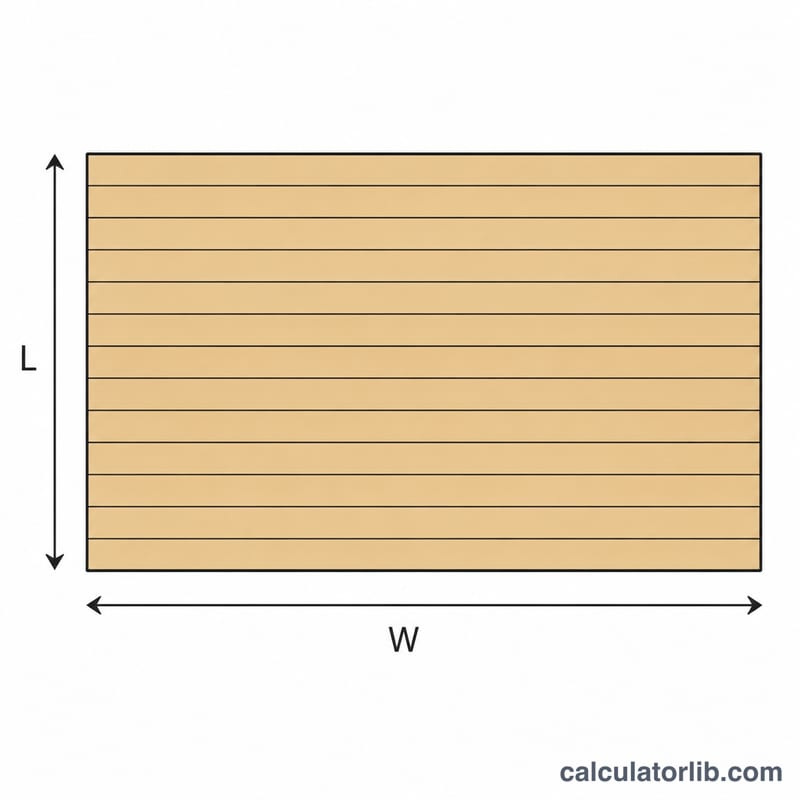
Measure the stained surface and enter its length and width in feet. Choose the number of coats (two is typical for semi-transparent stain on a deck). Enter the coverage rate printed on the can, which is usually 200-300 sq ft per gallon for semi-transparent and 150-250 sq ft per gallon for solid stain. Finally add an allowance of about 10 percent for spillage, roller loading and end-grain soaking. For a fence, remember to count both faces; for railings and balusters, add roughly the area of the pickets on all sides.
The formula
With \(L\) = length in feet, \(W\) = width in feet, \(n\) = coats, \(w\) = waste allowance in percent and \(C\) = coverage in square feet per gallon:
$$G = \frac{L \times W \times n \times (1 + w/100)}{C}$$Because stain comes in whole containers, the cans to buy are \(N = \lceil G \rceil\), and litres are \(G \times 3.785412\).
Worked example
A deck 20 ft by 12 ft gets two coats of a stain rated at 200 sq ft per gallon, with a 10 percent allowance:
$$G = \frac{20 \times 12 \times 2 \times 1.10}{200} = \frac{528}{200} = 2.64\ \text{gallons}$$That is about 10.56 quarts or 9.99 litres, so you would buy 3 one-gallon cans.
Stain Coverage Rates by Type and Wood Surface
Coverage (also called spread rate) is the area one gallon of stain will cover at the film thickness the manufacturer intends. It is driven by two things: how much pigment and solids the stain carries, and how thirsty the wood surface is. The figures below are in square feet per US gallon (1 US gallon = 3.785412 litres) and reflect the way coverage is quoted on North American product labels. Labels sold in Europe and much of the rest of the world quote m² per litre instead; to convert, multiply sq ft/gal by 0.02454 (so 250 sq ft/gal ≈ 6.1 m²/L).
| Stain type | Smooth planed | Rough sawn | Weathered / older decking | Pressure-treated pine | Cedar / redwood | Dense hardwood (ipe, cumaru) |
|---|---|---|---|---|---|---|
| Clear / water repellent | 250–400 | 125–200 | 150–250 | 200–300 | 200–300 | 350–500 |
| Transparent (toner) | 250–350 | 125–175 | 150–225 | 200–300 | 200–275 | 300–450 |
| Semi-transparent | 200–300 | 100–150 | 125–200 | 175–250 | 175–250 | 250–400 |
| Semi-solid | 175–275 | 90–140 | 125–175 | 150–225 | 150–225 | 225–350 |
| Solid / opaque | 150–250 | 75–125 | 100–150 | 125–200 | 150–200 | 200–300 |
Two patterns are worth remembering. First, rough sawn wood roughly halves the smooth-surface rate: the sawn texture has far more actual surface area than its measured length × width, and the open grain drinks stain. Second, the second coat usually stretches further than the first — often 25–50% further — because the first coat has already filled the most absorbent pores. If you are budgeting for two coats on bare, thirsty wood, it is reasonable to plan the first coat at the low end of the range and the second at the high end.
Dense tropical hardwoods such as ipe sit at the opposite extreme: they absorb very little, so a gallon covers a large area, and the real risk is applying too much and leaving a sticky surface film rather than running short.
These values are planning estimates only. The coverage printed on the can always takes precedence — formulations differ widely between brands and between oil-based and water-based products, and the manufacturer's figure is the one tied to the warranty and the application instructions.
FAQ
Does the second coat use as much as the first? Usually less. Bare, thirsty wood drinks the first coat, so a second coat can stretch 20-40 percent further. This calculator assumes equal coats, which is the safe, slightly generous estimate.
Rough sawn or weathered wood? Textured and weathered boards can cut coverage nearly in half. Use the low end of the can range, or raise the allowance to 20-25 percent.
Should I buy the extra can? Yes. Running out mid-job forces a new batch with a slightly different tint and leaves a visible lap line. Leftover stain also seals cut ends and touch-ups later.