What Is Ink Coverage?
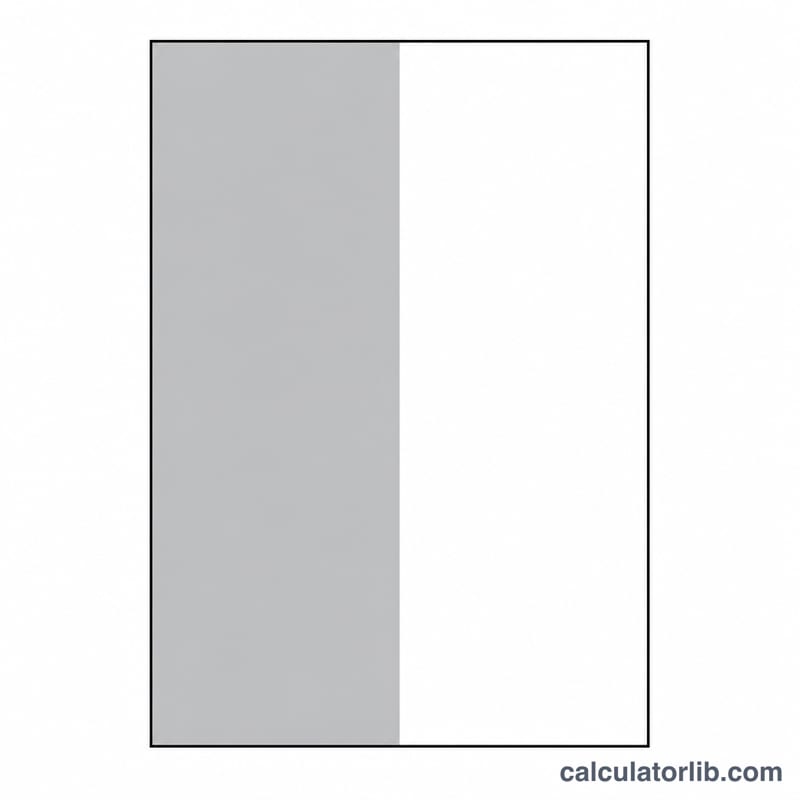
Ink coverage is the percentage of a page that is actually covered by ink. A blank page is near 0%, while a solid dark image approaches 100% for a single color (and can exceed 100% when multiple process colors overlap). Estimating coverage lets print shops and home users predict how much ink a job will consume and what it will cost before hitting print.
How to Use This Calculator
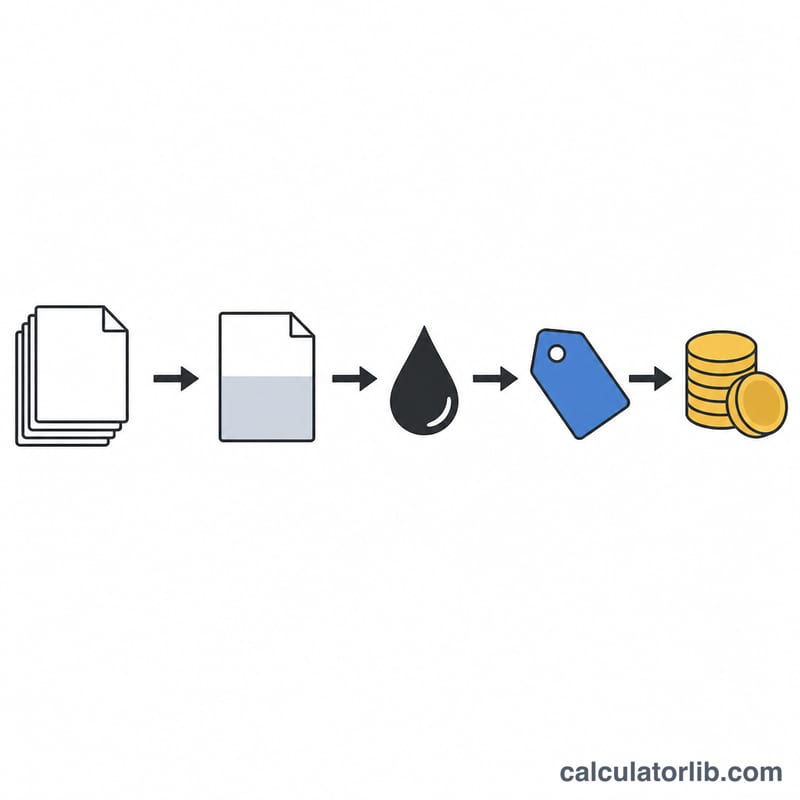
Enter the number of pages in your job, the average ink coverage per page as a percentage, the amount of ink used on a fully covered page at 100% (in millilitres), and the cost of ink per millilitre. The calculator returns the ink used per page, the total ink volume, and the total ink cost.
The Formula Explained
The core relationship multiplies page count \(P\), coverage fraction \(C/100\), ink per full page \(I\), and cost per millilitre \(R\):
$$\text{Total Cost} = P \times \frac{C}{100} \times I \times R$$Here \(P\) = pages, \(C\) = coverage percentage, \(I\) = ink (ml) at 100% coverage, and \(R\) = cost per ml. The ink per page is simply \(I \times C/100\).
Worked Example
Suppose you print 100 pages at 20% coverage, where a full page uses 2 ml of ink costing $0.50 per ml. The ink per page is:
$$2 \times \frac{20}{100} = 0.4\,\text{ml}$$The total ink and cost are:
$$0.4 \times 100 = 40\,\text{ml}, \quad 40 \times 0.50 = 20\,\text{USD}$$Typical Ink Coverage by Content Type
Ink coverage is the percentage of a page that is actually covered by ink for a given color channel. The values below are widely documented per-color averages you can drop straight into the coverage % field. They are approximations — real coverage depends on the specific document, font, images, and driver settings.
| Page content | Typical coverage (per color) | Notes |
|---|---|---|
| Light text / draft | ~3–5% | Sparse text, wide margins, draft mode |
| Normal text document | ~5–10% | The international ISO/IEC 24711 standard fixes 5% coverage as the reference for rating inkjet cartridge page yield |
| Mixed text and graphics / business docs | ~15–20% | Logos, tables, light shading, some images |
| Color presentations / charts | ~20–30% | Filled backgrounds, bold graphics |
| Full-page photos | ~30–40%+ per color | Edge-to-edge images; summed across cyan, magenta, yellow and black the Total Ink Coverage (TIC) can reach ~300–400% |
Because these figures are quoted per color channel, a full-color photo that reads as ~35% per channel represents a much higher combined ink load than a 35% black-only text page. When your job uses several colors, estimate each channel separately or use a combined TIC figure, and enter the value that matches how your ink price and volume are measured.
Practical Recommendations
The calculated cost is a planning estimate, not an exact meter reading. Use these guidelines to turn the number into reliable purchasing and printing decisions.
- Add a 10–15% buffer. Order or keep roughly 10–15% more ink than the raw estimate. Printers consume ink beyond what lands on the page — priming, automatic head cleaning and maintenance cycles, and driver overhead all draw from the cartridge but are not part of the coverage calculation.
- Round cartridges up to whole units. Divide your total estimated ink volume by the rated volume of one cartridge or bottle, then round up. You cannot buy a partial cartridge, and running dry mid-run wastes time and can trigger extra cleaning cycles.
- Test before large runs. Print a small representative sample and check actual ink use against your estimate. This verifies your coverage assumption before you commit to a long production run.
- Lower coverage to lower cost. Draft mode, toner/ink-save settings, grayscale, and lighter designs all reduce coverage. Re-running the estimate with a smaller coverage % shows the savings directly.
- Account for paper and resolution. Glossy and photo paper absorb and require more ink, and higher DPI settings lay down more ink, so real consumption on these media typically runs above the estimate — increase your buffer accordingly.
As a worked example, for 1000 normal-text pages at 10% coverage, using 0.1 ink units per fully-covered page at a price of $0.40 per unit:
$$\text{Total Cost} = P \times \frac{C}{100} \times I \times R = 1000 \times \frac{10}{100} \times 0.1 \times 0.40 = \$4.00$$
So the estimate is $4.00; applying a 15% buffer, you would plan for about $4.60 of ink to be safe.
This is general guidance. Ink units and prices differ by printer and supplier, so calibrate the input values to your own hardware and quotes for the most accurate result.
FAQ
Why can coverage exceed 100%? With CMYK printing, each color contributes its own coverage, so combined total ink coverage (TIC) can reach up to 400%.
How do I find my ink per full page? Check your printer specifications or divide a cartridge volume by its rated page yield at a standard 5% coverage, then scale to 100%.
Is this exact? It is an estimate; actual usage varies with paper, driver settings, and image content.