What the irrigation water pressure calculator does
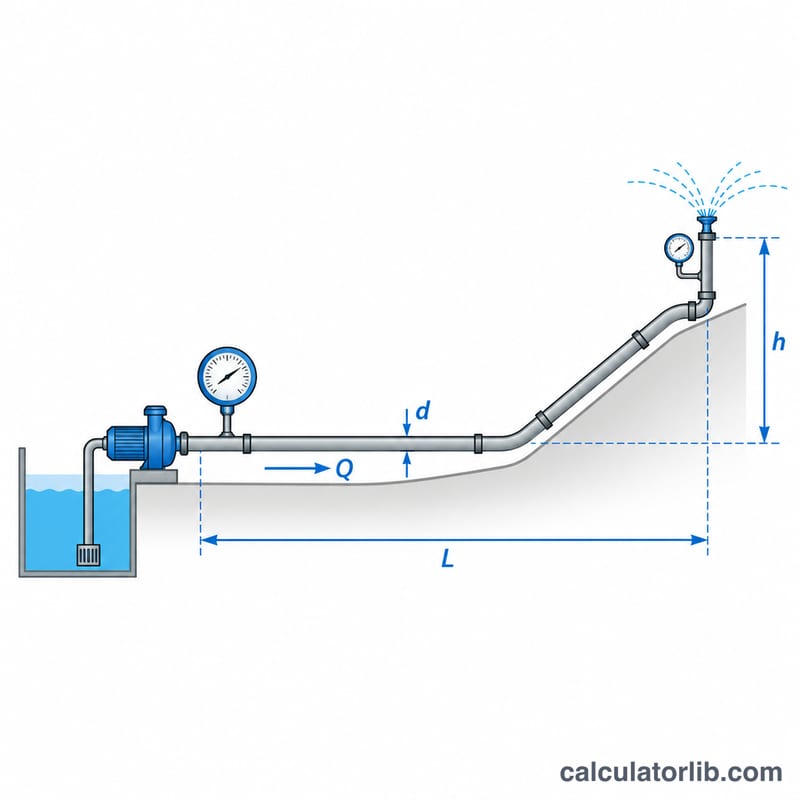
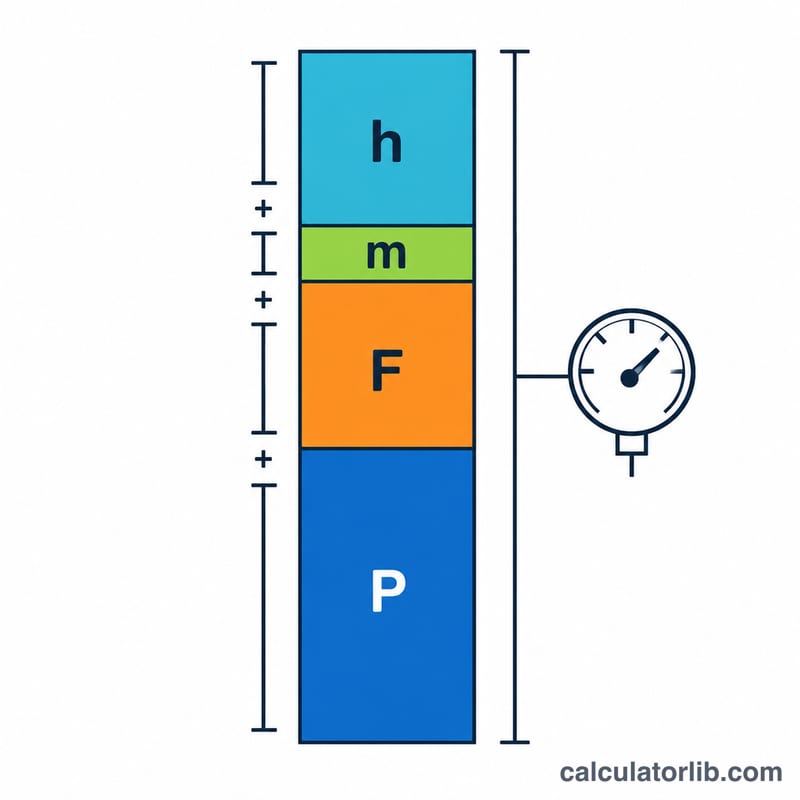
This tool estimates the pressure you need at the start of an irrigation line so that sprinklers or drip emitters still receive their design pressure at the far end. It adds three things together: the pressure the outlet needs, the pressure lost to friction in the pipe and fittings, and the pressure gained or lost with elevation. If you also enter the supply pressure you have available, it reports the resulting pressure at the outlet. Units are US customary: GPM, inches, feet and PSI.
How to use it
Enter the flow rate of the zone, the inside diameter of the pipe (not the nominal size; 1 inch Schedule 40 PVC is about 1.049 in), the pipe length, and a Hazen-Williams C factor (about 150 for PVC and polyethylene, 100 for old steel). Add a percentage for fittings and valves, usually 10 to 20 percent. Enter the elevation change, positive when the outlet is higher than the source, and the pressure the sprinkler needs.
The formulas
Friction loss uses the Hazen-Williams equation in PSI:
$$h_f = 4.52\,\frac{Q^{1.852} }{C^{1.852}\,d^{4.8655} }\,L$$where \(Q\) is flow in GPM, \(C\) is the roughness coefficient, \(d\) is the inside diameter in inches and \(L\) is the length in feet. Elevation adds 0.433 PSI per foot of rise:
$$P_{\text{req}} = P_{\text{out}} + h_f\,(1 + m) + 0.433\,\Delta z$$where \(m\) is the minor-loss fraction. Velocity is \(v = 0.4085\,Q / d^2\) in ft/s.
Worked example
A zone flows 20 GPM through 300 ft of 1.049 in PVC (\(C = 150\)), rising 10 ft, with 30 PSI needed at the outlet and 10% minor losses.
$$h_f \approx 0.0858 \times 300 \approx 25.7\,\text{PSI}$$$$P_{\text{req}} \approx 30 + 25.7 + 2.6 + 4.3 \approx 62.6\,\text{PSI}$$If your supply is only 50 PSI, the outlet would not reach its design pressure, so you would need larger pipe or a lower flow.
Hazen-Williams C Factors and Common Pipe Inside Diameters
The Hazen-Williams equation uses a roughness coefficient C: higher C means a smoother pipe and less friction loss. The values below are typical design values. Actual C depends on age, water quality and the source you use, so use your manufacturer's or local design standard when it differs.
| Pipe material | Typical C factor |
|---|---|
| PVC / polyethylene (plastic) | about 150 (140-150 is common) |
| Copper, new | about 140-150 |
| Steel, new | about 120 |
| Steel, old / corroded | about 100 or lower |
| Cast iron | about 100-130 (lower with age) |
Friction loss uses the inside diameter, not the nominal size. The table below lists PVC inside diameters in inches (US IPS sizing, ASTM). Schedule 40 values are standard. Class 200 (SDR 21) values are rounded approximations because wall thickness varies slightly by standard.
| Nominal size (in) | Schedule 40 PVC ID (in) | Class 200 PVC ID (in), approx. |
|---|---|---|
| 0.75 | 0.824 | 0.93 |
| 1 | 1.049 | 1.19 |
| 1.25 | 1.380 | 1.50 |
| 1.5 | 1.610 | 1.72 |
| 2 | 2.067 | 2.15 |
Polyethylene pipe is sold in several wall thicknesses (SDR ratings) and in different sizing systems. Its inside diameter therefore varies by product. Calculate it as \(ID = OD - 2 \times \text{wall thickness}\) from the manufacturer's data sheet rather than assuming a value.
Typical Operating Pressures and Velocity Limits
| Component | Typical operating pressure |
|---|---|
| Rotor sprinklers | about 35-55 PSI |
| Spray heads | about 20-30 PSI |
| Micro-sprayers | about 20-30 PSI |
| Drip emitters / drip lines | about 10-25 PSI (usually with a pressure regulator) |
- Velocity: keep water velocity at or below about 5 ft/s. Some references accept up to 5-7 ft/s. Higher velocities raise friction loss sharply and increase the risk of water hammer (surge pressure) when valves close. Velocity in ft/s is approximately \(v = 0.4085 \times Q / d^2\), with Q in GPM and d the inside diameter in inches.
- Minor losses: fittings, valves, backflow preventers and filters add loss. A 10-20% allowance on top of pipe friction is a common estimate. Use more for many fittings or for known restrictive devices.
- Elevation: each foot of rise costs about 0.433 PSI, and each foot of descent gains the same amount.
Note: these are typical figures only. The manufacturer's published pressure and flow data for your specific sprinklers, emitters, valves and filters always governs the design.
FAQ
Why is velocity shown? Above about 5 ft/s, pressure surges become a risk even if the pressure is adequate.
What if the line goes downhill? Enter a negative elevation change; the elevation term then reduces the required pressure.
Is this exact? Hazen-Williams is a standard design approximation for water at normal temperatures. Always confirm manufacturer data for sprinklers and valves.