What is final velocity?
Final velocity is the speed and direction of an object at the end of a motion interval. In introductory physics it is found with the kinematic equations, which assume constant (uniform) acceleration along a straight line. This calculator works in SI units (metres and seconds) and also converts the answer to km/h and mph.

How to use the calculator
Choose which quantity you know: time or distance. Enter the initial velocity \(u\) and acceleration \(a\) (use a negative value for deceleration), then enter either the time \(t\) or the distance \(s\). The tool returns the final velocity together with the distance or time that goes with it.
The formulas explained
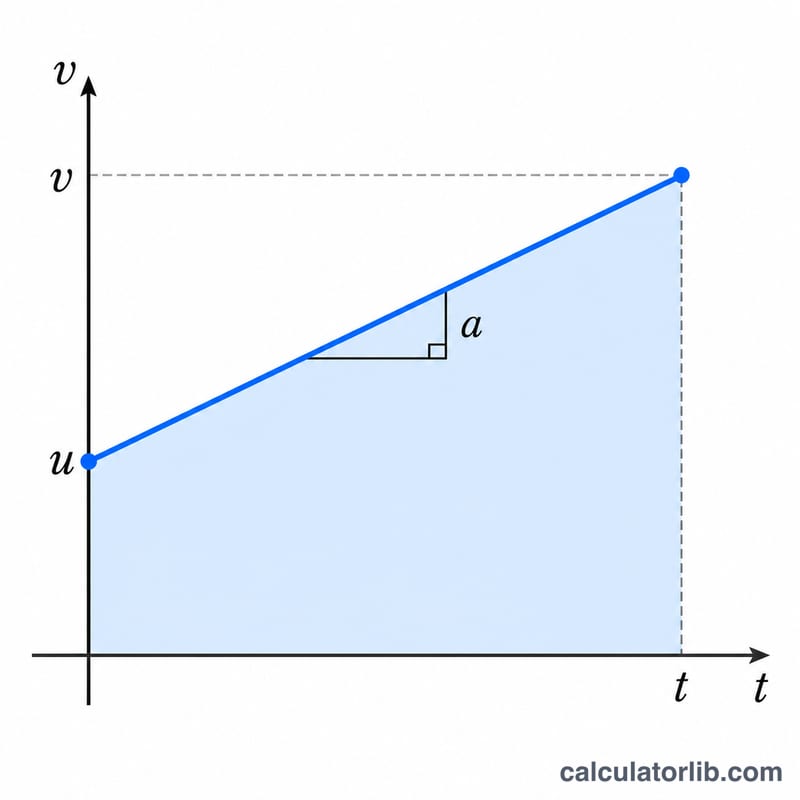
When time is known, use:
$$v = u + a t$$When distance is known, use the time-independent equation:
$$v^2 = u^2 + 2 a s$$Here \(v\) is final velocity, \(u\) is initial velocity, \(a\) is acceleration, \(t\) is time and \(s\) is displacement. In the distance mode the calculator takes the square root and gives it the sign of the initial velocity. If \(u^2 + 2as\) is negative, the object never reaches that distance and no real answer exists.
Worked example
A car starts at \(u = 4\,\text{m/s}\) and accelerates at \(a = 3\,\text{m/s}^2\) over \(s = 14\,\text{m}\).
$$v = \sqrt{4^2 + 2 \times 3 \times 14} = \sqrt{100} = 10\,\text{m/s}$$The time taken is
$$t = \frac{v - u}{a} = \frac{10 - 4}{3} = 2\,\text{s}$$In other units, 10 m/s is 36 km/h or about 22.37 mph.
More Worked Examples
Example 1: Time mode, starting from rest
A car starts from rest (u = 0) and accelerates at a = 2 m/s² for t = 8 s. Use \(v = u + at\).
- Substitute: \(v = 0 + 2 \cdot 8\)
- Multiply: \(v = 16\) m/s
- Convert to km/h: \(16 \times 3.6 = 57.6\) km/h
- Convert to mph: \(16 \times 2.23694 \approx 35.79\) mph
Result: 16 m/s (57.6 km/h, about 35.79 mph).
Example 2: Distance mode, braking with negative acceleration
A vehicle travels at u = 25 m/s and brakes with a = -5 m/s² over s = 40 m. Use \(v^2 = u^2 + 2as\).
- Substitute: \(v^2 = 25^2 + 2 \cdot (-5) \cdot 40\)
- Simplify: \(v^2 = 625 - 400 = 225\)
- Take the positive root: \(v = \sqrt{225} = 15\) m/s
Result: 15 m/s after 40 m of braking.
When does it stop? Set v = 0: \(0 = 625 + 2 \cdot (-5) \cdot s\), so \(s = 625 / 10 = 62.5\) m. The stopping time is \(t = (0 - 25)/(-5) = 5\) s. For any distance beyond 62.5 m, \(v^2\) would be negative and there is no real solution: the object has already stopped, and the constant-acceleration model no longer applies (it would otherwise reverse).
Velocity Unit Conversion Table
| m/s | km/h | mph |
|---|---|---|
| 1 | 3.6 | 2.23694 |
| 5 | 18 | 11.18 |
| 10 | 36 | 22.37 |
| 20 | 72 | 44.74 |
| 30 | 108 | 67.11 |
| 50 | 180 | 111.85 |
mph values are rounded to two decimals except the first row.
Exact factors
- 1 m/s = 3.6 km/h = 2.23694 mph
- 1 mph = 0.44704 m/s (exact by definition)
- 1 km/h = 0.27778 m/s (that is, 1/3.6)
Constants and Typical Acceleration Values
| Quantity | Value (m/s²) |
|---|---|
| Standard gravity g (defined value) | 9.80665 (commonly rounded to 9.81) |
| Moon, surface gravity (approx.) | 1.62 |
| Mars, surface gravity (approx.) | 3.71 |
| Jupiter, surface gravity (approx., at the cloud tops) | 24.79 |
Notes:
- The kinematic equations \(v = u + at\) and \(v^2 = u^2 + 2as\) assume constant acceleration in a straight line. They do not hold if acceleration changes during the motion.
- Use consistent SI units: velocity in m/s, acceleration in m/s², time in s and distance in m.
- Deceleration is entered as a negative acceleration when the positive direction is the direction of initial motion.
- For a falling object ignoring air resistance, use a = g (about 9.81 m/s² on Earth), with downward taken as positive.
FAQ
Does it work for free fall?
Yes. Use \(a = 9.81\,\text{m/s}^2\) (downwards positive) and a starting velocity of 0 for a dropped object, ignoring air resistance.
What if acceleration is zero?
Then velocity does not change and \(v = u\).
Can velocity be negative?
Yes. A negative sign simply means motion in the opposite direction to the one you defined as positive.