What Is the Sail Area Calculator?
The Sail Area Calculator estimates the total driving sail area of a sloop rig by combining the mainsail and the headsail (foretriangle). Sail area is one of the most important numbers in performance analysis: it feeds ratios like the sail area to displacement ratio, which predicts how lively a boat will feel in light and moderate wind.
The Formula Explained
Both the mainsail and the foretriangle are treated as right triangles, so each area is half the product of two measured sides. The total is their sum:
$$\text{SA} = \tfrac{1}{2}\,P \times E + \tfrac{1}{2}\,I \times J$$
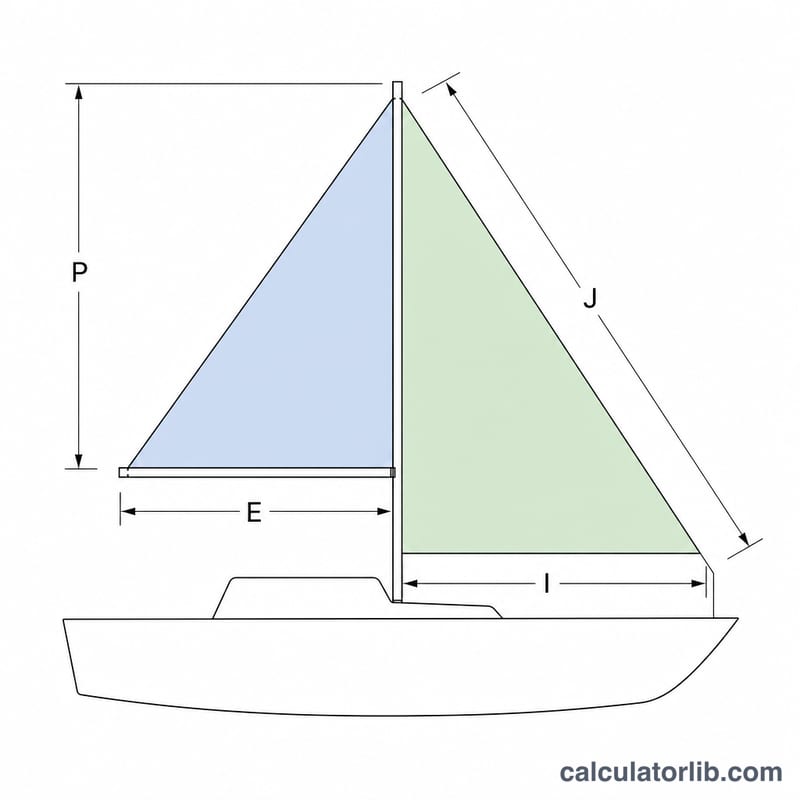
Here \(P\) = mainsail luff (hoist along the mast), \(E\) = mainsail foot (along the boom), \(I\) = foretriangle height (from deck to headstay attachment), and \(J\) = foretriangle base (from mast to headstay at deck). All lengths are in feet, giving an area in square feet.

How to Use It
Measure the four rig dimensions from your boat or its specification sheet, enter them in the fields, and submit. The calculator returns the mainsail area, the headsail area, and their total. Use the same length unit for all inputs so the result stays consistent.
Worked Example
Suppose \(P = 40\), \(E = 14\), \(I = 45\), and \(J = 15\) feet. The mainsail area is
$$A_{main} = \tfrac{1}{2}\times 40 \times 14 = 280\,\text{ft}^2$$
and the headsail area is
$$A_{head} = \tfrac{1}{2}\times 45 \times 15 = 337.5\,\text{ft}^2$$
so the total sail area is \(280 + 337.5 = 617.5\,\text{ft}^2\).
FAQ
Does this use the actual headsail or the foretriangle? It uses the foretriangle (I and J), the standard reference area for rating rigs regardless of the genoa overlap actually flown.
Can I use metric units? Yes. Enter all four dimensions in meters and the result will be in square meters.
Why is the mainsail modeled as a triangle? A basic Marconi mainsail is close to triangular; roach adds a few percent that this simplified estimate omits.