What this calculator does
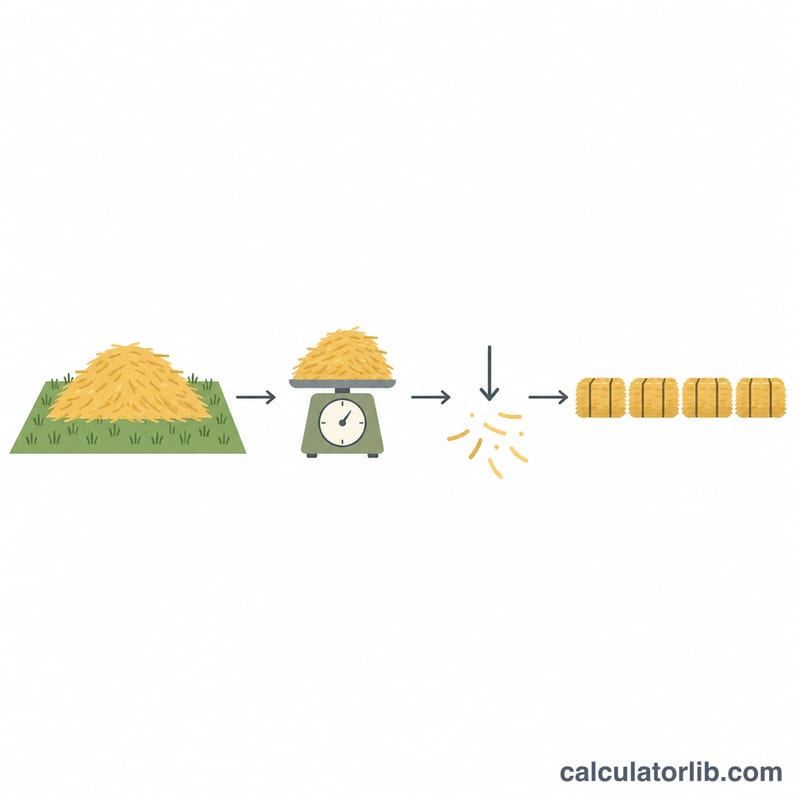
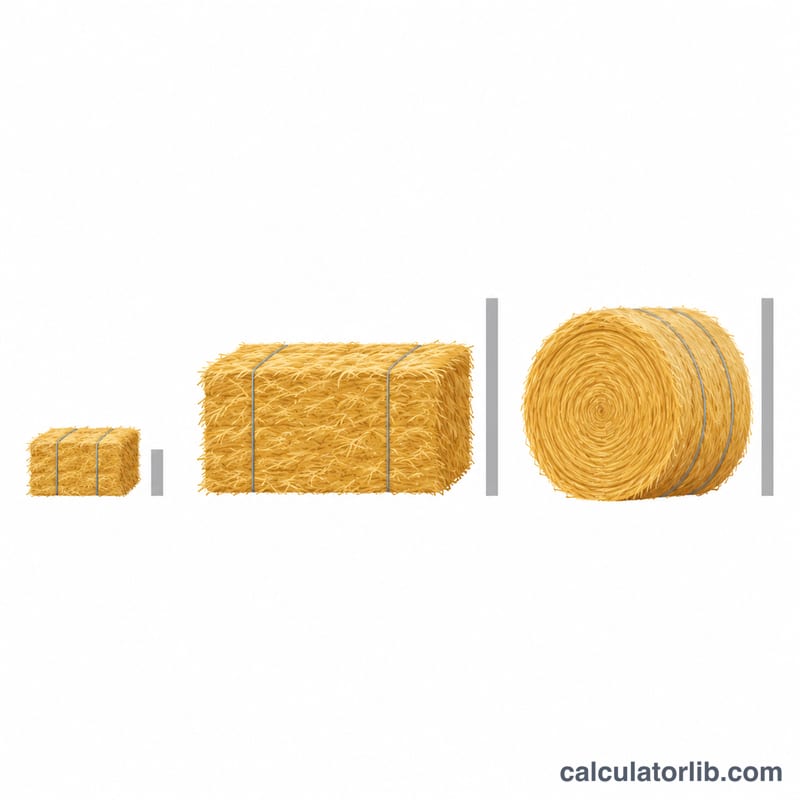
The Hay Bales Per Acre Calculator turns an expected forage yield into a bale count you can actually plan around: how many bales come off one acre, how many come off the whole field, and how much net tonnage you will have to haul and stack. It works for small squares, large squares and round bales alike, because the only thing that matters is the average weight of a finished bale.
How to use it
Enter the harvested area in acres, the yield you expect per acre from a single cutting (in tons), and the number of cuttings you plan to take in the season. Then enter the average weight of one bale in pounds, or pick a preset for a typical bale size. Finally, add a harvest and field loss percentage to account for raking losses, leaf shatter, spoilage and headland waste; 5-15% is typical for grass and alfalfa hay.
The formula explained
Yield is first converted from tons to pounds, since one US short ton is 2,000 lb, and then divided by bale weight:
$$B_a = \frac{Y \times n \times (1 - L) \times 2000}{W}$$where \(Y\) = tons per acre per cutting, \(n\) = number of cuttings, \(L\) = loss as a decimal, and \(W\) = average bale weight in pounds. Total bales are \(B_{\text{total}} = B_a \times A\) for \(A\) acres.
Worked example
A 40-acre field yields 1.5 tons per acre per cutting with three cuttings, baled into 1,100 lb round bales, with 10% loss:
$$B_a = \frac{1.5 \times 3 \times 0.90 \times 2000}{1100} = \frac{8100}{1100} = 7.36\ \text{bales/acre}$$Over the whole field that is \(7.36 \times 40 \approx 294.5\) bales, so plan storage for 295 round bales and about 162 tons of hay.
Typical Hay Yields by Forage Type and Cuttings
The single input that most changes your bale count is expected yield in tons per acre. The ranges below are drawn from United States land-grant university extension forage production guides and are typical of well-managed stands in temperate and southern US regions. They are ranges, not predictions: stand age, soil fertility and pH, nitrogen or manure history, irrigation, cutting interval, and growing-season rainfall can each move a field by a factor of two. Outside the US, use your own regional extension, provincial or ministry guidance — the same species can yield very differently under a different climate and cutting regime.
| Forage type | Tons/acre per cutting (dry matter) | Typical cuttings per year | Typical annual total (tons/acre DM) | Notes |
|---|---|---|---|---|
| Alfalfa, irrigated | 1.2 – 1.8 | 4 – 7 | 6 – 10 | Western US irrigated valleys; first cutting usually the largest |
| Alfalfa, dryland | 0.8 – 1.3 | 2 – 3 | 2 – 4 | Highly rainfall-dependent; later cuttings often fail in dry years |
| Alfalfa–grass mix | 1.0 – 1.5 | 3 – 4 | 3 – 5 | Grass fraction rises as the alfalfa stand thins with age |
| Orchardgrass | 1.0 – 1.5 | 2 – 3 | 2.5 – 4.5 | Responds strongly to split nitrogen applications |
| Timothy | 1.2 – 1.8 (first cutting) | 1 – 2 | 2 – 3.5 | Cool-season; regrowth after first cutting is light |
| Smooth bromegrass | 1.0 – 1.5 | 2 | 2 – 3.5 | Most of the yield comes in the first cutting |
| Tall fescue | 0.8 – 1.5 | 2 – 3 | 2 – 4 | Tolerates wetter, lower-fertility ground |
| Bermudagrass | 1.0 – 1.5 | 3 – 5 | 4 – 8 | Southern US warm-season; high end needs high N and water |
| Native / prairie grass hay | 0.7 – 1.5 | 1 | 0.75 – 2.0 | Single late-season cutting; unfertilized rangeland is at the low end |
Keep the moisture basis consistent
Extension yield tables are normally reported on a dry-matter (DM) basis — zero moisture. Baled hay is not dry: dry hay is typically baled and stored at about 15–18% moisture (large rounds are often baled a little drier, near 14–16%, to limit heating). Because your bale weight input is the weight of real, moist bales, you must convert a dry-matter yield to an as-baled yield before entering it:
$$\text{As-baled tons/acre} = \frac{\text{DM tons/acre}}{1 - \dfrac{\text{Moisture \%}}{100}}$$
For example, 4.0 tons/acre of dry matter baled at 15% moisture is \(4.0 \div 0.85 = 4.7\) as-baled tons per acre — about 18% more tonnage, and therefore about 18% more bales, than the DM figure suggests. The rule is simply to be consistent: either enter as-baled tons per acre with as-baled bale weights (recommended, and what scale tickets give you), or enter DM tons per acre with DM-equivalent bale weights. Mixing the two is the most common reason a bale estimate comes in low.
Also note how the cuttings field interacts with these numbers. The per-cutting column is meant to be multiplied by the cuttings count; the annual-total column already includes every cutting. If you enter an annual total, set cuttings to 1 so the yield is not counted several times over.
FAQ
What bale weight should I use? Weigh a few finished bales if you can. As rough defaults, two-string squares run 45-70 lb, 4x5 rounds about 700-900 lb, 5x5 rounds about 1,000-1,200 lb, and 3x4x8 big squares 1,400-1,800 lb. Moisture swings bale weight significantly.
Why include a loss percentage? Standing yield is never the same as baled yield. Mowing, tedding, raking and baling all drop leaves, and the first and last passes around a field are rarely full windrows.
Does this work in metric? The calculation assumes short tons and pounds. For metric tonnes and kilograms, enter tonnes per acre and multiply bale weight in kg by 2.2046 to get pounds, or simply keep both figures in matching units since the ratio drives the result.