What Is Square Foot Gardening Plant Spacing?
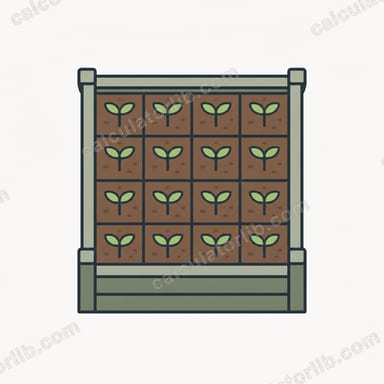
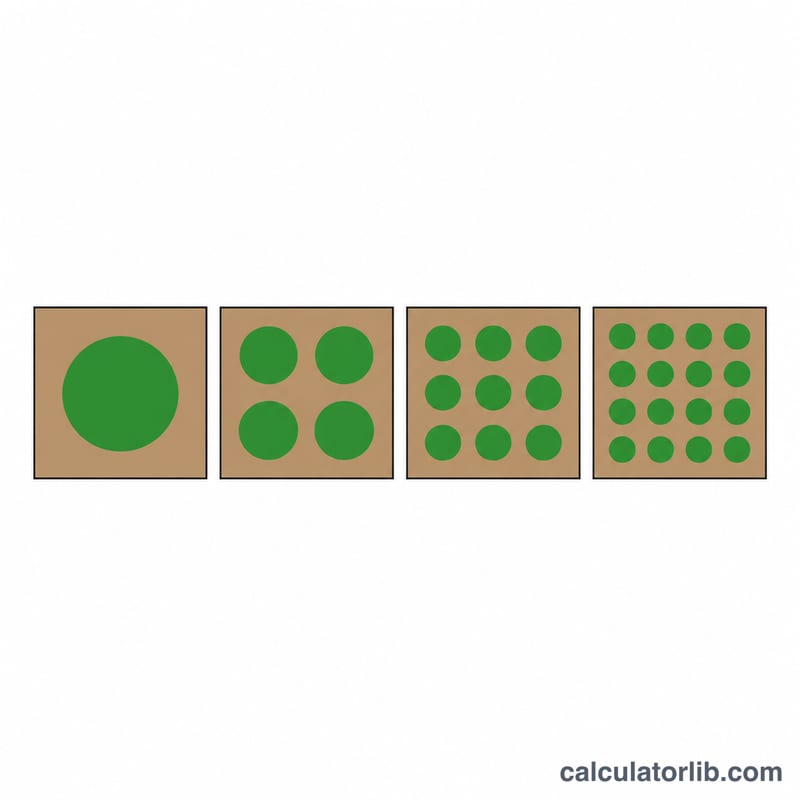
Square foot gardening divides a raised bed into a grid of 12-inch by 12-inch squares. Instead of planting in long rows, you fill each square with the maximum number of plants that still gives every seedling the room it needs. This calculator turns a crop's recommended spacing into a simple count of how many plants fit in each square and across your whole bed.
How to Use This Calculator
Enter the recommended spacing for your crop in inches (seed packets usually list this) and the total area of your bed in square feet. The tool returns the plants per square foot and the total for the bed, so you can plan seed orders and avoid overcrowding.
The Formula Explained
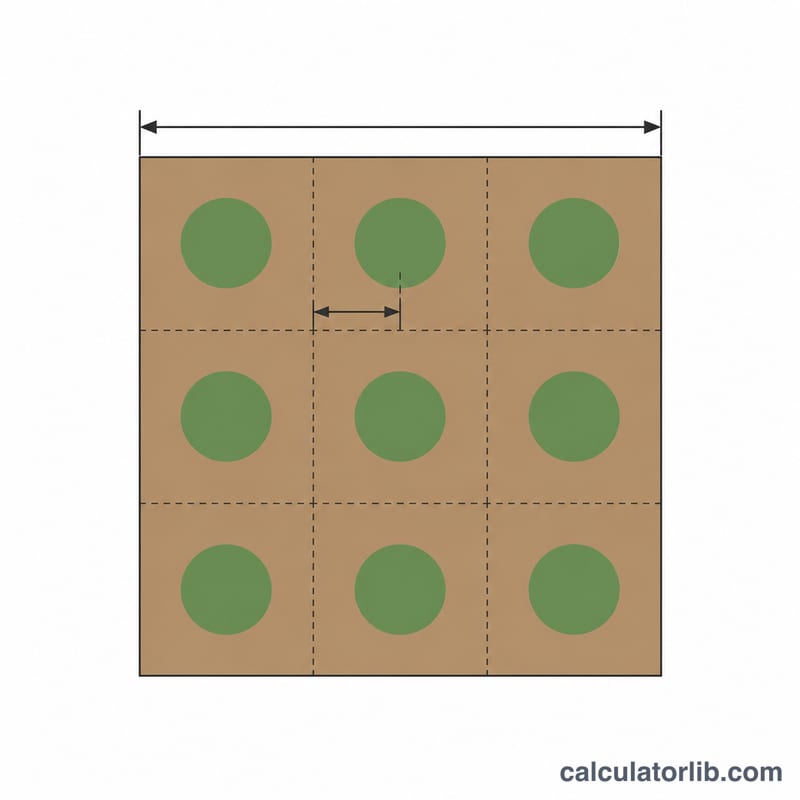
Each square is 12 inches wide. Dividing 12 by the spacing \(s\) tells you how many plants fit along one edge; you then square that count because a square has two dimensions, and multiply by the bed area \(A\) in square feet.
$$\text{Plants} = \left\lfloor \frac{12}{s} \right\rfloor^{2} \times A$$The floor brackets mean you round down to a whole plant, since you cannot plant a fraction of a seedling.
Worked Example
Suppose a crop needs \(s = 3\) inches of spacing in a bed of \(A = 4\) square feet. One edge holds \(\lfloor 12/3 \rfloor = 4\) plants, so each square holds:
$$\left\lfloor \frac{12}{3} \right\rfloor^{2} = 4^{2} = 16$$Across four square feet that is \(16 \times 4 = 64\) plants.
Common Crop Spacing and Plants per Square Foot
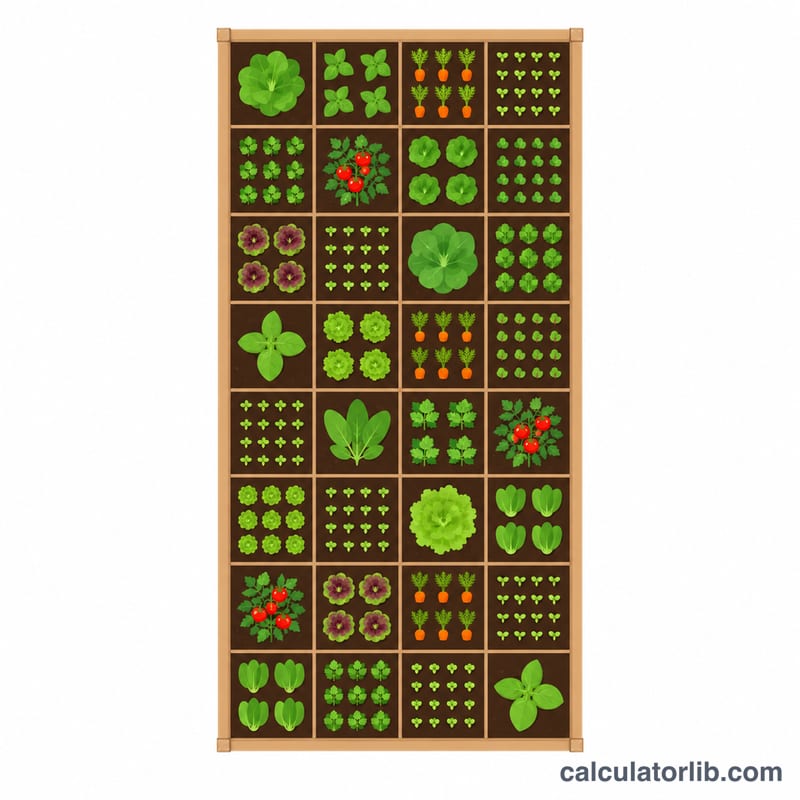
Square foot gardening splits a bed into 12-inch × 12-inch squares. The number of plants in each square comes from the crop's recommended spacing: divide 12 by the spacing, round down, then square the result.
$$\text{Plants per square} = \left\lfloor \frac{12}{\text{Spacing (in)}} \right\rfloor^{2}$$The table below lists common square foot gardening spacings. These are typical planning values. Seed packets and local growing conditions can call for slightly different spacing.
| Spacing (in) | Plants per 12-in square | Typical crops |
|---|---|---|
| 12 | 1 | Tomato (staked), pepper, broccoli, cabbage, cauliflower, eggplant |
| 6 | 4 | Leaf lettuce, Swiss chard, parsley, marigold |
| 4 | 9 | Bush beans, spinach, beets, garlic |
| 3 | 16 | Carrots, radishes, onions (green onions or sets) |
For a whole bed, multiply the per-square count by the bed's area. For example, a 4 ft × 8 ft bed (32 sq ft) planted entirely at 4-inch spacing holds \(\lfloor 12/4 \rfloor^{2} \times 32 = 3^{2} \times 32 = 9 \times 32 =\) 288 plants.
Large crops that need more than one square
| Crop | Typical allocation |
|---|---|
| Melons and vining squash, trellised | About 1 plant per 2 squares |
| Bush squash (e.g. zucchini) | About 1 plant per 4–9 squares |
| Sprawling squash and melons, not trellised | Up to 1 plant per 9 squares (a 3 × 3 block) |
Note: when spacing is greater than 12 inches, the formula gives \(\lfloor 12/\text{spacing} \rfloor = 0\). For example, at 18 inches, \(\lfloor 12/18 \rfloor^{2} = 0^{2} = 0\). These large crops are planned by how many squares each plant gets, not by how many plants fit in one square.
Practical Planting Tips
- Order extra seed for direct-sown crops. Sow 2–3 seeds at each planting spot and thin to the strongest seedling. That means you need about 2–3 times the calculated plant count in seeds. For example, 288 spots at 4-inch spacing need roughly 576–864 seeds.
- Buy a few extra transplants. Get roughly 10–20% more seedlings than the calculated count to replace any lost to transplant shock, pests or weather.
- Round partial squares down. If a dimension leaves less than a full 12-inch square, don't count that strip as a planting square. Squeezing plants in leads to crowding and smaller harvests.
- Measure the inside of the frame. Use the usable soil area inside the bed walls, not the outside dimensions. With thick boards, a bed labelled 4 ft × 8 ft can have noticeably less growing area.
- Give large crops whole squares. For crops spaced more than 12 inches apart, the per-square count is zero. Set aside a fixed number of whole squares per plant (for example, a 3 × 3 block for sprawling squash) rather than relying on the formula.
- Put tall crops where they won't shade others. In the Northern Hemisphere, place tall or trellised crops such as staked tomatoes and vining squash on the north side of the bed. In the Southern Hemisphere, use the south side.
These are general planning guidelines. Adjust spacing for the specific variety, your climate and your soil.
FAQ
What spacing should I use? Common square foot gardening spacings are 3, 4, 6, and 12 inches, giving 16, 9, 4, and 1 plant per square respectively.
What if my plant needs more than 12 inches? Large plants such as tomatoes take a full square or more; the calculator shows one plant per square as the minimum.
Does this work for odd-shaped beds? Use the total usable area in square feet and the result still applies as a close estimate.