What this calculator does
In sous vide cooking the water bath is held at the temperature you want the food to end up at, so the food can never overcook. What you still need to know is how long the center of the food takes to get there. This calculator estimates that core heating time from the food's thickness, shape and starting temperature and the bath temperature. You can also add an extra hold time.
How to use it
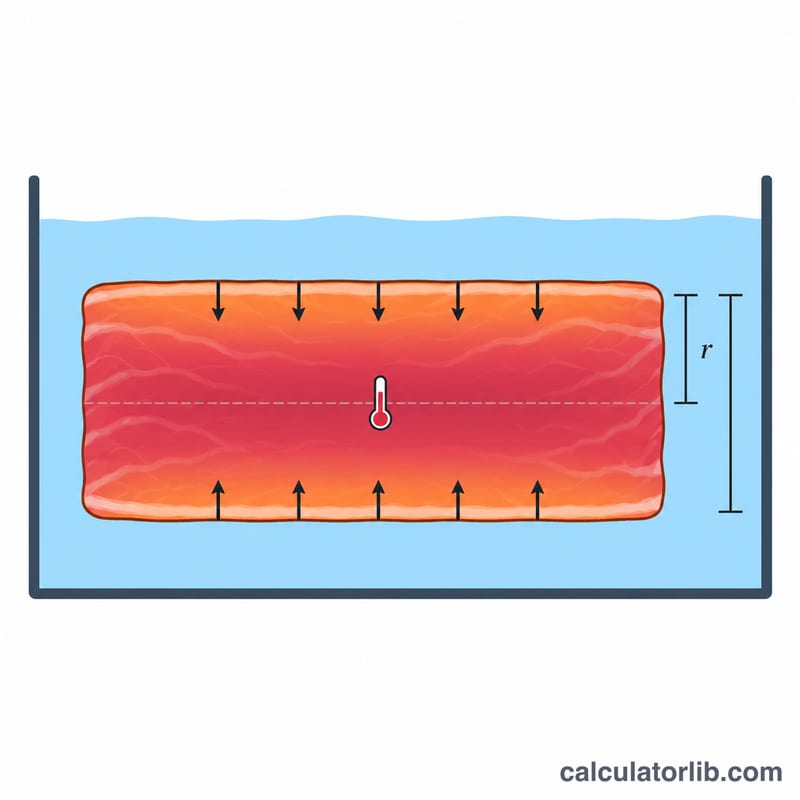
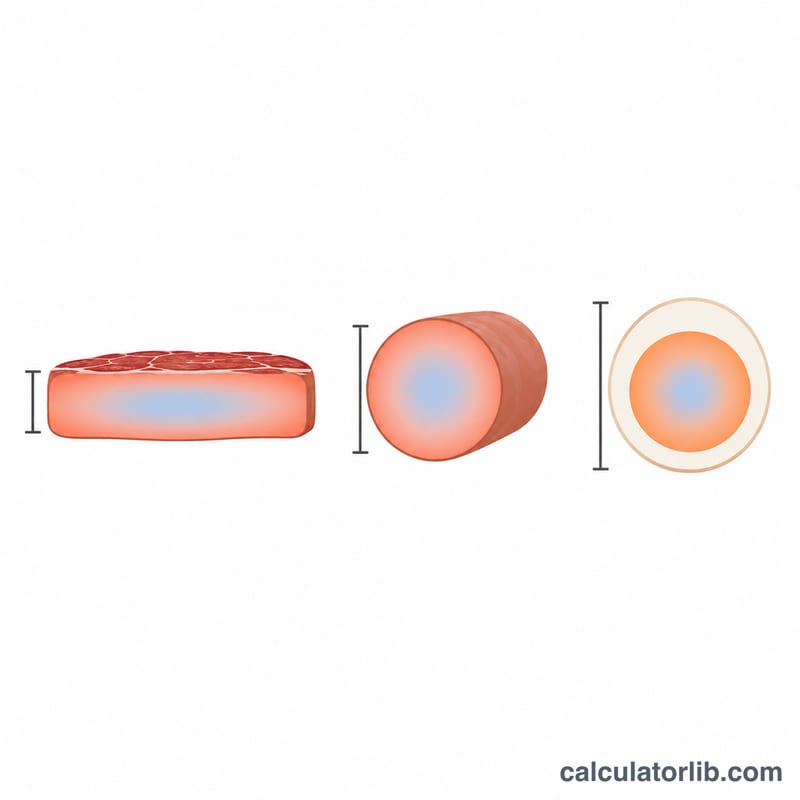
Pick the shape that best matches the food. Use a slab for steaks and fillets, a cylinder for a tenderloin or sausage, and a sphere for meatballs. Measure the thickest point, or the diameter for round pieces, in millimetres. Enter the bath temperature and the food's starting temperature (about 5 °C straight from the fridge). By default, the food counts as heated through once the core is within 0.5 °C of the bath. The default thermal diffusivity, \(1.11 \times 10^{-7}\,\text{m}^2/\text{s}\), is a typical value for lean meat.
The formula explained
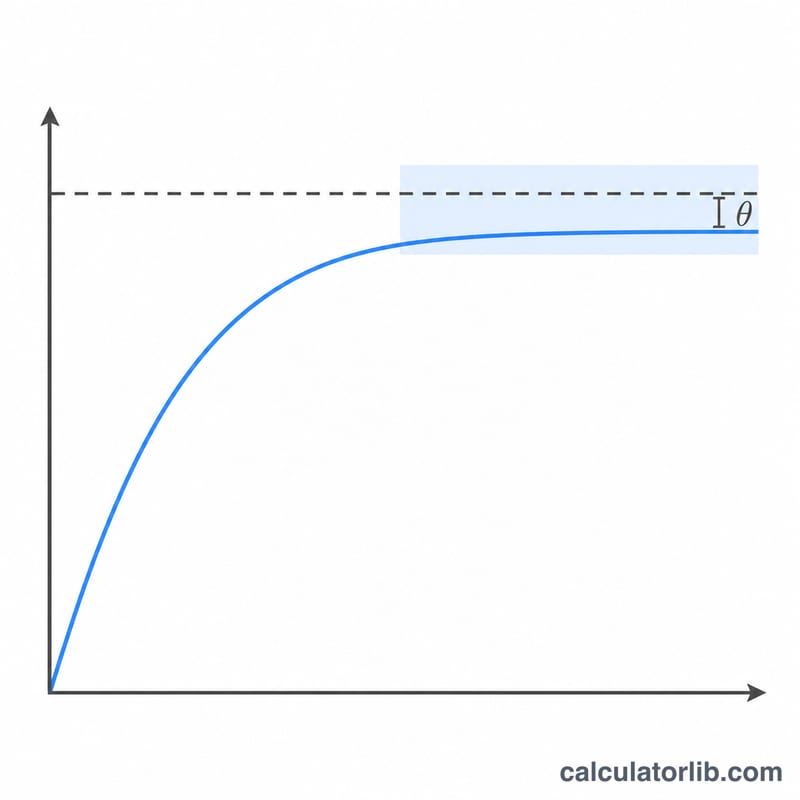
Heat moving into a solid that sits in well-stirred water follows the transient conduction equation. After the first few minutes, the first term of its series solution is accurate enough to use on its own:
$$t = \frac{R^2}{\alpha \lambda_1^2} \ln\left(\frac{C_1 (T_b - T_0)}{\Delta T}\right)$$Here \(R\) is the half-thickness or radius in metres, \(\alpha\) is the thermal diffusivity, \(T_b\) is the bath temperature, \(T_0\) is the starting temperature and \(\Delta T\) is the margin. The shape constants are \(\lambda_1 = \pi/2,\ C_1 = 4/\pi\) for a slab, \(2.4048,\ 1.602\) for a cylinder and \(\pi,\ 2\) for a sphere. Because time depends on \(R^2\), doubling the thickness makes heating take about four times as long.
Worked example
Take a 25 mm steak (a slab, so \(R = 0.0125\) m) straight from the fridge at 5 °C, cooked in a 55 °C bath:
$$t = \frac{0.0125^2}{1.11\times10^{-7} \times 2.4674} \ln\left(\frac{1.2732 \times 50}{0.5}\right) = 570.5 \times 4.847 \approx 2765\,\text{s}$$That works out to about 46 minutes for the core to reach 54.5 °C.
Thermal Diffusivity of Common Foods
Thermal diffusivity (α) measures how fast heat moves through a food. It equals thermal conductivity divided by the product of density and specific heat capacity. Most raw meats, fish and moist vegetables fall in a narrow range of about 1.1–1.6 ×10⁻⁷ m²/s, because their main component is water. The calculator's Diffusivity field takes the number in front of ×10⁻⁷. For example, enter 1.3 for 1.3 ×10⁻⁷ m²/s.
| Food | Typical α (×10⁻⁷ m²/s) | Notes |
|---|---|---|
| Lean beef (e.g. round, sirloin) | ≈ 1.3–1.4 | High water content, little fat |
| Pork (lean loin) | ≈ 1.2–1.4 | Similar to lean beef |
| Chicken breast | ≈ 1.3–1.4 | Lean and moist |
| Fish (e.g. cod, salmon) | ≈ 1.2–1.4 | Lean white fish like cod sits near the top of the range; fattier salmon sits lower |
| Fattier meats (e.g. pork belly, well-marbled beef) | ≈ 1.1–1.2 | Fat conducts heat less well than water |
| Potato (raw) | ≈ 1.3–1.5 | Depends on starch and moisture |
| Carrot (raw) | ≈ 1.4–1.6 | Very high water content |
These values are approximate figures from food-engineering references. Published measurements vary with species, cut, temperature and method, so treat them as starting points rather than exact constants. A value of about 1.1–1.4 is reasonable for most meat and fish.
Fat and water content matter. Water has a higher thermal diffusivity than fat or protein. So a lean, moist cut heats faster than a fatty or partly dried one of the same thickness. Frozen food behaves differently: ice has a much higher diffusivity than liquid water, but thawing absorbs latent heat. A heat-conduction model like this one doesn't account for that latent heat.
Higher diffusivity means shorter heating times. In the model, heating time is inversely proportional to α:
$$t \propto \frac{r^{2}}{\alpha}$$Raising α from 1.1 to 1.4 cuts the come-up time by about 21%, because \(1.1/1.4 \approx 0.79\). Doubling the thickness makes the time about four times longer. Thickness affects the result much more than any reasonable choice of diffusivity.
Pasteurization Hold Times by Temperature
Pasteurization depends on both time and temperature. Once the core of the food reaches a given temperature, it has to stay there long enough to reduce pathogens to the target level. The figures below come from the United States Department of Agriculture Food Safety and Inspection Service (USDA FSIS) lethality guidance, often called "Appendix A". Douglas Baldwin's widely used sous vide pasteurization tables are built on the same kind of time–temperature data. These are US regulatory reference values for Salmonella. Food-safety authorities in other countries may set different targets.
Beef and pork (FSIS, 6.5-log Salmonella reduction)
| Core temperature | Minimum hold time after core reaches temperature |
|---|---|
| 131 °F (≈ 55 °C) | 89 minutes |
| 135 °F (≈ 57.2 °C) | 36 minutes |
| 140 °F (60 °C) | 12 minutes |
| 145 °F (≈ 62.8 °C) | 4 minutes |
| 149 °F (65 °C) | 85 seconds |
Poultry (FSIS, 7-log Salmonella reduction)
| Core temperature | Approximate minimum hold time (lean poultry, ≈1% fat) |
|---|---|
| 55–57 °C | Not covered by the FSIS poultry table, which starts at 136 °F (≈ 57.8 °C). Hold times at these temperatures are much longer than at 60 °C. |
| 140 °F (60 °C) | ≈ 25 minutes |
| 145 °F (≈ 62.8 °C) | ≈ 8.4 minutes |
| 150 °F (≈ 65.6 °C) | ≈ 2.7 minutes |
The FSIS poultry table gives longer times for poultry with more fat, up to 12% fat. Thighs and skin-on cuts need more time than lean breast at the same temperature.
How to read these tables
- The times start only after the core reaches the listed temperature. They don't include the come-up time this calculator estimates. Enter the hold time in the Hold field and the calculator adds it to the heating time.
- Log reduction means a tenfold drop per log. A 7-log reduction lowers the Salmonella population by a factor of 10,000,000, and a 6.5-log reduction by about 3,160,000.
- Below about 54.4 °C (130 °F), these tables don't provide pasteurization times. Some pathogens can also grow during long cooks at low temperatures.
- The values target Salmonella. They don't cover spore-forming bacteria such as Clostridium botulinum or C. perfringens, which matter when cooked food is chilled and stored.
- Public-health agencies give stricter guidance for people who are immunocompromised, pregnant, elderly or very young. That guidance often calls for higher temperatures or fully cooked food.
This is general reference information, not food-safety advice for your situation. Follow your local food-safety authority's guidance.
FAQ
Is the heating time enough to make food safe?
Not on its own. Pasteurization also needs the food held at temperature for a period that depends on that temperature. Look up the hold time in a food-safety table and enter it as extra hold time.
Can I cook from frozen?
Partly. Enter a starting temperature below zero for a rough figure, but thawing absorbs extra heat, so add roughly 50% to the result.
Does the bath temperature change the time?
Only a little. The time depends on the ratio of the margin to the total temperature rise, which sits inside the logarithm, so thickness has by far the biggest effect.