What this calculator does
The Hay Bale Requirement Calculator turns a feeding plan into a purchase order. You tell it how many animals you keep, how heavy they are, how much dry matter they eat each day, how long you must feed them, how much hay is wasted at the feeder and how much one of your bales weighs. It returns the number of whole bales you need to put in the barn. The arithmetic is unit-neutral: enter body weight and bale weight in the same unit (kilograms here, or pounds if you read every output as pounds) and the bale count is unchanged.
How to use it
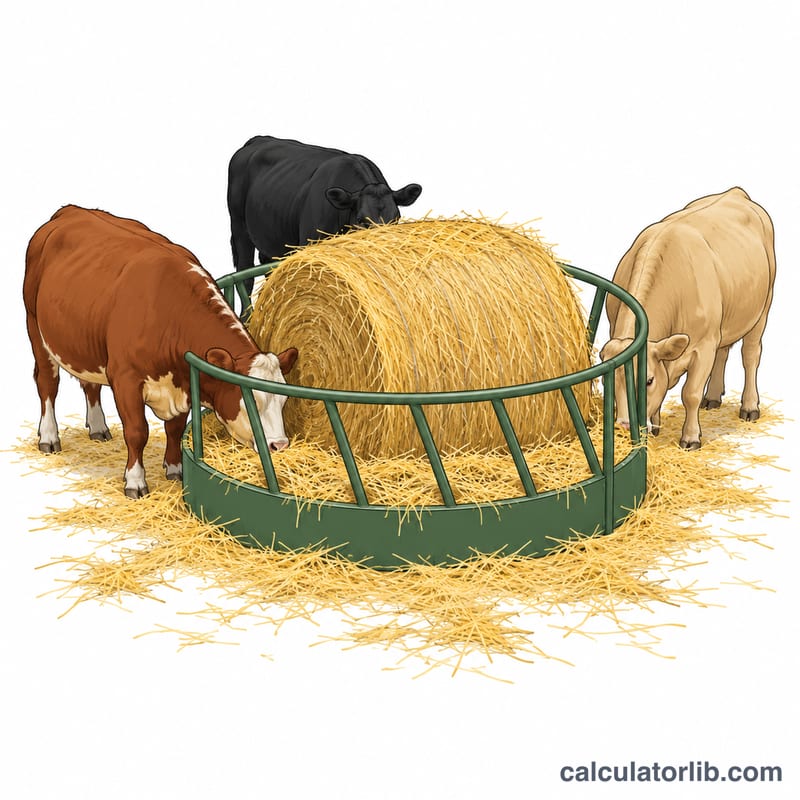
Start with intake. Livestock hay budgets are built on dry-matter intake as a share of body weight: roughly 2.0-2.5% for mature beef cattle, 1.5-2.5% for horses, and 2.5-3.0% for lactating or growing animals. Next set the feeding period — for many temperate farms this is the 120-180 days between pasture closing and spring turnout. Then set a waste allowance: 5-10% for a well-designed ring feeder, 20-40% for bales fed on open ground.
The formula explained
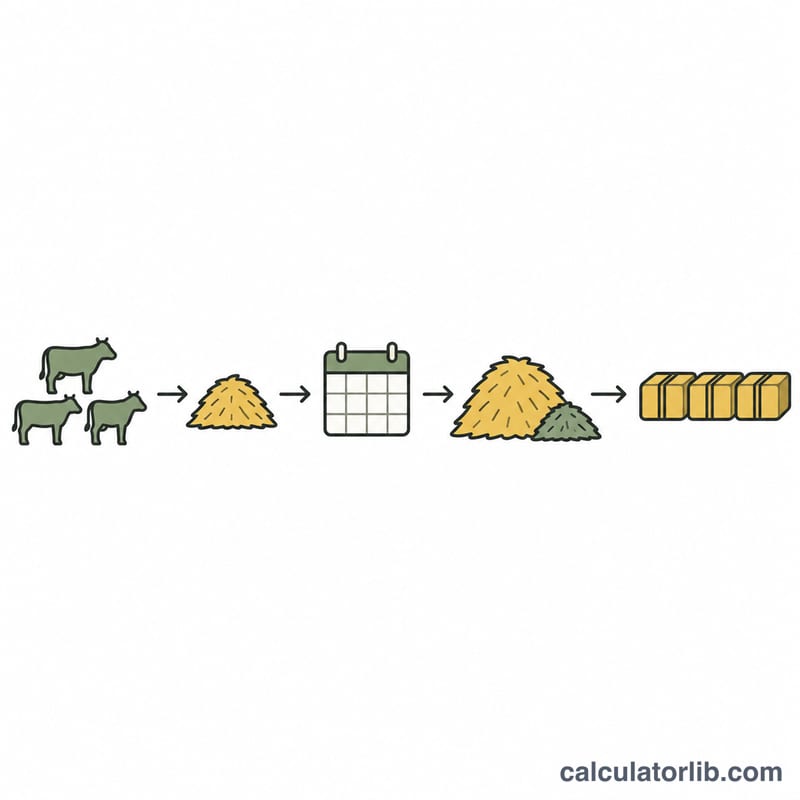
With \(N\) = number of animals, \(W\) = average body weight, \(I\) = daily intake as a percent of body weight, \(D\) = days of feeding, \(L\) = waste percent and \(B\) = weight of one bale:
$$\text{Bales} = \left\lceil \frac{N \times W \times \frac{I}{100} \times D \times \left(1 + \frac{L}{100}\right)}{B} \right\rceil$$The ceiling bracket exists because you cannot buy 0.9 of a bale.
Buy a margin above this figure: bale weights vary by moisture and baler settings, and a long winter or poor pasture can stretch the feeding period. Weigh a sample bale if you can.
Worked example
Thirty cows averaging 550 kg, fed for 120 days at 2.5% intake, with 10% waste and 500 kg round bales:
$$550 \times \frac{2.5}{100} = 13.75\,\text{kg per cow per day}$$$$13.75 \times 30 \times 120 = 49{,}500\,\text{kg}$$$$49{,}500 \times 1.10 = 54{,}450\,\text{kg}$$$$\frac{54{,}450}{500} = 108.9 \rightarrow 109\ \text{bales}$$Dry-Matter Intake, Waste and Bale-Weight Factors
The three inputs people most often guess at are daily intake, waste allowance and bale weight. The tables below give typical planning ranges for each. They are starting points for an estimate, not measured values for your animals or your hay — confirm bale weight by weighing and confirm intake against what the animals actually clean up.
1. Daily dry-matter intake as % of body weight
Basis: the intake ranges published in the US National Research Council (NRC) Nutrient Requirements series for beef cattle, dairy cattle, horses, sheep and goats, as summarised in North American extension feeding guides. Figures are dry-matter (DM) intake for forage-based diets; animals on poor-quality, high-fibre hay tend toward the low end because gut fill limits them, while high-producing animals on good hay reach the high end.
| Animal class | DM intake (% of body weight/day) | Example: kg DM/day at stated weight |
|---|---|---|
| Mature dry beef cow (mid gestation) | 1.8–2.0% | 9.9–11.0 kg at 550 kg |
| Lactating beef cow | 2.3–2.7% | 12.7–14.9 kg at 550 kg |
| Growing / weaned calf | 2.5–3.0% | 6.3–7.5 kg at 250 kg |
| Mature idle horse | 1.5–2.0% | 7.5–10.0 kg at 500 kg |
| Working or lactating horse | 2.0–2.5% | 10.0–12.5 kg at 500 kg |
| Ewe, dry / maintenance | ~2.0% | 1.4 kg at 70 kg |
| Ewe, late gestation | ~2.5% | 1.75 kg at 70 kg |
| Ewe, lactating | ~3.0% | 2.1 kg at 70 kg |
| Dairy goat (lactating) | 2.5–3.5% | 1.6–2.3 kg at 65 kg |
| Dairy cow (lactating, total ration DM) | 3.0–4.0% | 19.5–26.0 kg at 650 kg |
For dairy cows and other high-producing stock the figure is total ration dry matter, including grain and silage — only the forage share of it should be converted into hay bales.
2. Waste allowance by feeding method
Basis: feeding-loss trials reported by North American university extension services (notably Michigan State, Nebraska and Oklahoma State round-bale feeder studies). Losses are the share of hay offered that is trampled, soiled, pulled out or refused, and they vary widely with stocking density, mud and how often bales are set out.
| Feeding method | Typical feeding waste |
|---|---|
| Ring or cone feeder with sheeted (solid) base | 3–6% |
| Open ring feeder | 5–10% |
| Cradle or trailer feeder | 10–15% |
| Bale unrolled on the ground | 12–20% |
| Whole bale on open ground, unrestricted access | 20–45% |
Limiting access time (for example feeding a fixed allowance once or twice a day) pushes any method toward the low end of its range; free-choice access to several days' worth of hay pushes it toward the high end.
3. Typical bale weights
Basis: commonly quoted baler-output ranges in North America, where round and large square bales are named by their dimensions in feet. Actual weight swings by 20% or more with moisture, crop species, cut and baler density setting, so these are planning figures only.
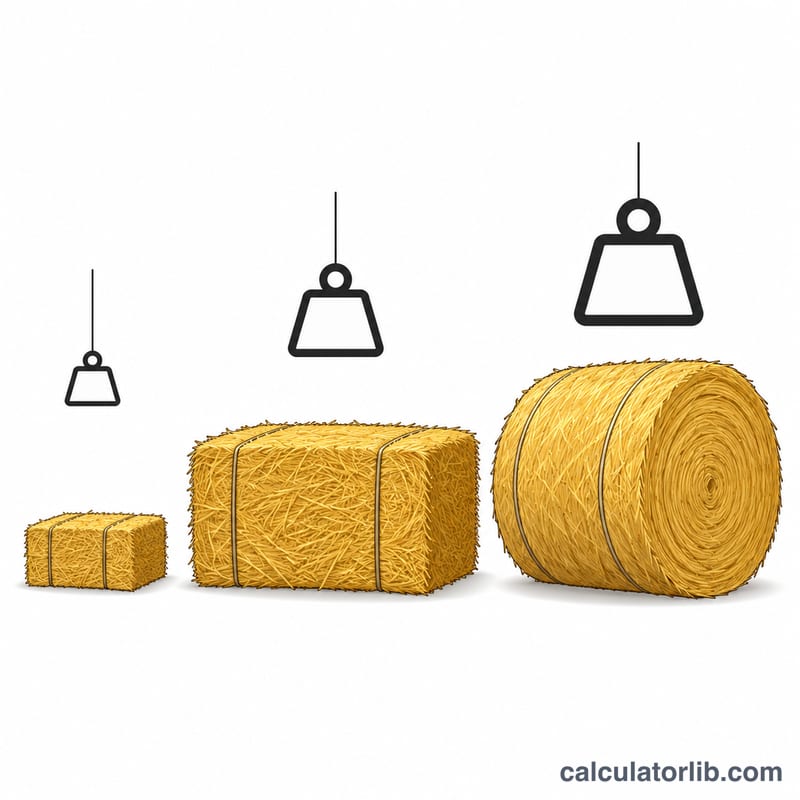
| Bale type (nominal size) | Typical as-fed weight |
|---|---|
| Small square (two-string) | 18–27 kg (40–60 lb) |
| Large square, 3×3×8 ft | 350–450 kg (770–990 lb) |
| Round, 4×4 ft | 250–350 kg (550–770 lb) |
| Round, 5×5 ft | 450–600 kg (990–1320 lb) |
| Round, 5×6 ft | 550–700 kg (1210–1540 lb) |
Dry matter vs as-fed. Bale weights are as-fed (wet) weights, while intake tables are dry matter. Field-cured hay is typically 85–90% dry matter, so a 500 kg bale carries roughly 425–450 kg of DM. Entering the as-fed bale weight against a dry-matter requirement therefore builds in a small extra margin of about 10–15% — useful padding, but if you want a strict dry-matter balance, multiply the bale weight by its DM fraction before entering it:
$$\text{Bale DM (kg)} = \text{as-fed weight} \times \frac{ {\text{DM}}\ \%}{100} \quad\Rightarrow\quad 500 \times 0.88 = 440\ \text{kg DM}$$A forage test gives the true dry-matter percentage along with protein and energy, which matters more than bale count if the hay is being fed to lactating or growing animals.
Turning the Number Into a Hay Order
A bale count is a planning figure, not a purchase order. These steps turn it into something you can actually buy, haul and store.
- Weigh bales instead of trusting the nominal size. Put 3–5 representative bales across a weighbridge, a loader scale or a livestock scale and use the average. A 5×5 round bale can plausibly be anywhere from 450 to 600 kg, and as the scenario table shows, that alone changes the bale count by a quarter. Weigh again if you switch suppliers, fields or cuts.
- Add a weather contingency. In regions where spring turnout timing is variable, add roughly 10–15% — or simply enter 2–3 extra weeks in the feeding-days field, which is easier to reason about. Running out in March, when hay is scarcest and dearest, costs far more than carrying a few spare bales.
- Round up twice. Round up to whole bales, then round again to whole transport loads or whole storage rows. If a trailer carries 17 round bales, ordering 124 (not 120) may cost nothing extra in freight per bale.
- Budget storage loss separately from feeding waste. The waste field in this calculator covers losses at the feeder. Storage is an additional loss: round bales stored outside, unprotected and in ground contact commonly lose 5–20% of their dry matter to weathering over a winter, versus about 2–5% under cover or wrapped. If you store outside, buy for the storage loss too, or stack on gravel/pallets in single rows with ends touching and gaps between rows to cut it.
- Check quality, not just quantity, for productive stock. Low-energy, high-fibre hay means animals must eat more to meet requirements — and often cannot, because gut fill limits them. If you are feeding lactating or growing animals, get a forage test (dry matter, crude protein, energy) and set the intake percentage from the hay you actually have rather than from a table midpoint.
- Re-run the number mid-season. Count bales fed at the halfway point and compare with the plan. If you have used 60% of the stack at the 50% mark, you have roughly a 20% shortfall coming and plenty of time to buy, extend grazing or adjust the ration. Catching drift in January is cheap; catching it in April is not.
Also sanity-check the units before ordering: intake tables are dry matter while bale weights are as-fed, and hay is typically 85–90% dry matter, so entering as-fed bale weights builds in a modest extra margin rather than a shortfall.
These are general planning practices for estimating forage quantity. They are not a ration, a feeding programme, or a substitute for advice from a qualified animal nutritionist or veterinarian, who should set intake targets and diet composition for your specific animals, hay and conditions.
FAQ
Should I use dry-matter or as-fed weight?
The intake percentage is a dry-matter figure, while a bale is weighed as-fed at roughly 85-90% dry matter. Using as-fed bale weight therefore builds in a small extra cushion, which most producers welcome.
Why does my bale weight matter so much?
Round bale weight swings from 350 kg to 650 kg with diameter, density and moisture. A 20% error in bale weight is a 20% error in your bale count, so weigh one bale on a scale or loader rather than trusting the baler label.
Can I use it for sheep or goats?
Yes. Enter the flock average body weight (say 70 kg) and an intake of 2.5-3.0%; small square bale weights of 18-25 kg are typical.