What is the Truss Load Calculator?
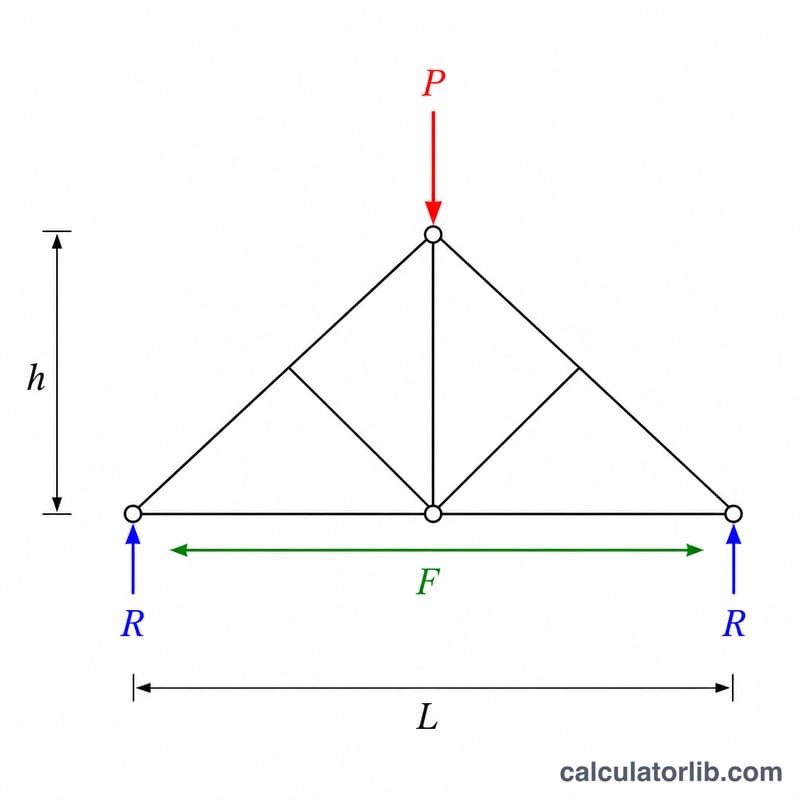
This calculator finds the support reactions and the internal member forces of a simple symmetric triangular (King-post style) truss carrying a single vertical point load at its apex. It is a fast way for students and engineers to check hand calculations for statically determinate trusses using the method of joints.
The formula explained
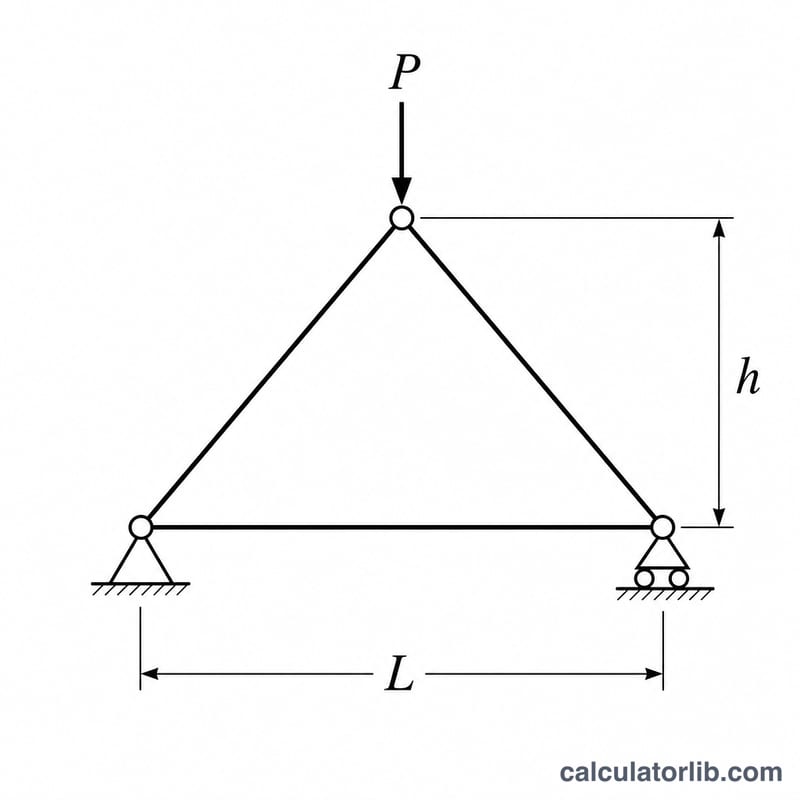
The truss has a bottom chord of span \(L\), an apex height \(h\), and a downward load \(P\) applied at the apex. Because the structure and load are symmetric, each support reaction is half the load:
$$R_A = R_B = \frac{P}{2}$$The two inclined members each have length \(\ell = \sqrt{(L/2)^2 + h^2}\). Resolving forces at a support joint gives the diagonal (in compression) and the bottom chord (in tension):
$$F_{diag} = \frac{R\,\ell}{h}, \qquad F_{bottom} = \frac{PL}{4h}$$Here \(R\) = support reaction in kN, \(\ell\) = diagonal length in m, \(h\) = apex height in m, and \(L\) = span in m.
How to use it
Enter the span \(L\), the apex height \(h\), and the apex load \(P\). The calculator returns the reaction at each support, the compression force in each diagonal, and the tension force in the bottom chord.
Worked example
For \(L = 6\,\text{m}\), \(h = 4\,\text{m}\), and \(P = 10\,\text{kN}\):
$$\ell = \sqrt{3^2 + 4^2} = 5\,\text{m}$$$$R = \frac{10}{2} = 5\,\text{kN}$$$$F_{diag} = \frac{5 \times 5}{4} = 6.25\,\text{kN}$$$$F_{bottom} = \frac{10 \times 6}{4 \times 4} = 3.75\,\text{kN}$$Interpreting Your Result
This calculator models a statically determinate, symmetric triangular truss (two diagonals meeting at an apex, tied by a bottom chord) carrying a single point load \(P\) at midspan. The three numbers it returns follow directly from equilibrium and the method of joints.
Support reactions. Because the load sits exactly at the center and the geometry is symmetric, each support carries half the load:
$$R = \dfrac{P}{2}$$
So the reaction is simply half of whatever you enter for the load; the two supports share it equally.
Bottom chord \(\rightarrow\) tension. The horizontal bottom chord is pulled outward at both ends as the truss tries to flatten under load. Its force is a tension force:
$$F_{bottom} = \dfrac{PL}{4h}$$
A tension member is at risk of yielding (or fracture) — it must be checked against the material's allowable tensile stress over its net cross-sectional area.
Diagonal \(\rightarrow\) compression. Each sloping diagonal pushes down into the support to resist the reaction, so it carries a compression force. Resolving vertical equilibrium at a support joint, the diagonal force is the reaction divided by the sine of the diagonal's angle to the horizontal:
$$F_{diag} = \dfrac{R}{\sin\theta} = \dfrac{P}{2}\cdot\dfrac{\sqrt{(L/2)^2 + h^2}}{h}$$
A compression member is at risk of buckling — a stability failure that can occur well below the material's crushing stress — so it must be checked against its allowable buckling/compressive capacity, which depends on member length, cross-section and end conditions.
Worked example. For a span \(L = 8\), height \(h = 3\) and load \(P = 10\) (consistent units, e.g. m and kN):
- Reaction: \(R = \dfrac{10}{2} = 5\) (kN) at each support.
- Bottom chord tension: \(F_{bottom} = \dfrac{10 \times 8}{4 \times 3} = \dfrac{80}{12} \approx\) 6.67 (kN, tension).
Comparing the forces. A member is adequate only when its axial force stays within its allowable axial capacity (or the axial stress stays within the allowable stress for the material and section). Note from the formula that a shallower truss (smaller \(h\)) increases the bottom-chord tension, while a longer span increases both chord and diagonal forces.
What this model leaves out. These results come from an idealized determinate truss with pin-connected joints and loads applied only at the joints. They ignore the truss's own self-weight, member buckling and slenderness, connection/gusset effects, load eccentricity, and any continuity or fixity at the joints. The output describes the internal axial forces implied by statics — it is not a check of whether any member or connection is adequate.
FAQ
Which members are in tension? The bottom (horizontal) chord is in tension, while the two inclined diagonals are in compression.
Does this handle unsymmetric loads? No. This model assumes a single central point load on a symmetric triangle, which keeps the truss statically determinate and both reactions equal.
What units should I use? Use consistent units, for example metres for span and height and kilonewtons for load; forces are then returned in kN.