What this calculator does
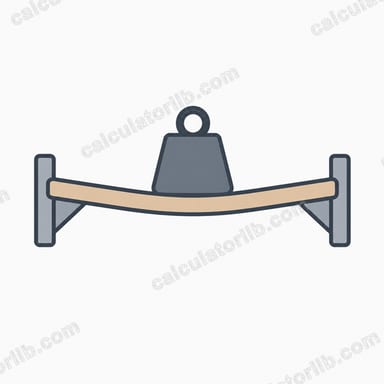
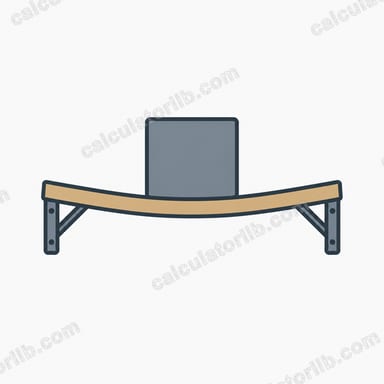
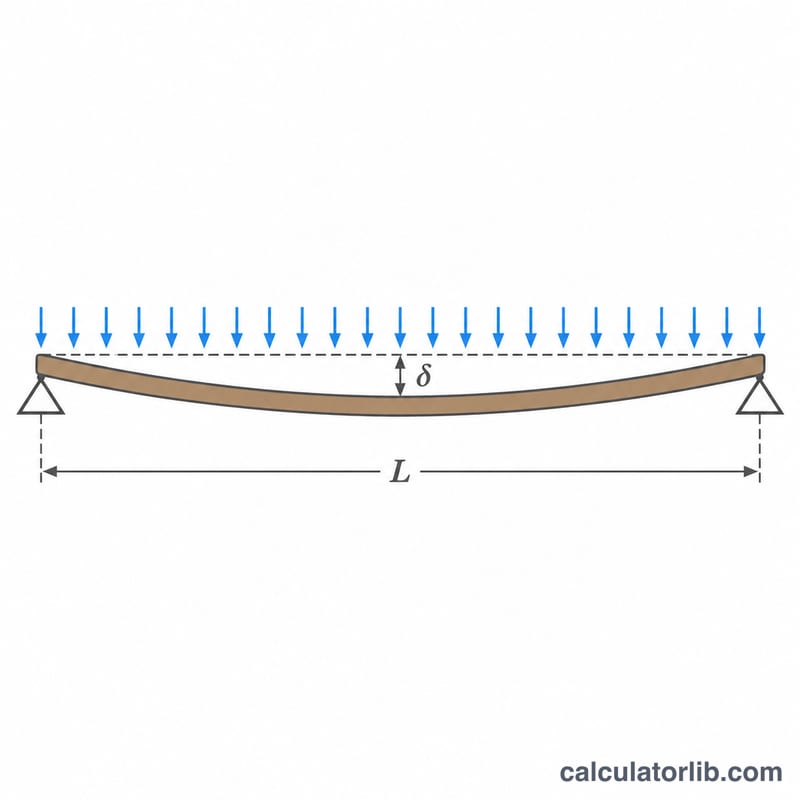
A shelf that looks solid on paper can bow alarmingly once books, tins or tools go on it. This tool predicts the mid-span sag of a shelf from four things you control: the clear span between supports, the shelf depth, the thickness, and the stiffness of the material. It is pure beam mechanics in metric units, so it applies anywhere in the world.
How to use it
Pick the material (or enter a custom modulus \(E\) in MPa), then enter the clear span between supports in mm, the depth front-to-back in mm, the thickness in mm, and the total load in kg. The result gives the sag in mm, the sag ratio, and the load at which the shelf reaches the common span/360 appearance limit.
The formula explained
For a board simply supported at both ends with the load spread evenly along it:
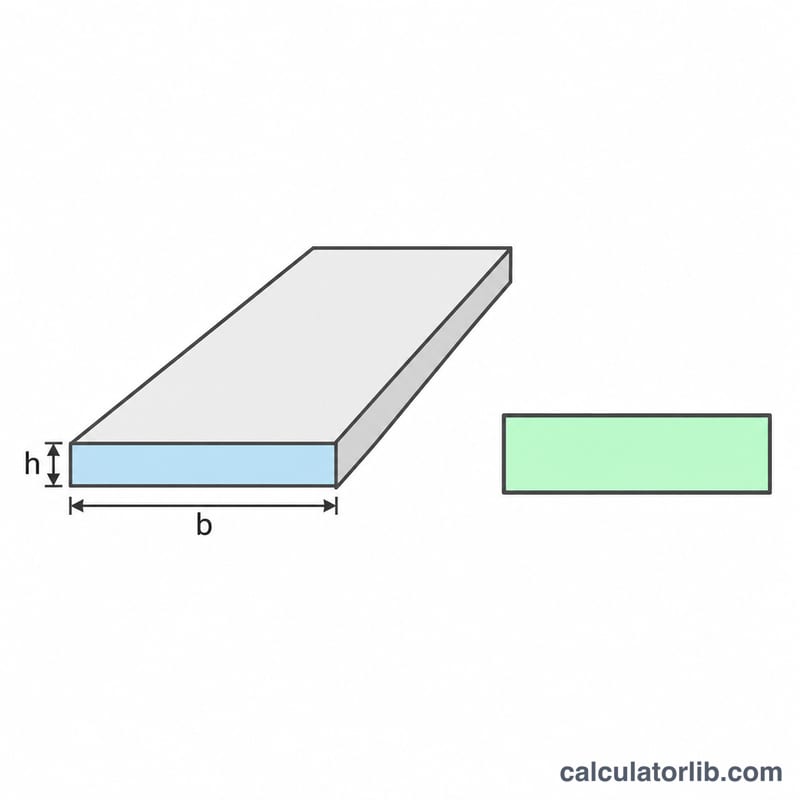
$$\delta = \frac{5 W L^{3}}{384 E I}, \qquad I = \frac{b\,t^{3}}{12}$$where \(\delta\) = sag in mm, \(W\) = total load in newtons (kg × 9.80665), \(L\) = span in mm, \(E\) = modulus of elasticity in MPa, \(b\) = shelf depth and \(t\) = thickness. Sag grows with the cube of the span and falls with the cube of the thickness, which is why shortening a span is the cheapest fix of all.
Worked example
A 900 mm particleboard shelf, 300 mm deep and 18 mm thick, carrying 20 kg:
$$I = \frac{300 \times 18^{3}}{12} = 145{,}800\,\text{mm}^4$$$$W = 20 \times 9.80665 = 196.13\,\text{N}$$$$\delta = \frac{5 \times 196.13 \times 900^{3}}{384 \times 2750 \times 145800} = 4.64\,\text{mm}$$That is a ratio of about span/194, well past the 2.5 mm allowed by span/360 — the shelf will visibly droop. Going to 25 mm thickness cuts the sag to roughly 1.7 mm.
Modulus of Elasticity (E) by Shelf Material
Sag is inversely proportional to the modulus of elasticity \(E\) of the shelf material and to its second moment of area \(I\). The values below are the bending modulus measured along the span (the direction the shelf bridges) — for plywood that means the face-grain direction, and for solid timber the along-the-grain direction. Across the grain or across the face plies, stiffness is far lower, so a shelf cut with the grain running across the span will sag much more than these figures suggest.
| Material | Typical E along span (MPa) | Typical density (kg/m³) | Notes |
|---|---|---|---|
| Particleboard / chipboard (incl. melamine-faced) | 2,500 – 3,000 | 650 – 750 | Lowest stiffness of the common shelf panels; also the most creep-prone |
| MDF | 3,000 – 4,000 | 700 – 800 | Uniform in all in-plane directions; heavy for its stiffness |
| Softwood plywood (e.g. pine, spruce, fir) | 7,000 – 9,000 | 500 – 650 | Face-grain parallel to span; much lower if rotated 90° |
| Hardwood plywood (e.g. birch, beech ply) | 9,000 – 11,000 | 650 – 750 | Dense, void-free cores give the upper end of the range |
| Softwood, solid (pine, spruce, fir) | 9,000 – 11,000 | 450 – 550 | Along the grain; knots and sloping grain reduce it |
| Temperate hardwood, solid (oak, maple, beech, ash) | 11,000 – 14,000 | 650 – 760 | Along the grain; the best stiffness-to-weight of the wood options |
| Glass, annealed or toughened (soda-lime) | ≈ 70,000 | ≈ 2,500 | Toughening does not change E — see note below |
| Aluminium 6061 / 6063 | ≈ 69,000 | ≈ 2,700 | All common aluminium alloys and tempers share essentially the same E |
| Mild steel | ≈ 200,000 | ≈ 7,850 | Stiffest option; a thin steel plate still sags little but is heavy |
Points to keep in mind
- Toughening (tempering) changes strength, not stiffness. Toughened and annealed soda-lime glass both have \(E \approx 70{,}000\) MPa, so a toughened shelf deflects exactly as much as an annealed one of the same size. What toughening buys is a much higher allowable bending stress and safer breakage behaviour.
- Panel values vary with grade and moisture. Published E for particleboard, MDF and plywood depends on the board grade, density and thickness, and drops as moisture content rises — a panel in a damp garage or bathroom is measurably less stiff than the same panel in a heated room. Treat the ranges above as typical dry-room values and use the manufacturer's declared figure when you have it. Panel bending modulus is measured by regional test standards — EN 310 in Europe, ASTM D1037 (fibre and particle panels) or ASTM D3043 (structural panels) in the United States — and figures from different standards are not always directly interchangeable.
- Don't forget self-weight. The calculator's load field should include the shelf's own mass as well as what sits on it. A 900 mm × 300 mm × 18 mm MDF shelf has a volume of \(0.9 \times 0.3 \times 0.018 = 0.00486\ \text{m}^3\), so at 750 kg/m³ it weighs about 3.6 kg — not negligible next to a 20 kg book load. The same shelf in glass would weigh about 12 kg, and in steel about 38 kg.
- Stiffness follows thickness cubed. Because \(I = \dfrac{b\,t^{3}}{12}\), going from 18 mm to 25 mm MDF multiplies \(I\) by \((25/18)^{3} \approx 2.68\) and cuts sag to about 37% of its original value — usually a cheaper fix than changing material.
Deflection Limits and Creep Factors
There is no universal rule for "how much sag is too much", so shelf design borrows the span-ratio limits used for floors and ceilings in building codes (for example the \(L/360\) live-load limit for floors in the US IBC/IRC, and comparable serviceability ratios in Eurocode-based practice). Domestic shelving itself is generally not code-regulated; the ratios below are practical appearance and serviceability targets, not legal requirements.
| Criterion | What it looks like | 600 mm span | 900 mm span | 1200 mm span |
|---|---|---|---|---|
| Span / 360 | Reads as flat; no sag visible against a straight reference line. Target for display shelves, kitchens and anything at eye level | 1.7 mm | 2.5 mm | 3.3 mm |
| Span / 240 | Slight bow, noticeable only if you look for it. Acceptable for utility, garage, pantry and workshop shelving | 2.5 mm | 3.8 mm | 5.0 mm |
| Span / 180 | Clearly visible sag. Usual outer limit — beyond this the shelf looks overloaded even if it is structurally safe | 3.3 mm | 5.0 mm | 6.7 mm |
The limit is simply the span divided by the ratio, e.g. \(1200 \div 240 = 5.0\ \text{mm}\). Note that the allowance grows with span, but sag itself grows with \(L^{3}\) — which is why doubling a span is roughly eight times worse in deflection while the limit only doubles.
Long-term creep multipliers
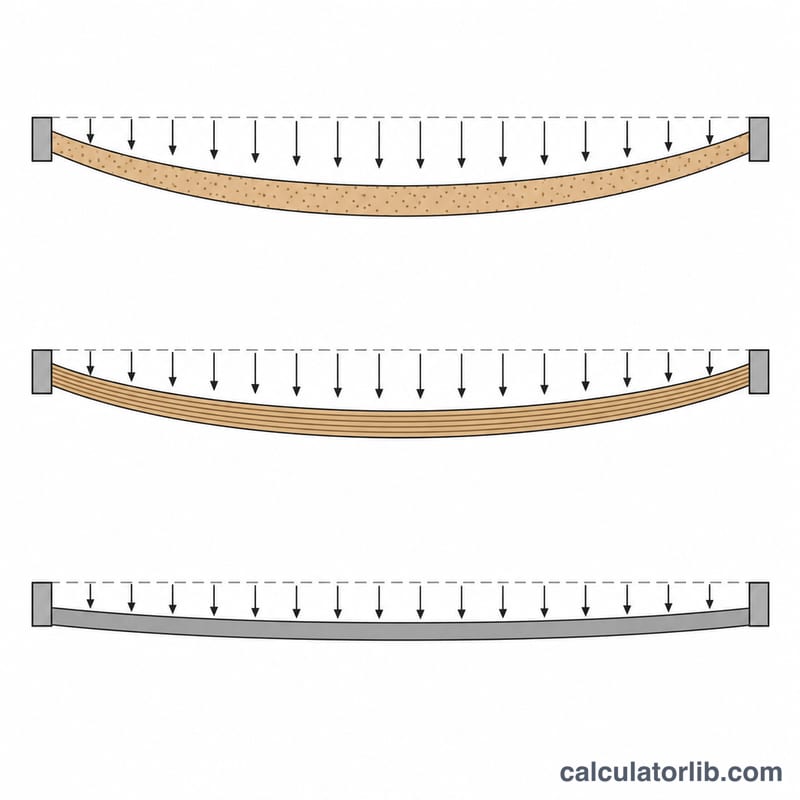
The calculator returns the instantaneous elastic deflection — the sag the moment the load is applied. Under a load that stays in place for months or years, wood-based materials continue to deform (creep). Multiply the calculated value by the factor below to estimate the long-term sag of a permanently loaded shelf.
| Material | Long-term multiplier on initial elastic sag | Comment |
|---|---|---|
| Particleboard / chipboard | 2.0 – 2.5 × | Worst creep of the common shelf materials; higher still in humid conditions |
| MDF | ≈ 2.0 × | A loaded MDF shelf typically ends up sagging about twice its day-one figure |
| Plywood | 1.5 – 2.0 × | Better than solid-fibre panels thanks to the cross-laminated structure |
| Solid timber | 1.5 – 2.0 × | Lower end when kept dry and at stable humidity |
| Glass, aluminium, steel | ≈ 1.0 × | No practical creep at room temperature; the calculated sag is the final sag |
Worked check: 18 mm MDF, 900 mm span
Take a 900 mm × 300 mm shelf in 18 mm MDF (\(E = 3{,}500\) MPa) carrying 20 kg of books:
$$I = \frac{300 \times 18^{3}}{12} = \frac{300 \times 5{,}832}{12} = 145{,}800\ \text{mm}^4$$ $$F = 20 \times 9.80665 = 196.13\ \text{N}$$ $$\delta = \frac{5 \times 196.13 \times 900^{3}}{384 \times 3{,}500 \times 145{,}800} = \frac{7.149 \times 10^{11}}{1.960 \times 10^{11}} = 3.6\ \text{mm}$$That initial 3.6 mm is about \(L/247\) — fine for a garage, borderline for a living room. Apply the MDF creep factor of 2.0 and the long-term sag becomes roughly 7.3 mm, or \(L/123\), well past the \(L/180\) outer limit. For permanently loaded shelves, check the creep-adjusted figure against the table above, not the instantaneous one.
Glass shelving is a strength problem, not a deflection problem
At \(E \approx 70{,}000\) MPa, glass is stiff enough that a shelf meeting a sensible deflection target may still be dangerously close to breaking — and glass gives no warning before it fails. Glass shelf thickness is therefore normally set by allowable bending stress and safety factors (and by using toughened or laminated glass with finished edges), with deflection as a secondary comfort check. Follow the glass supplier's span and thickness tables and your local safety-glass regulations rather than sizing a glass shelf on sag alone.
Two further practical caveats: these formulas assume a uniformly distributed load on a simply supported shelf, so a heavy point load at mid-span produces more sag (up to about 1.6 × the uniform case for the same total weight), while fixed or continuous supports produce less. And a shelf that is securely fixed to a back wall, or that has a stiffening lip or edge-band on its front edge, is considerably stiffer than the bare panel this calculation models.
FAQ
How much sag is acceptable? Span/360 looks flat to the eye; span/180 is the usual outer limit before a shelf reads as sagging.
Does a front edge lip help? Yes, substantially. A glued-on hardwood nosing or a dropped front edge raises \(I\) far more than extra board thickness and is the standard cure for long spans.
Why does my shelf sag more over time? Wood-based panels creep: particleboard and MDF can roughly double their initial deflection after months under constant load. Size for about half the allowable sag if the load is permanent.