What this calculator does
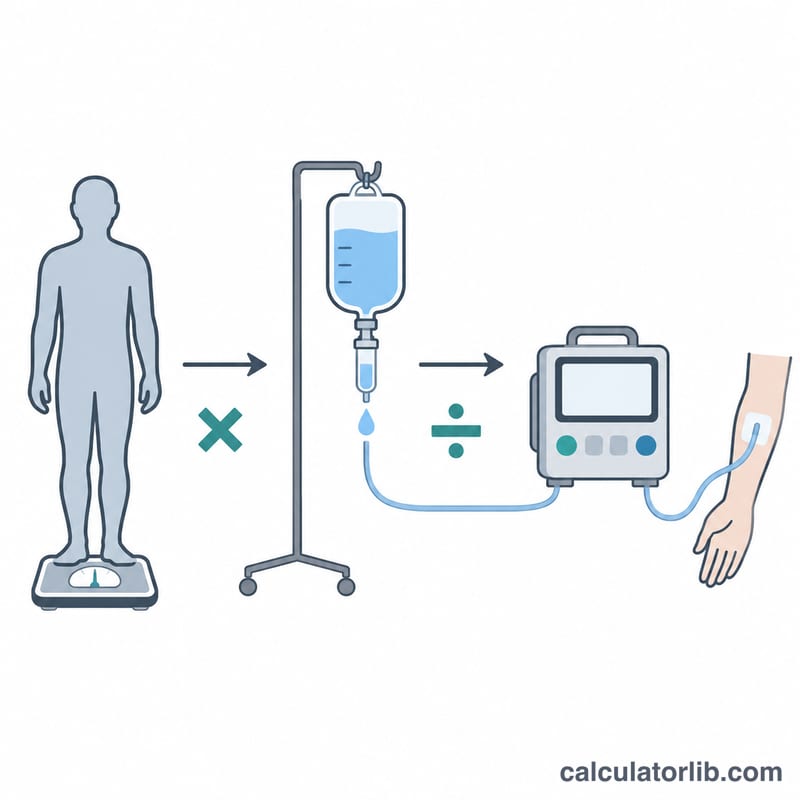
Heparin is ordered by weight, in units per kilogram per hour, but an infusion pump is programmed in millilitres per hour. This calculator bridges the two: enter the patient weight, the ordered dose, and the strength of the premixed bag, and it returns the pump rate in mL/hr along with the hourly units, the bag concentration, the 24-hour total and the volume needed for an optional loading bolus. It works for any concentration, so it covers 25,000 units in 250 mL (100 units/mL), 25,000 units in 500 mL (50 units/mL) and non-standard bags alike. The calculation is pure arithmetic and applies anywhere; the dosing targets themselves come from your local protocol.
How to use it
Enter the dosing weight in kilograms (many protocols use actual body weight, capped for obesity), the ordered dose in units/kg/hr, then the total heparin units and total volume printed on the bag label. Leave the bolus field at 0 if no loading dose was ordered.
The formula
With \(W\) = weight in kg, \(D\) = dose in units/kg/hr, \(U\) = units in the bag and \(V\) = bag volume in mL:
$$\text{Rate}_{\text{mL/hr}} = \frac{W \times D \times V}{U} = \frac{W \times D}{C},\quad C = \frac{U}{V}$$The hourly dose \(W \times D\) is in units/hr; dividing by the concentration \(C\) in units/mL cancels units and leaves mL/hr.
Worked example
A 70 kg patient is ordered 18 units/kg/hr from a 25,000 unit / 250 mL bag, with an 80 units/kg bolus.
$$C = \frac{25000}{250} = 100\ \text{units/mL}$$$$W \times D = 70 \times 18 = 1260\ \text{units/hr}$$$$\text{Rate} = \frac{1260}{100} = 12.6\ \text{mL/hr}$$The bolus is \(70 \times 80 = 5600\) units, or \(5600 / 100 = 56\) mL.
Pump Rate Across Common Orders and Bag Concentrations
Every number below is recomputed from the same conversion the calculator uses, where \(W\) is the dosing weight in kg, \(D\) is the ordered dose in units/kg/hr, and \(C\) is the bag concentration in units/mL:
$$\text{Rate (mL/hr)} = \frac{W \times D}{C}, \qquad C = \frac{\text{Heparin in bag (units)}}{\text{Bag volume (mL)}}$$Results are rounded to one decimal place. The doses shown are illustrative only — the units/kg/hr target, the bag concentration stocked, and whether actual or adjusted body weight is used all come from your own institution's heparin protocol, which differs between hospitals and between countries.
| Weight (kg) | Dose (units/kg/hr) | Bag | Concentration C (U/mL) | Hourly dose (units/hr) | Pump rate (mL/hr) |
|---|---|---|---|---|---|
| 60 | 12 | 25,000 U / 250 mL | 100 | 720 | 7.2 |
| 70 | 18 | 25,000 U / 250 mL | 100 | 1,260 | 12.6 |
| 70 | 18 | 25,000 U / 500 mL | 50 | 1,260 | 25.2 |
| 80 | 16 | 25,000 U / 250 mL | 100 | 1,280 | 12.8 |
| 85 | 12 | 25,000 U / 250 mL | 100 | 1,020 | 10.2 |
| 95 | 18 | 25,000 U / 250 mL | 100 | 1,710 | 17.1 |
| 110 | 14 | 25,000 U / 250 mL | 100 | 1,540 | 15.4 |
| 110 | 14 | 20,000 U / 500 mL | 40 | 1,540 | 38.5 |
Two patterns are worth reading off the table. First, the hourly dose in units/hr depends only on weight and ordered dose — the 70 kg rows deliver 1,260 units/hr whether the bag is 50 U/mL or 100 U/mL. Second, the mL/hr the pump needs is inversely proportional to concentration: halving \(C\) exactly doubles the volume rate (12.6 → 25.2 mL/hr), and a 40 U/mL bag at the same order needs 38.5 mL/hr instead of 15.4 mL/hr. Substituting the last row in full:
$$\text{Rate} = \frac{110\ \text{kg} \times 14\ \text{units/kg/hr}}{40\ \text{units/mL}} = \frac{1{,}540\ \text{units/hr}}{40\ \text{units/mL}} = 38.5\ \text{mL/hr}$$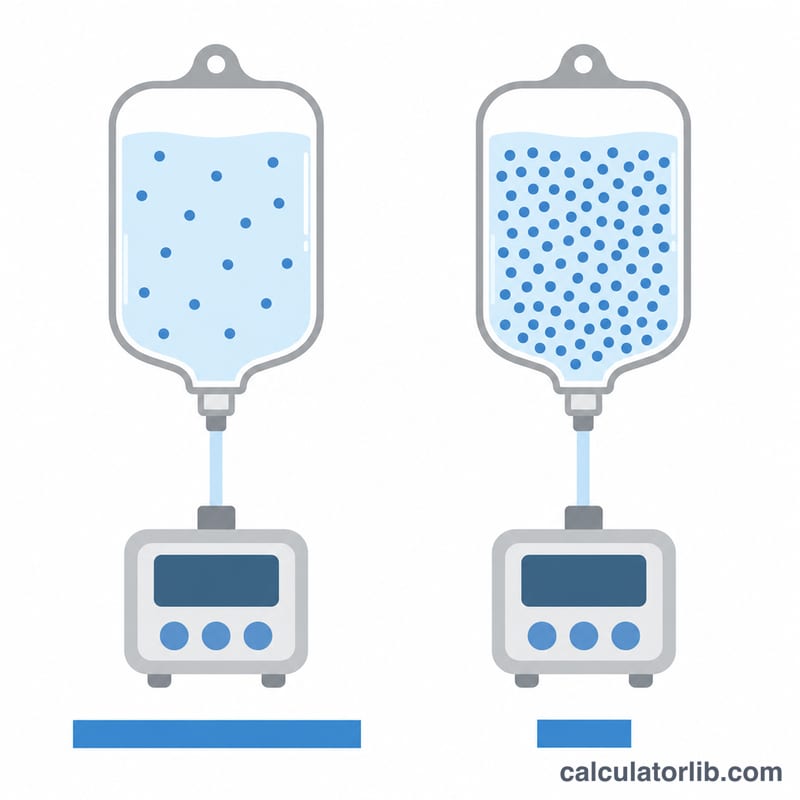
Key Terms and Variables
| Term | Units | Meaning |
|---|---|---|
| Dosing weight (\(W\)) | kg | The weight the order is based on. Many protocols use actual body weight, while others use an adjusted body weight or cap the dosing weight (for example at a fixed maximum) in obesity. Which weight to use — and whether a cap applies — is a protocol choice at your institution, not something this conversion decides. Enter the weight the order was written against. |
| Ordered dose (\(D\)) | units/kg/hr | The prescribed weight-based infusion intensity, e.g. 18 units/kg/hr. It is set by the order and the nomogram, never by the pump. |
| Hourly dose | units/hr | What the patient actually receives per hour: \(W \times D\). Example: 80 kg × 16 units/kg/hr = 1,280 units/hr. |
| Heparin in bag | units (U) | Total heparin in the premixed bag or syringe, e.g. 25,000 U. |
| Bag volume | mL | Total fluid volume of that bag, e.g. 250 mL or 500 mL. |
| Bag concentration (\(C\)) | units/mL (U/mL) | \(C = U / V\) — the strength actually hanging. 25,000 U in 250 mL is 100 U/mL; 25,000 U in 500 mL is 50 U/mL. Available concentrations are stock-dependent and vary by country and pharmacy. |
| Infusion (pump) rate | mL/hr | The volumetric rate programmed into the IV pump: \(W \times D / C\). This is the only one of these numbers the pump understands. |
| Loading bolus | units/kg → units → mL | An optional one-time dose given before or at the start of the infusion. The ordered bolus in units/kg is multiplied by weight to give total units, then divided by \(C\) to give the volume to administer: \(\text{Bolus (mL)} = W \times \text{bolus dose} / C\). Protocols commonly cap the maximum bolus in units. |
| 24-hour total | units/day (and mL/day) | \(W \times D \times 24\) units, equal to the pump rate × 24 in mL. A planning figure for bag changes and total exposure. |
| aPTT | seconds (or ratio) | Activated partial thromboplastin time — a clotting test used to monitor unfractionated heparin. Therapeutic ranges are laboratory- and reagent-specific, so they are defined locally, not universally. |
| Anti-Xa (heparin) level | IU/mL | A direct assay of heparin activity, used instead of or alongside aPTT at many centres. Like aPTT, its target range is set by the local protocol. |
aPTT and anti-Xa are deliberately not inputs to this tool. They drive the titration decision — the new units/kg/hr or the rate change — through the institution's nomogram. Once a new dose has been decided, this calculator converts it to mL/hr.
Interpreting Your Pump Rate
The output is a unit conversion, not a clinical recommendation. The dose was already decided by the prescriber and the protocol; all this does is express that same dose in the units an infusion pump accepts.
- units/hr is what the patient receives; mL/hr is what the pump needs. The two are linked only through the stated concentration \(C\). Change the bag, and the mL/hr must change even though the order has not.
- A surprising mL/hr almost always means a mismatched concentration or weight. If a 50 U/mL bag is entered as 100 U/mL, the computed rate is half what it should be and the patient receives half the ordered dose; the reverse error doubles it. A weight typed in pounds instead of kilograms inflates the rate by roughly 2.2×. Before programming, check the rate against the order independently: does \(\text{rate} \times C\) give back the expected units/hr? For 12.6 mL/hr at 100 U/mL, \(12.6 \times 100 = 1{,}260\) units/hr — which should equal \(W \times D\).
- Rounding to the pump's resolution shifts the delivered dose slightly. A pump limited to 0.1 mL/hr increments turns a computed 17.14 mL/hr into 17.1 mL/hr; at 100 U/mL that is 1,710 instead of 1,714 units/hr, a difference of well under 1%. On a device limited to whole mL/hr the shift is larger, and the reduced-resolution rate — not the ideal one — is what the patient gets.
- The 24-hour total is a hypothetical. It assumes the rate runs unchanged and uninterrupted for 24 hours: no titration, no holds for procedures or bleeding, no line downtime, no bag-change gaps. Real cumulative exposure after a day of nomogram-driven titration is usually different.
- The bolus volume is separate from the infusion. It is a one-time volume, typically given as a slow push or a short dedicated infusion, and it is not added to the hourly rate. Giving the bolus does not change the mL/hr the pump should then run at.
- Concentration is a safety variable in its own right. Where more than one strength is stocked, confirming the label on the bag in hand — not the strength usually used on your unit — is the step that prevents the twofold errors above.
Dose selection, bolus decisions, titration increments, monitoring intervals and target aPTT or anti-Xa ranges all follow your institution's heparin protocol or nomogram, which varies by hospital, by indication and by country. Independent double-checks of weight, concentration and programmed rate are standard practice for high-alert infusions in many settings. This section is general information about a unit conversion, not medical advice, and it is not a substitute for the order, the product labelling or the judgement of the treating clinician and pharmacist.
FAQ
Why does my rate change when the pharmacy sends a different bag? Because rate depends on concentration. The same 1260 units/hr needs 12.6 mL/hr at 100 units/mL but 25.2 mL/hr at 50 units/mL.
Should I round the rate? Round to the resolution your pump accepts, usually one decimal place, and re-check the resulting units/hr.
Does this adjust for aPTT or anti-Xa results? No. It converts a dose you already decided on; titration steps come from your nomogram.