What this calculator does
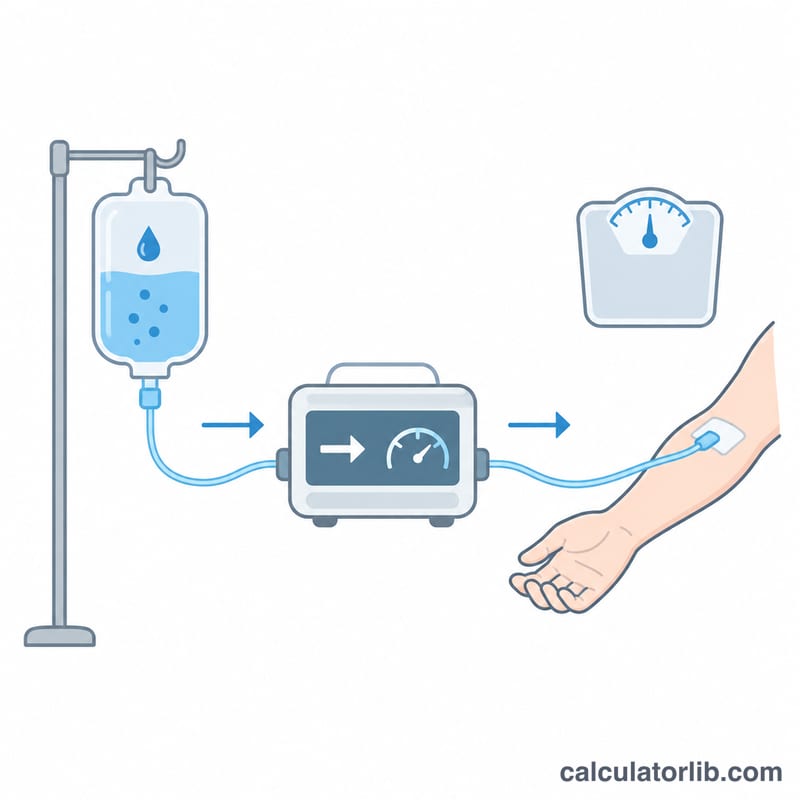
Heparin drips are ordered in units per kilogram, but an infusion pump is programmed in millilitres per hour. This calculator bridges that gap: enter the patient weight, the ordered bolus and infusion doses, and the strength of the premixed bag, and it returns the bolus in units and millilitres, the hourly unit dose, the pump rate in mL/hr, and the total heparin delivered in 24 hours. It is unit-system neutral and not tied to any country, but every number must still be checked against the local anticoagulation protocol.
How to use it
Enter the dosing weight in kilograms (many protocols use actual body weight, with an adjusted weight in obesity). Enter the bolus dose in units/kg and the maintenance dose in units/kg/hr; common venous thromboembolism orders are 80 units/kg bolus and 18 units/kg/hr, while acute coronary syndrome orders are often 60 and 12. Finally enter the bag contents, for example 25,000 units in 250 mL. Enter a bolus dose of 0 if no loading dose is ordered.
The formula explained
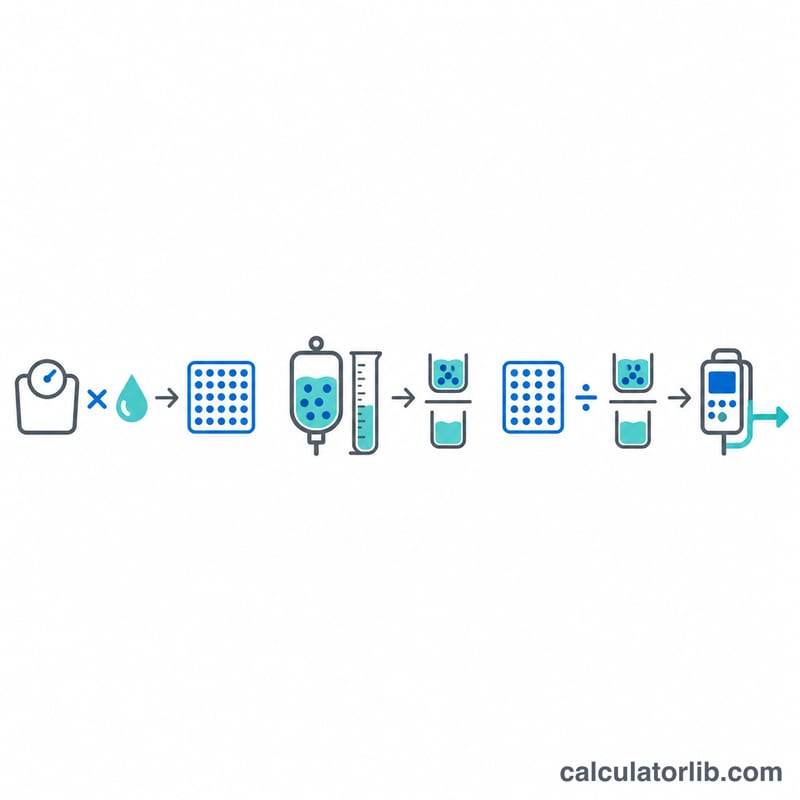
First find the concentration, where \(U\) = units in the bag and \(V\) = bag volume in mL:
$$C = \frac{U}{V}$$Then, with \(W\) = weight in kg, \(D_b\) = bolus dose in units/kg and \(D_i\) = infusion dose in units/kg/hr:
$$\text{Bolus} = W \times D_b \qquad R_u = W \times D_i \qquad R_{mL} = \frac{R_u}{C}$$The bolus volume is the bolus dose in units divided by the bag concentration (units/mL), i.e. the volume drawn from the bag.
Worked example
An 80 kg patient is ordered 80 units/kg bolus then 18 units/kg/hr from a 25,000 unit in 250 mL bag:
$$C = \frac{25000}{250} = 100\,\text{units/mL}$$$$\text{Bolus} = 80 \times 80 = 6400\,\text{units} = \frac{6400}{100} = 64\,\text{mL}$$$$R_u = 80 \times 18 = 1440\,\text{units/hr} \Rightarrow R_{mL} = \frac{1440}{100} = 14.4\,\text{mL/hr}$$That is 34,560 units over 24 hours.
Standard Heparin Protocol Doses and Bag Concentrations
Unfractionated heparin (UFH) infusions are almost always ordered as weight-based doses: a one-time bolus in units/kg and a continuous maintenance infusion in units/kg/hr. The table below shows dosing patterns that appear in widely used nomograms in the United States (for example the Raschke weight-based nomogram for venous thromboembolism and the ACC/AHA-style acute coronary syndrome nomograms). The numbers are illustrative of published protocols only — maximum doses, caps, dosing weight rules and aPTT/anti-Xa targets differ between hospitals, and your local institutional protocol and the prescriber's order always govern the actual dose.
| Indication | Bolus dose | Bolus cap | Infusion dose | Infusion cap |
|---|---|---|---|---|
| VTE / PE treatment (high-intensity) | 80 units/kg | Often 10,000 units | 18 units/kg/hr | Often 1,800 units/hr |
| ACS / NSTEMI (with antiplatelet therapy) | 60 units/kg | 4,000 units | 12 units/kg/hr | 1,000 units/hr |
| STEMI after fibrinolytic therapy | 60 units/kg | 4,000 units | 12 units/kg/hr | 1,000 units/hr |
| Lower-intensity / high bleeding risk, bridging, atrial fibrillation | Bolus often omitted | — | 12–15 units/kg/hr (some protocols start lower) | Per protocol |
Once the dose in units/hr is known, the pump rate depends only on the bag concentration \(C\) in units/mL:
$$C = \frac{\text{bag units}}{\text{bag volume (mL)}}, \qquad \text{Rate (mL/hr)} = \frac{\text{Weight (kg)} \times \text{Dose (units/kg/hr)}}{C}$$| Premixed bag | Concentration \(C\) | Rate for 1,260 units/hr | Bag volume used per 24 hr |
|---|---|---|---|
| 25,000 units / 250 mL | 100 units/mL | 12.6 mL/hr | 302 mL (>1 bag) |
| 25,000 units / 500 mL | 50 units/mL | 25.2 mL/hr | 605 mL (>1 bag) |
| 20,000 units / 500 mL | 40 units/mL | 31.5 mL/hr | 756 mL (>1 bag) |
| 10,000 units / 100 mL | 100 units/mL | 12.6 mL/hr | 302 mL |
Worked substitution for the 50 units/mL bag:
$$\text{Rate} = \frac{70\ \text{kg} \times 18\ \text{units/kg/hr}}{50\ \text{units/mL}} = \frac{1260\ \text{units/hr}}{50\ \text{units/mL}} = 25.2\ \text{mL/hr}$$Note that 25,000 units/250 mL and 10,000 units/100 mL are both 100 units/mL, so they run at the same mL/hr — only the bag change frequency differs. The 24-hour heparin requirement for this patient is \(24 \times 70 \times 18 = 30{,}240\) units.
This is general educational information about how the arithmetic works, not medical advice. Verify every dose, concentration and pump rate against the prescriber's order and your institution's protocol, and follow local independent double-check requirements for high-alert medications.
How Weight and Bag Strength Change the Pump Rate
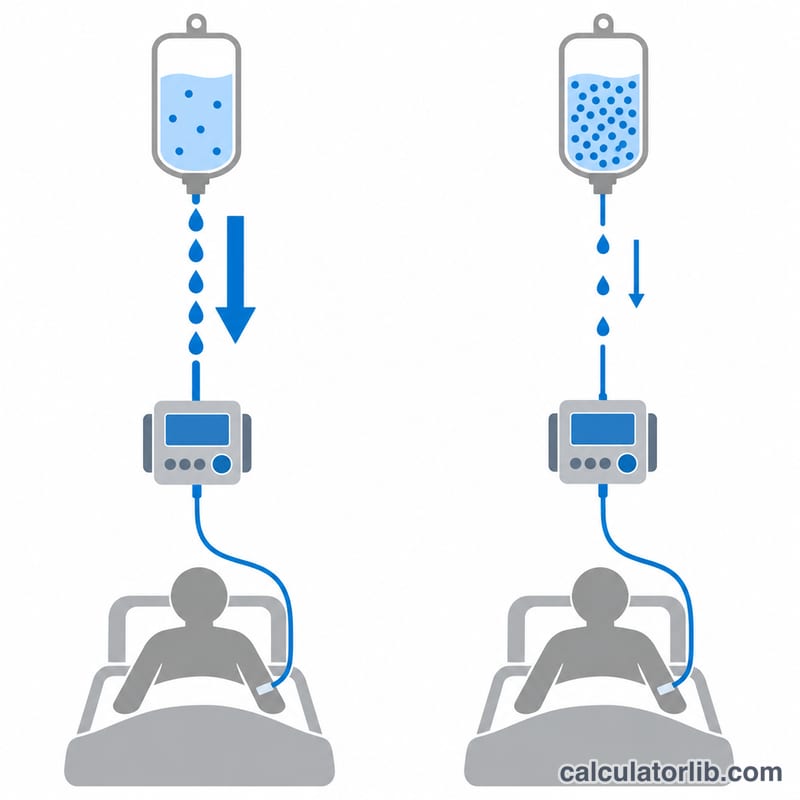
Two things drive the number you program into the pump: the patient's dosing weight (which sets units/hr) and the bag concentration (which converts units/hr into mL/hr). The same order can produce a pump rate that differs by more than a factor of two purely because of which premixed bag is hanging — one of the main reasons concentration must be confirmed on the label before every rate change.
| Weight | Dose | Units/hr | mL/hr @ 100 units/mL | mL/hr @ 50 units/mL | mL/hr @ 40 units/mL |
|---|---|---|---|---|---|
| 50 kg | 18 units/kg/hr | 900 | 9.0 | 18.0 | 22.5 |
| 70 kg | 18 units/kg/hr | 1,260 | 12.6 | 25.2 | 31.5 |
| 90 kg | 18 units/kg/hr | 1,620 | 16.2 | 32.4 | 40.5 |
| 120 kg | 18 units/kg/hr (uncapped) | 2,160 | 21.6 | 43.2 | 54.0 |
| 120 kg | 18 units/kg/hr, capped at 1,800 units/hr | 1,800 | 18.0 | 36.0 | 45.0 |
| 50 kg | 12 units/kg/hr | 600 | 6.0 | 12.0 | 15.0 |
| 70 kg | 12 units/kg/hr | 840 | 8.4 | 16.8 | 21.0 |
| 90 kg | 12 units/kg/hr (uncapped) | 1,080 | 10.8 | 21.6 | 27.0 |
| 90 kg | 12 units/kg/hr, capped at 1,000 units/hr (ACS-style) | 1,000 | 10.0 | 20.0 | 25.0 |
| 120 kg | 12 units/kg/hr (uncapped) | 1,440 | 14.4 | 28.8 | 36.0 |
The 120 kg row at 18 units/kg/hr is where a cap bites: the uncapped calculation gives \(120 \times 18 = 2160\) units/hr, but a protocol ceiling of 1,800 units/hr reduces the starting rate by about 17% — 21.6 mL/hr becomes 18.0 mL/hr on a 100 units/mL bag. The same thing happens one step earlier on ACS-style orders: at 12 units/kg/hr the 1,000 units/hr ceiling is already reached at roughly 83 kg, so every patient heavier than that starts at the same 1,000 units/hr regardless of weight. Caps of this kind are common in US protocols but the exact ceiling (or its absence) is institution-specific.
| Weight | Bolus @ 80 units/kg | Volume @ 100 units/mL | Volume @ 50 units/mL | Bolus @ 60 units/kg, capped at 4,000 units |
|---|---|---|---|---|
| 50 kg | 4,000 units | 40 mL | 80 mL | 3,000 units |
| 70 kg | 5,600 units | 56 mL | 112 mL | 4,000 units (capped from 4,200) |
| 90 kg | 7,200 units | 72 mL | 144 mL | 4,000 units (capped from 5,400) |
| 120 kg | 9,600 units | 96 mL | 192 mL | 4,000 units (capped from 7,200) |
Boluses are usually drawn from a concentrated vial and given by slow IV push rather than pulled from the infusion bag — the volumes above are shown only to make the unit conversion concrete and to highlight how large a bag-derived bolus would be. General educational information, not medical advice; follow the order and local protocol.
Key Terms and Variables
- Bolus (loading) dose — units, from units/kg
- A single dose given up front to reach a therapeutic blood level quickly, calculated as weight × bolus dose (e.g. 80 units/kg). Often capped (e.g. 4,000 or 10,000 units) and frequently omitted entirely in patients at high bleeding risk.
- Maintenance / infusion dose — units/kg/hr
- The continuous rate that keeps the anticoagulant effect steady after the bolus. Multiplying by weight gives units/hr; multiplying by 24 × weight gives the 24-hour total in units/day.
- Bag concentration \(C\) — units/mL
- Total heparin units in the bag divided by its volume: \(C = \text{bag units} \div \text{bag volume}\). A 25,000 units/500 mL premix is 50 units/mL. This is the single conversion factor between dose and pump rate.
- Units/hr vs mL/hr
- Units/hr is the pharmacologic dose and is what the order and the titration nomogram speak in. mL/hr is the volumetric rate the pump is programmed with, obtained by dividing units/hr by \(C\). The two are only equal when \(C = 1\) unit/mL, which never occurs in practice — so mixing them up is a classic and potentially large dosing error.
- Dosing weight — kg
- The weight actually used in the calculation. Many protocols use actual (total) body weight, but because heparin distributes poorly into fat, some institutional protocols switch to an adjusted body weight or cap the dosing weight (for example above a BMI threshold or above roughly 100–150 kg) in obesity. Which rule applies is a local protocol decision, not a universal one.
- Unfractionated heparin (UFH)
- The heparin given as a continuous IV drip in units; short half-life (on the order of 1–2 hours at therapeutic doses), monitored by laboratory testing, and reversible with protamine. This is the drug this calculator addresses.
- Low-molecular-weight heparin (LMWH)
- Fractionated heparins such as enoxaparin or dalteparin, given subcutaneously in mg or units per kg at fixed intervals, with predictable kinetics and usually no routine monitoring. LMWH doses are not interchangeable with the units/hr figures here.
- aPTT — activated partial thromboplastin time, seconds
- A clotting time test traditionally used to monitor UFH. The therapeutic aPTT band is reagent- and analyzer-specific and must be calibrated locally, which is why a target range quoted at one hospital may not apply at another.
- Anti-Xa level — IU/mL
- A direct measure of heparin activity against factor Xa, increasingly used instead of aPTT for UFH monitoring because it is less affected by acute-phase proteins, lupus anticoagulant and baseline coagulopathy. Therapeutic ranges for UFH are commonly expressed in IU/mL and defined by the local laboratory.
- Therapeutic range
- The aPTT or anti-Xa window in which anticoagulation is considered effective without excess bleeding risk. Results above it prompt rate reduction or a brief hold; results below it prompt a rebolus and/or a rate increase, per the titration nomogram.
- Protocol cap / ceiling
- A maximum bolus (units) or maximum infusion rate (units/hr) written into the order set — e.g. 4,000 units and 1,000 units/hr on ACS-style orders, or 1,800 units/hr on some VTE orders. Above the corresponding weight, the weight-based formula is overridden by the flat cap.
These definitions are general educational information, not medical advice, and no part of this page is a recommendation for any individual patient. Heparin is a high-alert medication: dosing, dosing weight, monitoring test, therapeutic range and titration steps must come from the prescriber's order and your institution's protocol.
FAQ
Why does the mL/hr rate change when I change the bag? The unit dose stays the same, but a 20,000 unit in 500 mL bag is only 40 units/mL, so the pump must run about 2.5 times faster to deliver the same units.
Should the bolus be capped? Many protocols cap the bolus (for example at 10,000 units) and the starting rate (for example at 1,800 units/hr). This tool shows the raw weight-based result, so apply your protocol ceiling manually.
How is the rate titrated afterwards? By aPTT or anti-Xa level at the interval your protocol specifies, usually 6 hours after starting or after any rate change. This calculator sets the starting point only.