
What is the SAG Calculator?
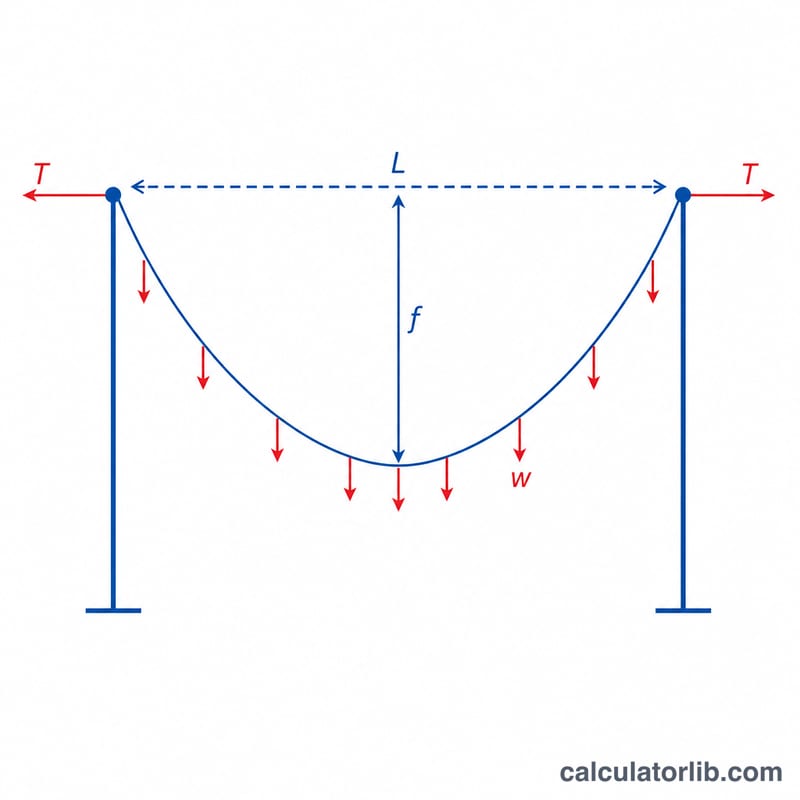
The SAG Calculator estimates how far a cable, wire, or transmission conductor dips at the middle of a span. When a cable is strung between two supports it forms a curve under its own weight. For shallow spans this curve is closely approximated by a parabola, and the lowest point — the sag — depends on the cable's weight per unit length, the horizontal distance between supports, and the horizontal tension pulling it taut.
How to use it
Enter three values: the weight per unit length w (in newtons per metre), the span L (the horizontal distance between supports, in metres), and the horizontal tension T (in newtons). The calculator returns the midspan sag in metres and an estimate of the total cable length needed.
The formula explained
The classic parabolic sag relation is:
$$S = \frac{\text{Weight } w \cdot \text{Span } L^{2}}{8 \cdot \text{Tension } T}$$
Sag grows with the square of the span and with cable weight, but shrinks as tension increases. Higher tension flattens the curve but raises stress on the supports and conductor — engineers balance the two. The approximate cable length adds the extra material the curve requires: \(L_{c} \approx L + \frac{8s^{2}}{3L}\).
Worked example
A conductor weighs 1.5 N/m, spans 100 m, and is held at 5000 N horizontal tension. Then $$\text{sag} = \frac{1.5 \times 100^{2}}{8 \times 5000} = \frac{15000}{40000} = \mathbf{0.375 \text{ m}}$$ The cable length is about \(100 + \frac{8(0.375)^{2}}{3 \times 100} = 100 + \frac{1.125}{300} \approx 100.00375 \text{ m}\).
FAQ
Does this work for power lines? Yes — the parabolic approximation is standard for overhead transmission and distribution conductors with shallow sag. For very deep sags the exact catenary equation is more accurate.
What units should I use? Keep them consistent: weight in N/m, span and sag in metres, tension in N. You can use any consistent system as long as w, L, and T match.
Why does higher tension reduce sag? Tension is the horizontal force resisting the cable's weight; more pull holds the cable closer to a straight line, reducing how far it droops.