
What Is the Joules to Volts Calculator?
This calculator converts electrical energy measured in joules (J) into voltage measured in volts (V), given the amount of electric charge in coulombs (C). It is based on the fundamental relationship between energy, charge, and electric potential, making it useful for students, electricians, and engineers working with capacitors, batteries, and electrical circuits.
How to Use It
Enter the energy in joules and the charge in coulombs, then read the resulting voltage. For example, a capacitor storing 100 joules across a charge of 5 coulombs produces a potential difference of 20 volts. The tool handles decimals and large numbers and guards against division by zero.
The Formula Explained
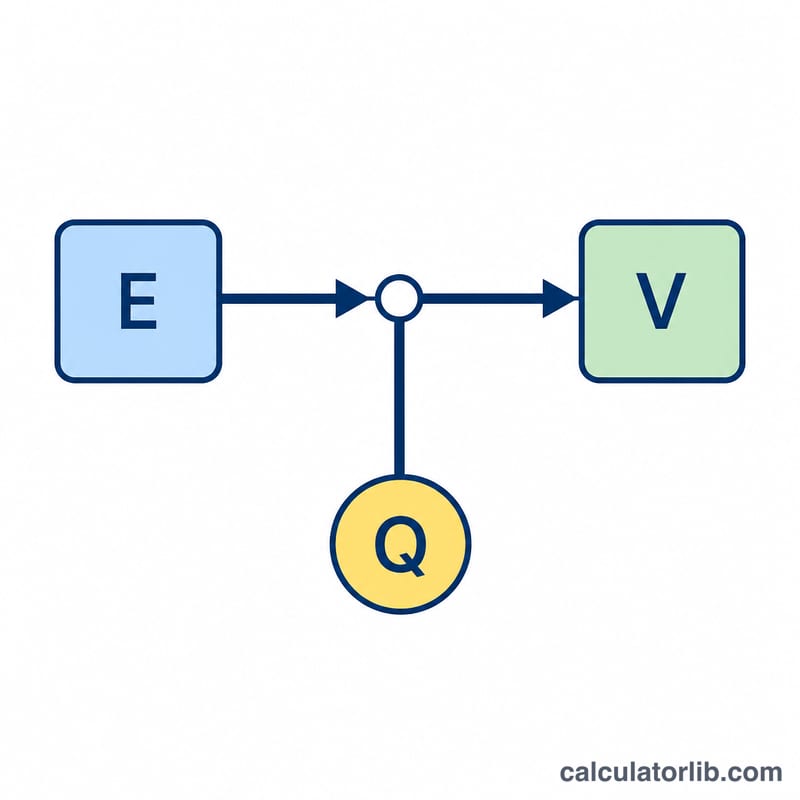
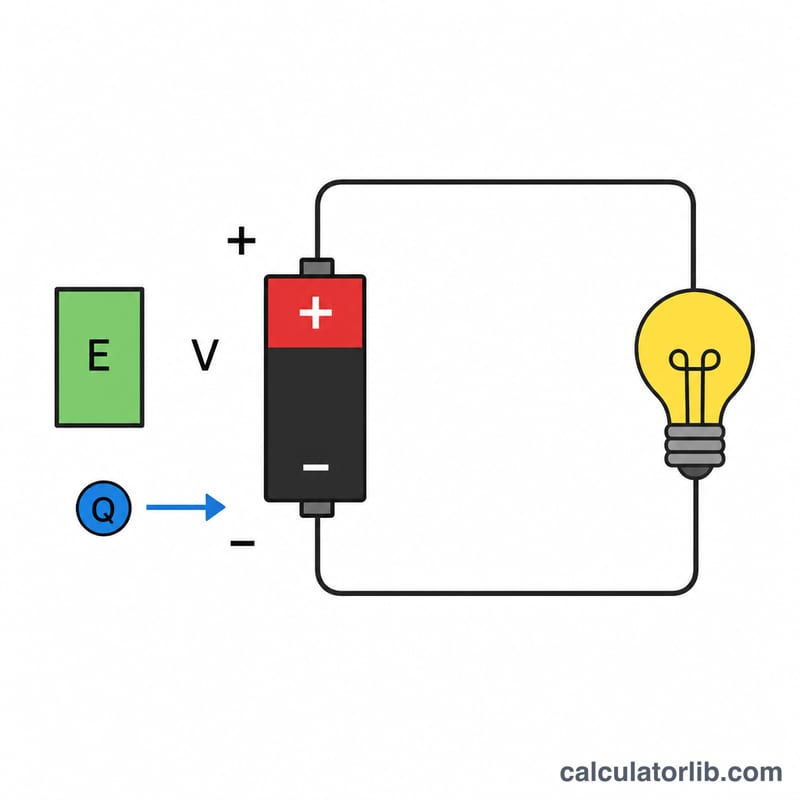
The voltage equation is $$V = \frac{E}{Q}$$ where \(V\) is voltage in volts, \(E\) is energy in joules, and \(Q\) is charge in coulombs. One volt is defined as one joule of energy per coulomb of charge. Voltage therefore expresses how much energy each unit of charge carries through a circuit.
Worked Example
Suppose a device delivers 240 joules of energy moving 12 coulombs of charge. The voltage is $$V = \frac{240}{12} = 20 \text{ volts}.$$ This means each coulomb of charge carries 20 joules of energy.
FAQ
Can I convert joules directly to volts? No — you also need the charge in coulombs, because volts measure energy per unit charge.
What if the charge is zero? Voltage is undefined when charge is zero, so the calculator returns 0 to avoid dividing by zero.
Is this the same as power? No. Power (watts) is energy per unit time, while voltage here is energy per unit charge.