What is a bolt circle?
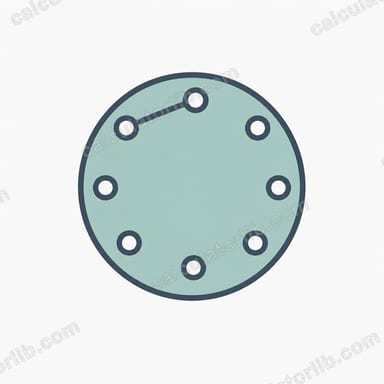
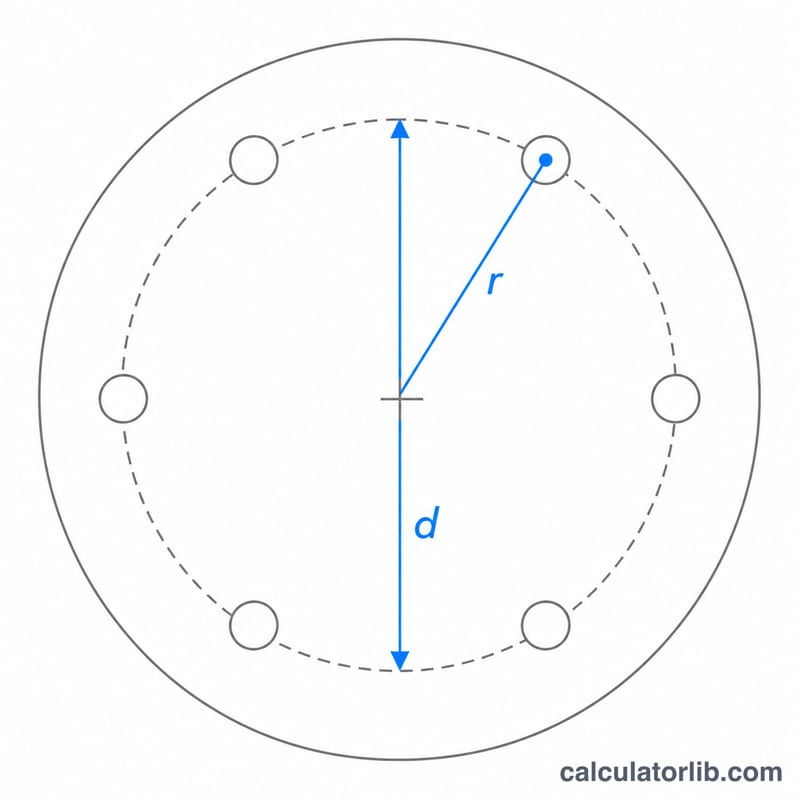
A bolt circle (also called a pitch circle diameter, PCD, or bolt pattern) is the imaginary circle on which the centers of evenly spaced holes lie. Flanges, wheel hubs, pipe fittings, motor mounts and indexing plates all use them. Machinists running a mill, CNC router or drill press need the exact X and Y position of every hole, and this calculator produces that coordinate table instantly.
How to use the calculator
Enter the number of holes, the bolt circle diameter, the angle of the first hole, and the coordinates of the circle center. Choose counterclockwise (standard math convention) or clockwise numbering. The result lists every hole with its angle and X/Y position, plus the angular spacing and the straight-line distance between neighbouring holes. Coordinates use the same unit as the diameter, so millimetres in means millimetres out.
The formula explained
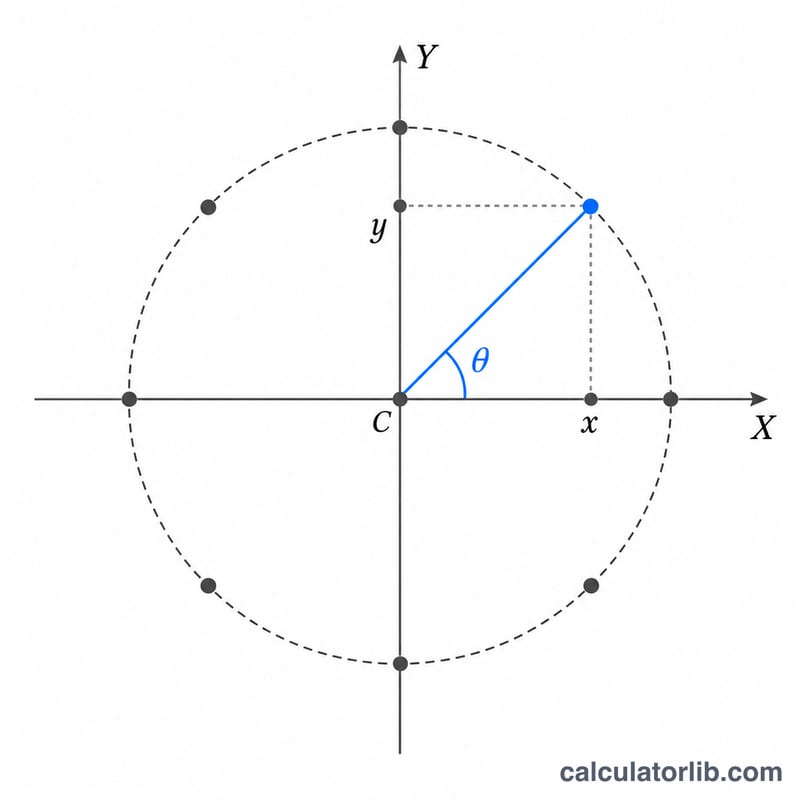
The holes are separated by an equal angle \(360^\circ / n\). Hole \(i\) (counting from 0) sits at angle \(\theta_i\), and its position follows from polar-to-Cartesian conversion:
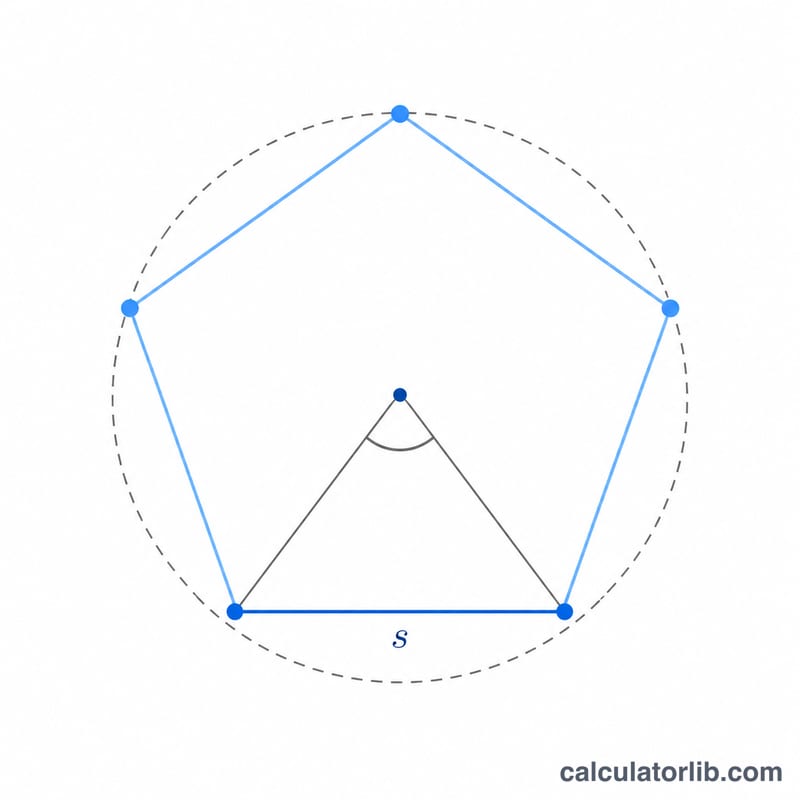
$$X_i = c_x + \frac{D}{2}\cos\theta_i, \qquad Y_i = c_y + \frac{D}{2}\sin\theta_i, \qquad \theta_i = \theta_0 + \frac{360^\circ\, i}{n}$$Here \(D\) is the bolt circle diameter, \((c_x, c_y)\) is the center, \(\theta_0\) is the start angle measured from the positive X axis, and \(n\) is the hole count. The chord spacing between adjacent holes is \(s = D\sin(180^\circ/n)\).
Worked example
Six holes on an 80 mm circle centered at (10, 20), with the first hole at 30°. The radius is 40 and the spacing is 60°. For the first hole:
$$X_1 = 10 + 40\cos 30^\circ = 10 + 34.641 = 44.641$$$$Y_1 = 20 + 40\sin 30^\circ = 20 + 20 = 40$$The second hole sits at 90°, giving \((10, 60)\). The chord spacing is \(80 \sin 30^\circ = 40\,\text{mm}\).
Angle Spacing and Chord Factors by Hole Count
When holes are spaced evenly on a bolt circle, the angle between neighbouring holes depends only on the hole count \(n\). The straight-line distance between the centres of two neighbouring holes (the chord) is the circle diameter multiplied by a fixed factor:
$$\Delta\theta = \frac{360^\circ}{n}, \qquad c = D \cdot \sin\!\left(\frac{180^\circ}{n}\right)$$| Hole count n | Angular spacing 360°/n | Chord factor sin(180°/n) |
|---|---|---|
| 3 | 120° | 0.86603 |
| 4 | 90° | 0.70711 |
| 5 | 72° | 0.58779 |
| 6 | 60° | 0.50000 |
| 8 | 45° | 0.38268 |
| 10 | 36° | 0.30902 |
| 12 | 30° | 0.25882 |
| 16 | 22.5° | 0.19509 |
| 24 | 15° | 0.13053 |
Note: chord spacing = D × factor, in the same unit as D. For example, an 8-hole pattern on a 100 mm circle gives \(c = 100 \times 0.38268 = 38.268\) mm between neighbouring hole centres. The chord is what you measure with calipers between two holes. It is always shorter than the arc length along the circle.
FAQ
Where is zero degrees?
Zero degrees points along the positive X axis (3 o'clock). Positive angles turn counterclockwise unless you select clockwise. To put the first hole at 12 o'clock, enter a start angle of 90.
Why use the chord spacing?
The chord is the straight distance between neighbouring hole centers. It lets you check a layout with calipers or set dividers when no CNC machine is available.
Does the unit matter?
No. The math works in any unit; the output simply uses the unit of your diameter and center values.