What this calculator does
This calculator is built for homes in the United States. It uses the US Department of Energy climate zones and ENERGY STAR recommended attic R-values: R30 for Zone 1, R49 for Zones 2 and 3, and R60 for Zones 4 through 7. These figures reflect common guidance and may differ from your local building code, so check local requirements before you buy materials. You can also enter your own target R-value.
How to use it
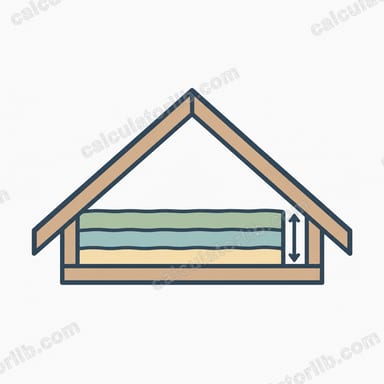
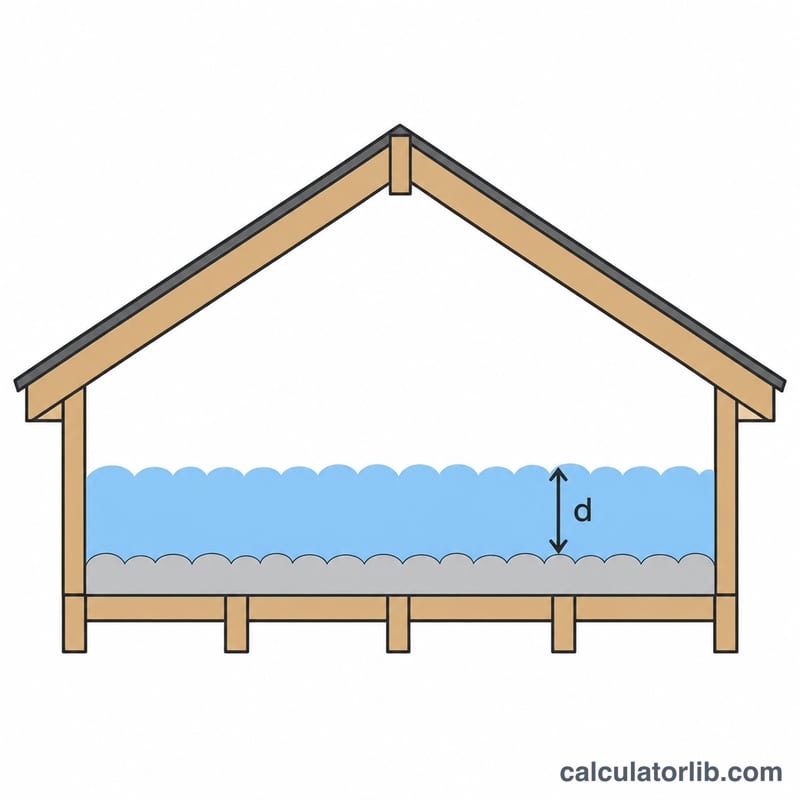
Enter your attic floor area, pick your climate zone, then describe what is already in the attic (type and depth in inches). Choose the new insulation you plan to add. The tool returns the extra depth in inches, the total finished depth, the percentage of the target already met, and the volume of new material in cubic feet.
The formula explained
R-value measures resistance to heat flow, and for a uniform layer it scales with thickness. Existing R-value is the existing depth times its R per inch. The shortfall is divided by the R per inch of the new material:
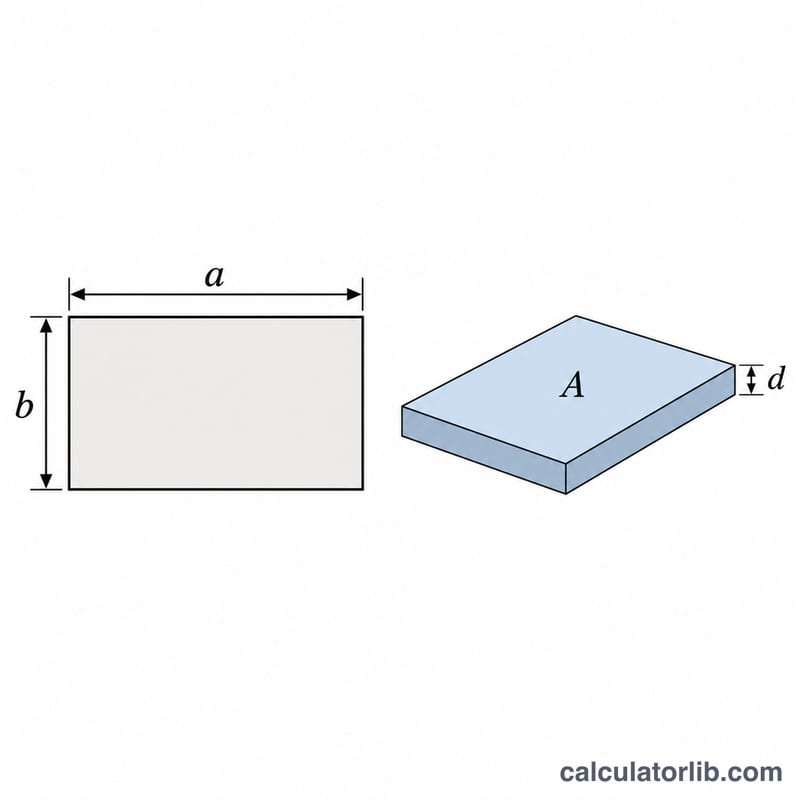
$$d_{\text{add}} = \max\left(0,\ \frac{R_{\text{target}} - d_{\text{existing}} \times r_{\text{existing}}}{r_{\text{new}}}\right)$$Volume is then \(V = A \times d_{\text{add}} / 12\), where \(A\) is the area in square feet and depth is in inches. Typical values used: blown cellulose 3.5, blown fiberglass 2.5, fiberglass batt 3.2, open-cell foam 3.7 and closed-cell foam 6.5 R per inch.
Worked example
A 1,000 sq ft attic in Zone 4 has no insulation, and you plan to blow in cellulose. The target is R60:
$$d_{\text{add}} = \frac{60 - 0}{3.5} = 17.14\,\text{in}$$$$V = \frac{1000 \times 17.14}{12} = 1428.6\,\text{ft}^3$$That is roughly 17 inches of cellulose, about 1,429 cubic feet of material.
R-Value Per Inch by Insulation Type
The table lists typical R-value per inch for common attic insulation and the depth needed to reach three common targets. Depth is calculated as \(d = R_{target} / r_{per\ inch}\). Values are typical and vary by manufacturer, density and installation quality, so check the product label or coverage chart for the exact figure.
| Insulation type | R per inch | Inches for R30 | Inches for R49 | Inches for R60 |
|---|---|---|---|---|
| Blown cellulose | 3.5 | 8.6 | 14.0 | 17.1 |
| Blown fiberglass | 2.5 | 12.0 | 19.6 | 24.0 |
| Fiberglass batt | 3.2 | 9.4 | 15.3 | 18.8 |
| Open-cell spray foam | 3.7 | 8.1 | 13.2 | 16.2 |
| Closed-cell spray foam | 6.5 | 4.6 | 7.5 | 9.2 |
Loose-fill insulation settles over time, so the installed depth is often a little more than the minimum shown. Inches are rounded to one decimal place.
Recommended Attic R-Values by Climate Zone
These are ENERGY STAR recommendations for attics in the United States, based on the U.S. Department of Energy (DOE) climate zones. The example regions are approximate, because zone boundaries often follow county lines and a single state can span several zones.
| DOE climate zone | Recommended attic R-value | Example regions |
|---|---|---|
| 1 | R30 | Hawaii, southern tip of Florida, Puerto Rico |
| 2 | R49 | Gulf Coast, southern Texas, much of Florida, southern Arizona |
| 3 | R49 | Georgia, Alabama, the Carolinas, northern Texas, Southern California |
| 4 | R60 | Virginia, Kentucky, Missouri, Maryland, the Pacific Northwest coast |
| 5 | R60 | Illinois, Ohio, Pennsylvania, Nebraska, Colorado, upstate New York |
| 6 | R60 | Minnesota, Wisconsin, Montana, Vermont, Maine |
| 7 | R60 | Northern Minnesota, northern Maine, parts of Alaska |
These figures are recommendations, not legal requirements. Your local building code or utility rebate program may require a different R-value, so check with your local building department. You can also enter a custom target R-value in the calculator.
FAQ
Does loose-fill insulation settle?
Yes. Blown cellulose and fiberglass settle over time, so installers often size by the settled depth printed on the bag coverage chart. Treat the result as the settled depth you want.
Can I mix insulation types?
Yes. R-values of stacked layers add together, which is how this calculator treats existing plus new insulation. Avoid compressing the existing layer, because that lowers its R per inch.
Do I need to account for air sealing?
Insulation works best after air leaks around wiring, pipes, and hatches are sealed. This calculator covers thermal resistance only, not air leakage or ventilation.