
What is the Insulation Calculator?
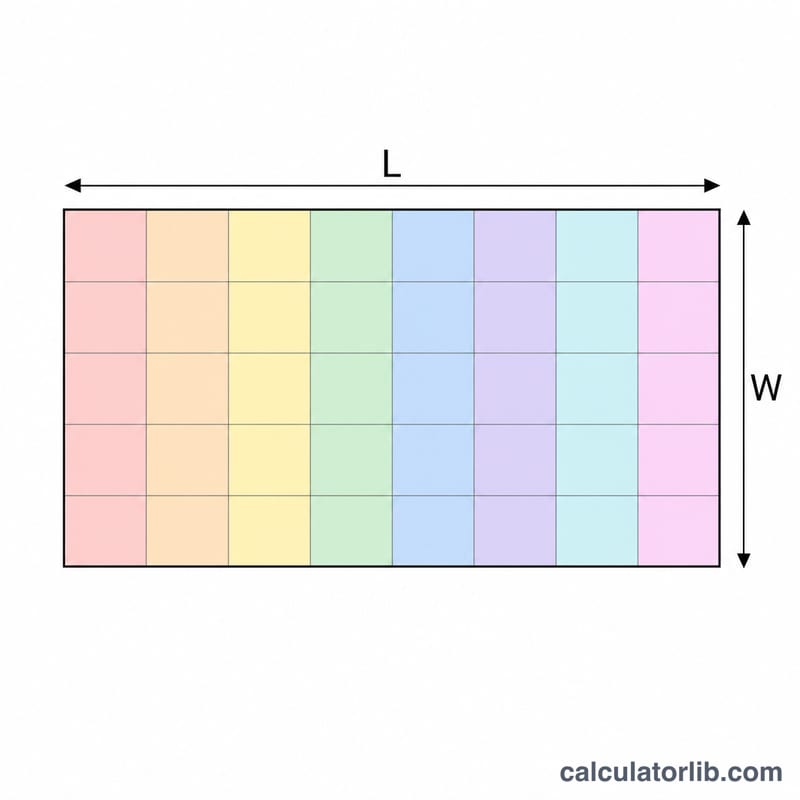
This calculator estimates how many bags of blown-in or batt insulation you need to cover a given space. It multiplies the length and width of the area to get the total square footage, then divides by the coverage rating printed on each bag and rounds up — because you can only buy whole bags.
How to use it
Measure the area you want to insulate in feet and enter the length and width. Then read the coverage per bag from the product label (manufacturers list square feet covered at a target R-value) and enter that value. The result shows the total area and the number of bags to buy.
The formula explained
First, \( \text{area} = \text{length} \times \text{width} \). Then $$\text{Bags} = \left\lceil \frac{\text{Length (ft)} \times \text{Width (ft)}}{\text{Coverage per bag (sq ft)}} \right\rceil$$ The ceiling function rounds any fraction up to the next whole number so you never come up short. For irregular rooms, break the space into rectangles, calculate each, and add the areas before dividing.
Worked example
Suppose your attic floor is 30 ft long and 20 ft wide, giving an area of 600 sq ft. If each bag covers 40 sq ft at your desired R-value, then \( 600 \div 40 = 15 \) exactly, so you need 15 bags. If the area were 610 sq ft, \( 610 \div 40 = 15.25 \), which rounds up to 16 bags.
FAQ
Does coverage depend on R-value? Yes. Bag labels list different coverage figures for different target R-values — more insulation depth means fewer square feet per bag. Use the figure for your goal.
Should I add extra? It's wise to buy one extra bag to account for settling, waste, and measurement error.
What units does this use? The example uses feet and square feet, but any consistent unit works as long as the coverage value is in the same square units as length × width.