
What is borrowing power?
Borrowing power is the largest loan a lender would be likely to approve for you, given your income, living costs, existing debts and the interest rate. This calculator gives a planning estimate; actual lender criteria, fees and assessment rates vary.
How to use this calculator
Enter your annual gross income, typical monthly living expenses and any existing monthly debt payments such as car loans or credit cards. Then enter the interest rate, the loan term in years and the maximum debt-to-income (DTI) ratio you want to use. Many lenders use a limit around 36 to 43 percent, but check the figure that applies to you.
The formula explained
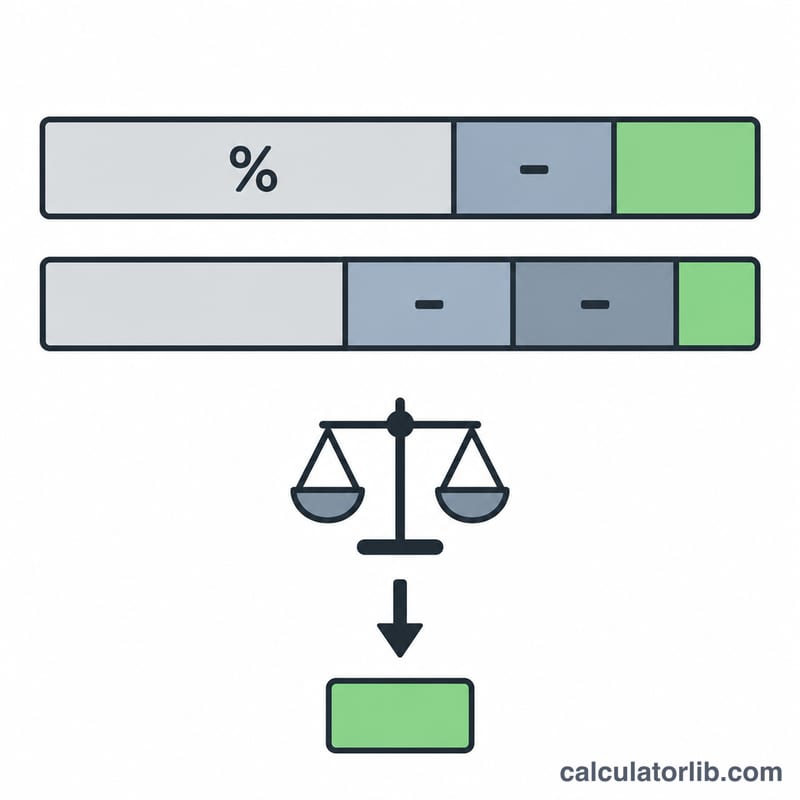
First we work out the largest monthly payment you can support. It is the smaller of two limits: the DTI allowance and your monthly surplus.
$$P = \min\left(\frac{I}{12} \times D - B,\ \frac{I}{12} - E - B\right)$$Then the payment is converted into a loan amount with the annuity formula:
$$L = P \times \frac{1-(1+r)^{-n}}{r}$$Here \(r\) is the monthly interest rate (annual rate divided by 12 and by 100) and \(n\) is the number of monthly payments. If the rate is zero, the loan is simply \(P \times n\).
Worked example
Income of 90,000 per year, expenses of 2,000 per month, existing debts of 500 per month, a 6% rate, a 30-year term and a 36% DTI limit. Monthly income is 7,500.
$$P = \min(7500 \times 0.36 - 500,\ 7500 - 2000 - 500) = \min(2200,\ 5000) = 2200$$$$L = 2200 \times \frac{1-1.005^{-360}}{0.005} \approx 2200 \times 166.79 \approx 366{,}942$$So the estimated borrowing power is about 366,942.
Typical Debt-to-Income Limits
Debt-to-income (DTI) ratio compares your monthly debt payments with your gross monthly income. The calculator uses the DTI limit you enter, so it helps to know the benchmarks lenders commonly cite. These are general guidelines, not rules that apply everywhere. Limits vary by lender, loan type, and jurisdiction.
| Benchmark | Typical figure | What it refers to |
|---|---|---|
| Front-end (housing) ratio | about 28% | Housing costs (loan payment, and often taxes and insurance) as a share of gross income, from the traditional "28/36" guideline used in the US |
| Back-end (total debt) ratio | about 36% | All monthly debt payments, including the new loan, as a share of gross income, from the same "28/36" guideline |
| US qualified-mortgage reference point | 43% | A commonly cited total DTI threshold in the United States. Current US rules put more weight on price-based and underwriting criteria, and some lenders and loan programs allow higher ratios |
How to use these figures
- Conservative: 28%–36% leaves more room for other spending and for rate rises.
- Common mainstream range: roughly 36%–43% is often seen in standard lending.
- Above 43%: some lenders approve it with strong credit, savings, or other compensating factors, but approval is less certain and the budget is tighter.
Other countries use different methods. Some regulators and lenders in the UK, Australia, Canada, and the EU rely on detailed expense assessments, stress-test rates, or DTI caps instead of one fixed percentage. Check the rules of your own country and the policy of your lender.
This calculator applies the lower of two limits: the DTI-based payment and your income minus expenses and debts. The result is an estimate. It is general information, not financial advice, and it is not a loan approval.
Key Terms Explained
- Borrowing power
- The maximum loan amount a lender might offer, based on your income, expenses, existing debts, the interest rate, and the loan term.
- Gross income
- Your income before tax and other deductions. DTI limits are usually applied to gross income, though some lenders assess net income instead.
- Debt-to-income ratio (DTI)
- Monthly debt payments divided by gross monthly income, expressed as a percentage. For example, $1,800 of payments on $5,000 monthly income is a DTI of 36%.
- Monthly surplus
- Money left each month after living expenses and existing debt payments. In this calculator it equals monthly income minus expenses minus debts, and it caps the payment you can afford.
- Loan term
- The length of time over which the loan is repaid, usually in years. A longer term lowers the monthly payment and so raises the amount you can borrow, but total interest paid is higher.
- Interest rate (nominal annual vs monthly)
- The nominal annual rate is the quoted yearly percentage. The monthly rate used in the calculation is the annual rate divided by 12 (here, rate % ÷ 1200 as a decimal). It does not account for compounding within the year.
- Annuity payment
- A fixed payment made every period, with each payment covering interest plus some principal. The loan amount is the present value of these payments: \(L = P \cdot \frac{1-(1+r)^{-n}}{r}\).
- Assessment / stress-test rate
- A higher rate than the actual loan rate, which some lenders or regulators use to test whether you could still afford repayments if rates rose. Entering a higher rate in the calculator gives a more cautious estimate.
FAQ
Does this guarantee loan approval?
No. Lenders also consider credit history, deposit, employment and their own stress-test rates. Treat the result as an estimate.
Why use gross income?
DTI limits are usually defined on gross income. The surplus check is a second safeguard so that expenses are also covered.
How does the interest rate change the result?
A higher rate lowers the loan a given payment can support, so borrowing power falls as rates rise.