
What This Calculator Does
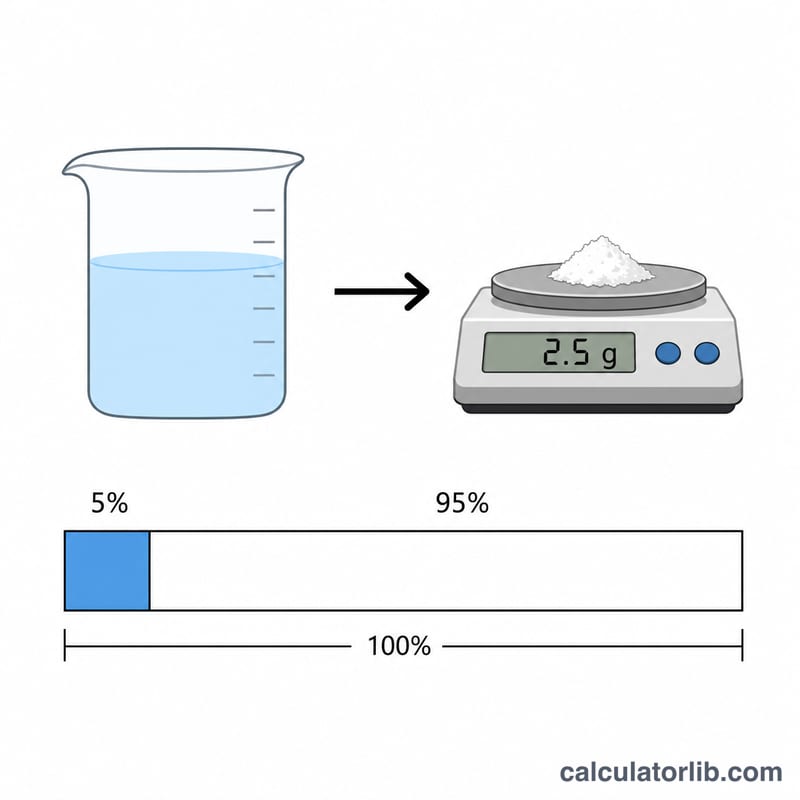
This tool converts a mass percent concentration (% w/w) and a total solution mass into the actual mass of dissolved solute in grams. It also reports the mass of solvent. Mass percent expresses how many grams of solute are present per 100 grams of total solution, making it a unit-independent, temperature-stable way to describe concentration.
How to Use It
Enter the mass percent of the solute (for example, 10 for a 10% w/w solution) and the total mass of the solution in grams. The calculator instantly returns the mass of solute and the mass of solvent. Both inputs accept decimals, so you can model precise laboratory recipes.
The Formula Explained
The relationship is straightforward: mass of solute = (% w/w ÷ 100) × mass of solution. Dividing the percentage by 100 converts it to a fraction; multiplying by the total solution mass gives the portion that is solute. The solvent mass is simply the leftover: total solution mass minus solute mass.
$$\text{Mass of Solute} = \frac{\text{Mass Percent (\%)}}{100} \times \text{Mass of Solution (g)}$$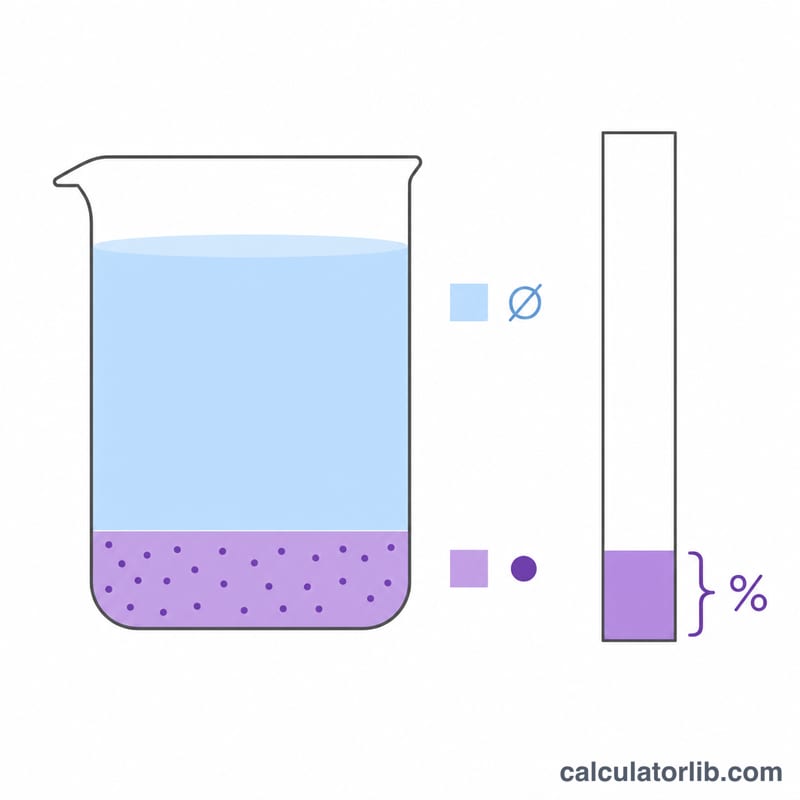
Worked Example
Suppose you have 200 g of a 10% w/w saline solution. Multiply: $$(10 \div 100) \times 200 = 0.10 \times 200 = 20 \text{ g of solute}$$ (salt). The remaining \(200 - 20 = 180\) g is solvent (water). So 20 g of salt dissolved in 180 g of water gives 200 g of a 10% w/w solution.
FAQ
Is mass percent the same as weight percent? Yes. "% w/w" (weight/weight) and mass percent are used interchangeably and both compare solute mass to total solution mass.
Does temperature affect mass percent? No. Because it is based on mass rather than volume, mass percent does not change with temperature, unlike molarity.
What is the difference between solution and solvent mass? Solution mass is the total (solute + solvent). Solvent mass is just the dissolving medium. This calculator gives you both the solute and solvent portions.