What this calculator does
The Mass of Substance Calculator finds how many grams of a solute are contained in a solution when you know its molar concentration, its volume, and the molar mass of the substance. It is a staple of everyday chemistry, letting you convert quickly between amount of substance and mass without manual arithmetic.
The formula explained
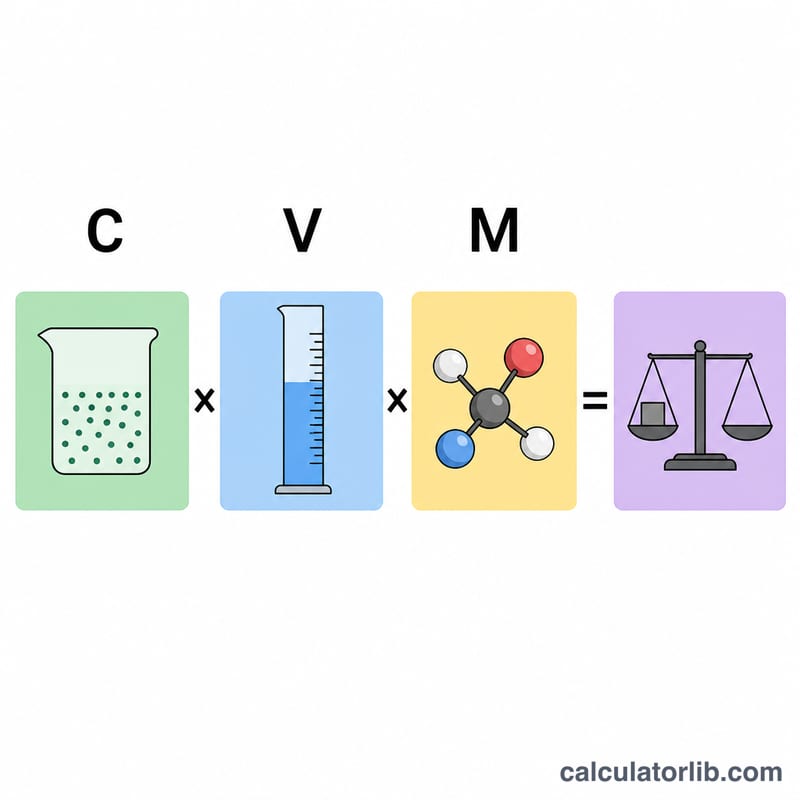
The calculation combines two simple relationships. The amount of substance is \(n = c \times V\), and mass is \(m = n \times M\). Substituting one into the other gives the single working equation:
$$m = c \times V \times M$$
where \(c\) = molar concentration in mol/L, \(V\) = volume in litres (L), \(M\) = molar mass in g/mol, and \(m\) = mass in grams. Keep the units consistent: if your volume is given in millilitres, divide by 1000 to convert to litres first.
How to use it
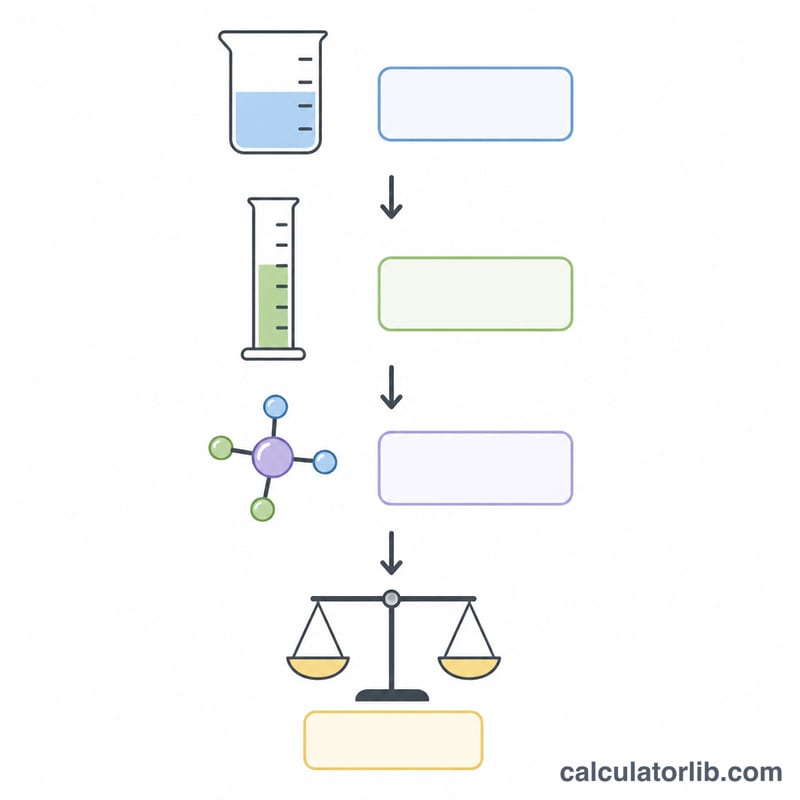
Enter the concentration of your solution, the volume you are preparing or analysing, and the molar mass of the dissolved compound (the sum of the atomic masses in its chemical formula). The calculator returns the mass of solute together with the amount of substance in moles.
Worked example
Suppose you dissolve sodium chloride to make a 0.5 mol/L solution and you have 2 L of it, with a molar mass of 58.44 g/mol:
$$m = 0.5 \times 2 \times 58.44 = 58.44\,\text{g}$$
So the solution contains 58.44 g of NaCl, corresponding to \(n = 0.5 \times 2 = 1\) mol.
Common Molar Masses
The molar mass \(M\) (in grams per mole, g/mol) is the mass of one mole of a substance and is one of the three inputs in \(m = c \times V \times M\). The values below are calculated from standard atomic weights and are rounded to two decimal places; small differences between sources reflect rounding or updated atomic-weight values.
| Compound | Chemical formula | Molar mass (g/mol) |
|---|---|---|
| Water | H₂O | 18.02 |
| Sodium hydroxide | NaOH | 40.00 |
| Sodium chloride | NaCl | 58.44 |
| Potassium chloride | KCl | 74.55 |
| Calcium carbonate | CaCO₃ | 100.09 |
| Copper(II) sulfate | CuSO₄ | 159.61 |
| Glucose | C₆H₁₂O₆ | 180.16 |
To find the mass dissolved, multiply the molar mass by the solution's concentration and volume. For example, preparing 0.5 L of a 0.1 mol/L NaCl solution requires \(m = 0.1 \times 0.5 \times 58.44\), giving 2.922 g of sodium chloride.
FAQ
What units should I use? Concentration in mol/L, volume in litres, and molar mass in g/mol give mass in grams.
How do I find molar mass? Add the atomic masses of every atom in the compound formula, e.g. water \(H_2O\) is about 18.02 g/mol.
Can I use millilitres? Convert to litres first by dividing by 1000, since the formula assumes volume in litres.