What this converter does
This tool estimates what a sum of money from 1936 Republic-era China, when the national fabi yuan circulated, might be worth today. It gives the result in modern Chinese renminbi (CNY) and in Macau patacas (MOP). It is a historical estimate, not an official conversion, because no single exchange rate links the 1936 currency to today.
How to use it
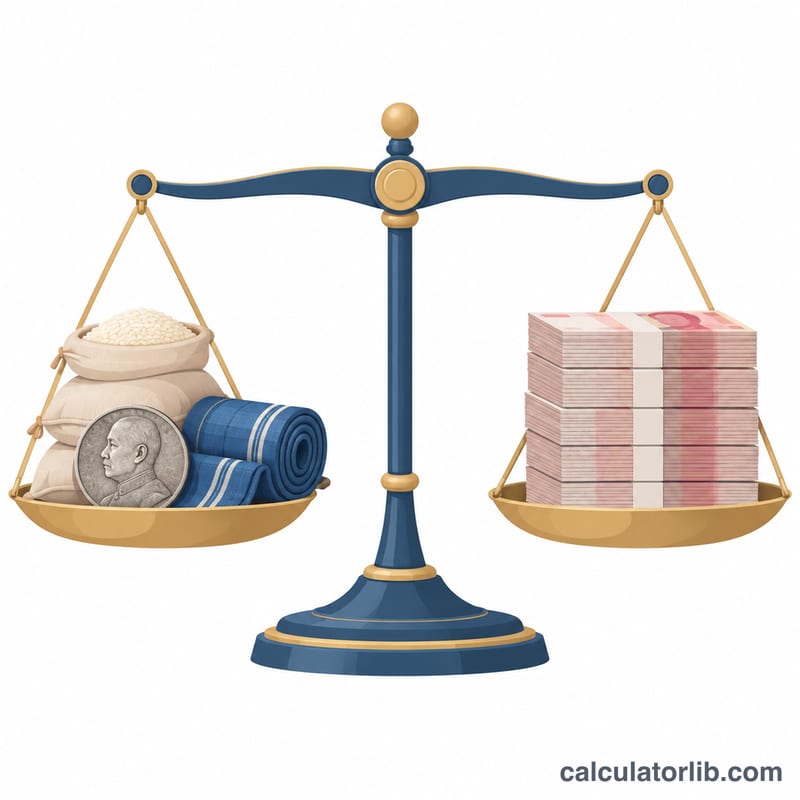
Enter the amount in 1936 yuan. Then choose a purchasing-power multiplier, meaning how many modern yuan you consider equal to one 1936 yuan. The default of 40 is an adjustable illustrative assumption, not an official figure. Finally enter the current MOP per CNY rate; the default of 1.12 is a rough value, so check a live rate before relying on it.
The formula explained
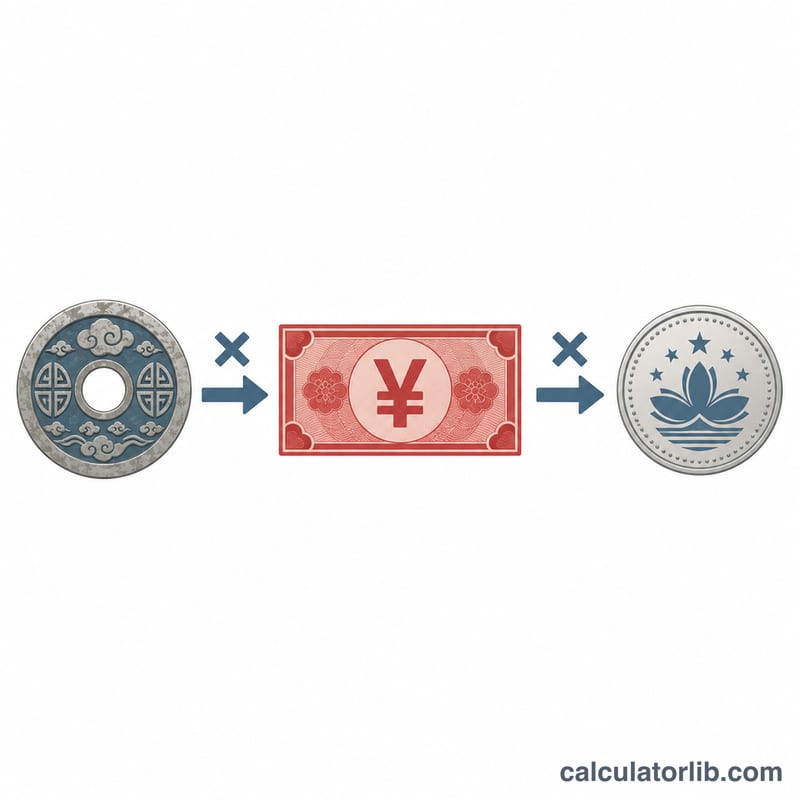
The calculation has two steps. First the 1936 amount is scaled by the multiplier, then the modern yuan figure is converted to pataca:
$$\text{CNY}_{modern} = A \times M, \qquad \text{MOP} = \text{CNY}_{modern} \times R$$Here \(A\) = amount in 1936 yuan, \(M\) = modern CNY per 1936 yuan, and \(R\) = MOP per CNY.
Worked example
Suppose a 1936 salary was 100 yuan, with \(M = 40\) and \(R = 1.12\):
$$\text{CNY}_{modern} = 100 \times 40 = 4000$$$$\text{MOP} = 4000 \times 1.12 = 4480$$So 100 yuan in 1936 corresponds to about 4,000 CNY or 4,480 MOP under these assumptions.
Comparing Different Multiplier Scenarios
The multiplier is the most uncertain input in this converter. The table below converts the same sum, 100 yuan from 1936, using four illustrative multipliers and a fixed rate of 1.12 MOP per CNY. The multipliers are assumptions chosen to show how much the answer depends on method (for example a wage-based comparison, a rice-price comparison or a general price index). They are not official figures.
| Illustrative multiplier | Possible basis (assumption) | Modern CNY | Modern MOP |
|---|---|---|---|
| 20 | Conservative, general price index style | 2,000 | 2,240 |
| 40 | Mid-range assumption | 4,000 | 4,480 |
| 60 | Higher, staple-food (e.g. rice) price style | 6,000 | 6,720 |
| 100 | High, wage or labour-value style | 10,000 | 11,200 |
The calculation is: \(\text{Modern CNY} = 100 \times 40 = 4{,}000\), then \(\text{Modern MOP} = 4{,}000 \times 1.12 = 4{,}480\). Going from the lowest to the highest multiplier changes the result fivefold, so treat any single figure as a rough illustration, not a precise value.
Interpreting Your Result
The output is a purchasing-power estimate. It is not a market price, an official exchange value or a statement of what 1936 currency could be sold for today. It simply scales an amount by the multiplier you choose and then applies the MOP per CNY rate you enter.
Why results differ by method
- Wages: comparing what a typical worker earned in 1936 with modern pay usually gives a high multiplier, because incomes have grown much faster than prices.
- Commodity prices: comparing the cost of rice, flour or other staples gives a different multiplier, and it varies by which goods are chosen.
- Silver content: before the 1935 currency reform, Chinese money was closely tied to silver. A silver-weight comparison measures metal value, not what the money could buy day to day.
- Region: prices and wages differed a great deal between cities such as Shanghai and inland or rural areas, so one national multiplier hides large local differences.
Why no continuous index exists
The 1936 yuan refers to the fabi, the paper currency introduced in the November 1935 reform. It lost most of its value during the war years and the civil war that followed, and it was replaced by the gold yuan in 1948. Several other currencies also circulated in different regions during this period. Because of these breaks, there is no single continuous price index linking 1936 to today, and any multiplier is an approximation built from limited records.
About the MOP rate
The MOP per CNY rate changes over time. The value you enter, such as 1.12, is an assumption, so check a current source for the rate you want to use.
This tool is for historical illustration and general information only. It is not financial advice and should not be used for valuation, investment or legal decisions.
Frequently asked questions
Why is the multiplier adjustable?
Estimates depend on the method. Comparing wages, rice prices, silver content or a general price index gives very different answers, and prices in 1936 varied widely by city and region. Try several multipliers to get a range.
Does the result reflect official exchange rates?
No. The result only reflects the multiplier and exchange rate you enter. The currency system changed drastically after 1937 and the old fabi no longer exists, so the multiplier is a judgement about purchasing power.
Can I use it for other years?
Yes, mathematically, if you enter a multiplier appropriate to that year. The labels and default values are set for 1936 Republic-era China.