What this calculator does
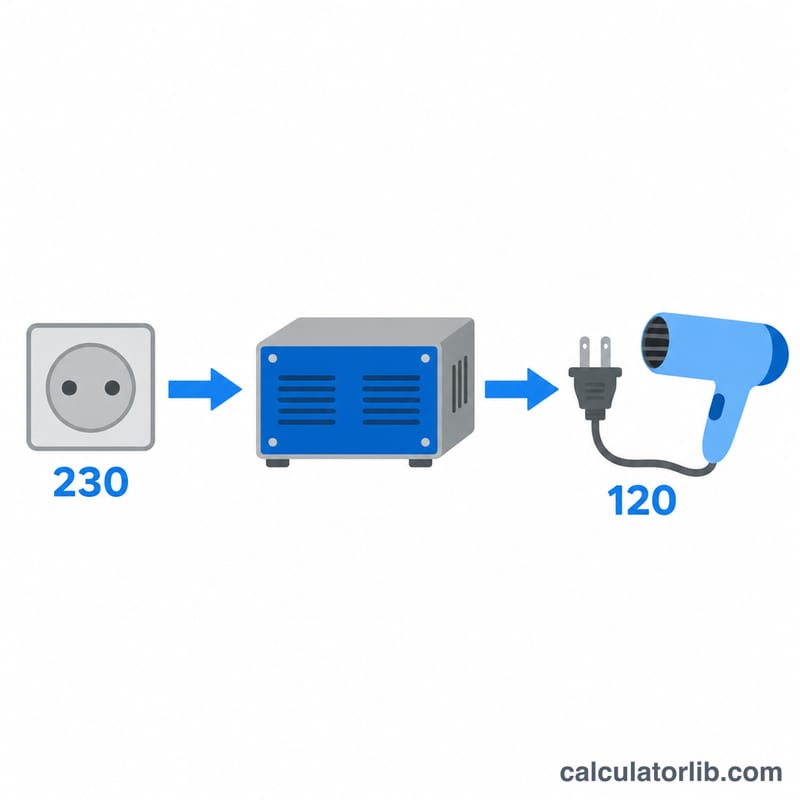
If you travel from North America to a country with 220-240 V mains, a 120 V appliance needs a step-down transformer. The transformer must be rated for more power than the appliance draws, or it will overheat, trip, or fail. This calculator estimates the minimum wattage rating you need and suggests the next standard transformer size.
How to use it
Enter the wattage printed on the appliance label. If the label only lists amps, multiply amps by 120 to get watts. Enter how many identical appliances will run at once, choose the load type, and set a safety margin (20-25% is a common choice). The result shows the minimum rating and the standard size to buy.
The formula explained
The required rating is:
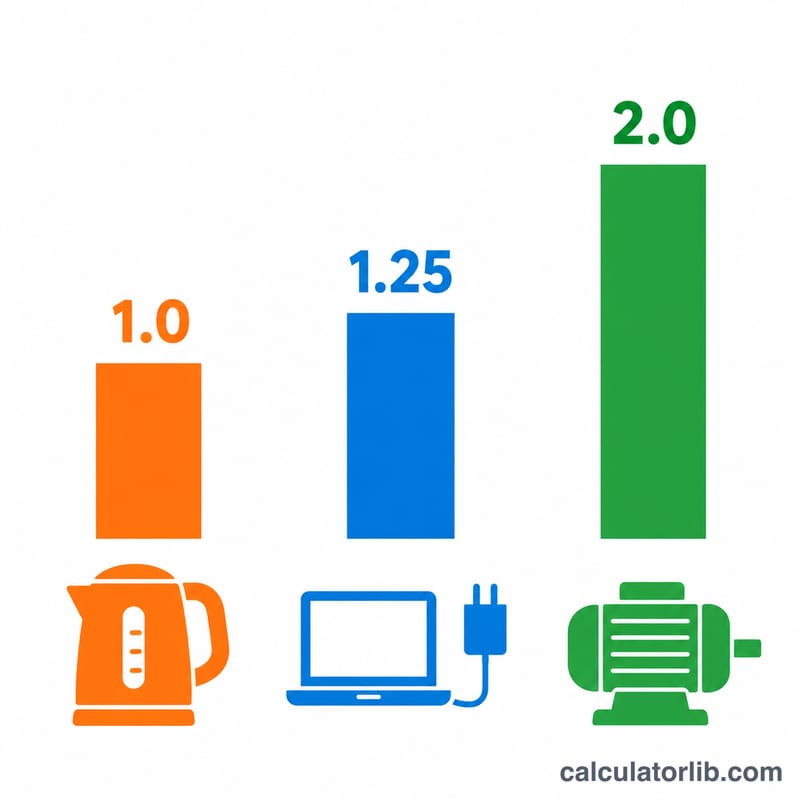
$$P_{\text{req}} = N \times P \times F \times \left(1 + \frac{m}{100}\right)$$Here \(N\) is the number of appliances, \(P\) is the rated watts of each, \(F\) is the load multiplier, and \(m\) is the safety margin in percent. The multiplier is 1.0 for resistive loads, 1.25 for electronics with power supplies, and 2.0 for motors and compressors, which can briefly draw several times their running power at startup.
Worked example
Two 1000 W motor-driven appliances with a 20% margin:
$$P_{\text{req}} = 2 \times 1000 \times 2.0 \times 1.2 = 4800\,\text{W}$$The next standard size is 5000 W. The current on the 120 V side is \(2000 / 120 \approx 16.67\) A.
Typical Appliance Wattages and Load Types
Use this table for a rough starting point when you size a 120V step-down transformer for travel. The values are typical ranges only. The rating label on your appliance always takes precedence, so check the label or power adapter for the real wattage (or volts × amps).
| Appliance | Typical wattage | Load type | Calculator load type |
|---|---|---|---|
| Phone charger | 5–20 W | Electronic | 2 (F = 1.25) |
| Laptop charger | 45–100 W | Electronic | 2 (F = 1.25) |
| Camera battery charger | 10–30 W | Electronic | 2 (F = 1.25) |
| Electric shaver | 15–20 W | Electronic / motor | 2 or 3, choose 3 to be conservative |
| Curling iron | 30–50 W | Resistive (heating) | 1 (F = 1.0) |
| Travel iron | 1000–1200 W | Resistive (heating) | 1 (F = 1.0) |
| Hair dryer | 1000–1875 W | Resistive plus small motor | 1 or 3, choose 3 if unsure |
| Fan | 30–75 W | Motor | 3 (F = 2.0) |
| Small blender | 300–600 W | Motor | 3 (F = 2.0) |
| CPAP machine | 30–90 W | Electronic | 2 (F = 1.25) |
Motor loads draw a higher starting (surge) current than their running wattage, and electronics can have inrush current and power-factor effects. The factor F builds this allowance into the calculation.
Standard Transformer Sizes
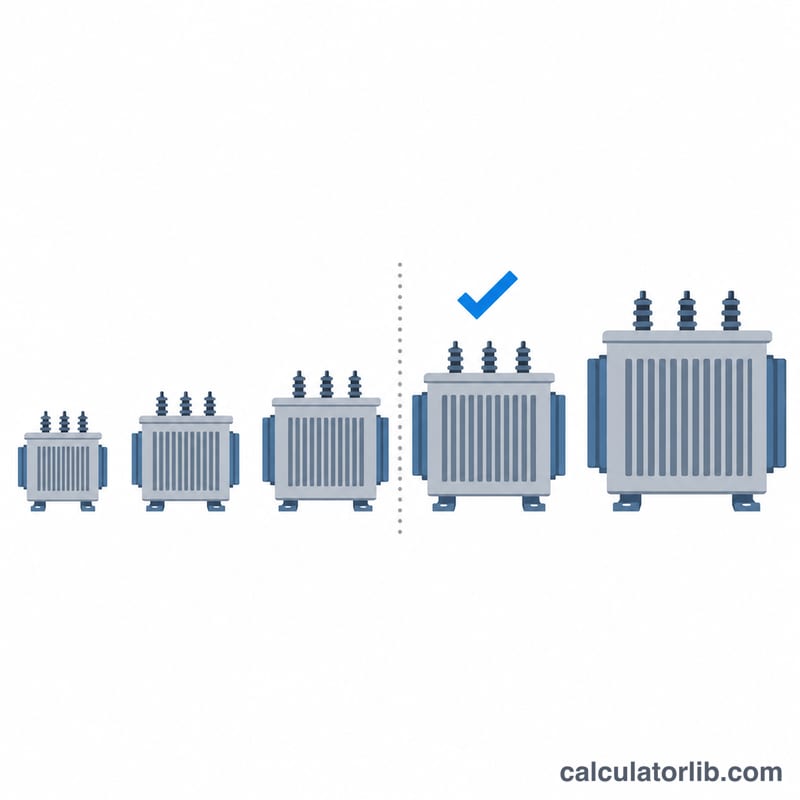
Step-down transformers are sold in a limited set of continuous-power ratings. The calculator takes the required wattage and rounds it up to the next standard size. The ratings below are common, but available sizes vary by manufacturer, so check what the one you are buying actually offers.
| Rating (W) | Typical use |
|---|---|
| 50 | Single phone or small device charger |
| 100 | Laptop plus phone charging |
| 200 | Several chargers, a laptop and a camera charger |
| 300 | Small fan, CPAP machine with accessories, multiple electronics |
| 500 | Larger electronics, small motor-driven devices |
| 750 | Small blender or a combination of devices |
| 1000 | Low-power heating items or mixed loads |
| 1500 | Many 1000–1200 W resistive appliances such as a travel iron |
| 2000 | Higher-power resistive appliances, with a margin |
| 3000 | High-power or motor-driven appliances with a surge allowance |
| 5000 | Heavy-duty or multi-appliance use, usually fixed installations |
Higher-wattage transformers are heavy and bulky, which matters for luggage. For heating appliances such as hair dryers and irons, a dual-voltage model is often more practical than a large transformer. Also note that a transformer changes voltage only, not frequency (50 Hz versus 60 Hz), so some motor-driven or clock-type devices may still run differently.
Scenario Comparison: Load Type and Safety Margin
The calculator uses this formula:
$$P_{req} = N \times P \times F \times \left(1 + \frac{m}{100}\right)$$
where N is the number of appliances, P is the appliance wattage, F is the load-type factor (1.0 resistive, 1.25 electronics, 2.0 motor) and m is the safety margin in percent. The table compares a single 1000 W appliance with a 20% margin.
| Load type | F | Calculation | Required watts | Next standard size |
|---|---|---|---|---|
| Resistive | 1.0 | \(1 \times 1000 \times 1.0 \times 1.20\) | 1200 W | 1500 W |
| Electronic | 1.25 | \(1 \times 1000 \times 1.25 \times 1.20\) | 1500 W | 1500 W |
| Motor | 2.0 | \(1 \times 1000 \times 2.0 \times 1.20\) | 2400 W | 3000 W |
The same 1000 W label can need anywhere from a 1500 W to a 3000 W transformer, depending on what kind of load it is.
Optional example: laptop and phone charger
Take a 65 W laptop charger and a 10 W phone charger, both electronics (F = 1.25), with a 20% margin:
- Laptop: \(65 \times 1.25 \times 1.20 = 97.5\) W
- Phone: \(10 \times 1.25 \times 1.20 = 15\) W
- Total: \(97.5 + 15 = 112.5\) W, so the next standard size is 200 W.
These figures are illustrative. Use the wattage printed on your own appliances, and consider a larger margin if you plan to add devices later.
FAQ
Can I use a travel transformer for a hair dryer?
Only with a large, heavy-duty transformer. Many hair dryers draw 1500 W or more. A dual-voltage hair dryer is usually the better option.
Is a transformer the same as a plug adapter?
No. A plug adapter only changes the plug shape. A transformer changes the voltage. Check whether your device is dual-voltage (100-240 V) before buying a transformer.
Should I run a transformer at its full rating?
No. Continuous operation near the maximum rating causes heat build-up, so keeping a margin is recommended. Also, 120 V devices designed for 60 Hz may run differently on 50 Hz supplies, especially motors and clocks.