What is the Cycling Wattage Calculator?
This calculator estimates the mechanical power, in watts, a cyclist must produce to ride at a chosen speed. It models the three forces a rider must overcome: rolling resistance between the tyres and the road, aerodynamic drag against the air, and gravity when climbing a gradient. A drivetrain loss factor converts the power delivered to the wheel into the higher power you must produce at the pedals. It is a universal physics model and applies anywhere.
How to use it
Enter your total mass (rider plus bike and gear), your target speed in km/h, and the road grade as a percentage (use 0 for flat, negative for descents). The defaults for rolling resistance (Crr \(\approx 0.005\) for road tyres), aerodynamic drag area (CdA \(\approx 0.3\) m² for a road hoods position), air density (\(\rho = 1.225\) kg/m³ at sea level) and drivetrain loss (\(\approx 2\%\)) are reasonable for a road cyclist, but you can refine them. The result shows total pedal power plus a breakdown by force.
The formula explained
Power equals force times velocity. Rolling resistance force is \(C_{rr}\cdot m\cdot g\), aerodynamic drag force is \(0.5\cdot\rho\cdot C_dA\cdot v^{2}\), and climbing force is \(m\cdot g\cdot\text{grade}\). Multiplying each by speed \(v\) (in m/s) gives the power for each component. Note that aerodynamic power grows with the cube of speed, which is why going faster on the flat becomes so demanding.
$$P = \dfrac{\left(C_{rr}\,m\,g\,v\right) + \left(\tfrac{1}{2}\,\rho\,C_dA\,v^{3}\right) + \left(m\,g\,G\,v\right)}{1 - \dfrac{\text{Drivetrain Loss (\%)}}{100}}$$where
$$\left\{ \begin{aligned} v &= \dfrac{\text{Speed (km/h)}}{3.6}, \quad g = 9.8067 \\ m &= \text{Mass (kg)}, \quad G = \dfrac{\text{Grade (\%)}}{100} \\ C_{rr} &= \text{Crr}, \quad C_dA = \text{CdA} \\ \rho &= \text{Air Density} \end{aligned} \right.$$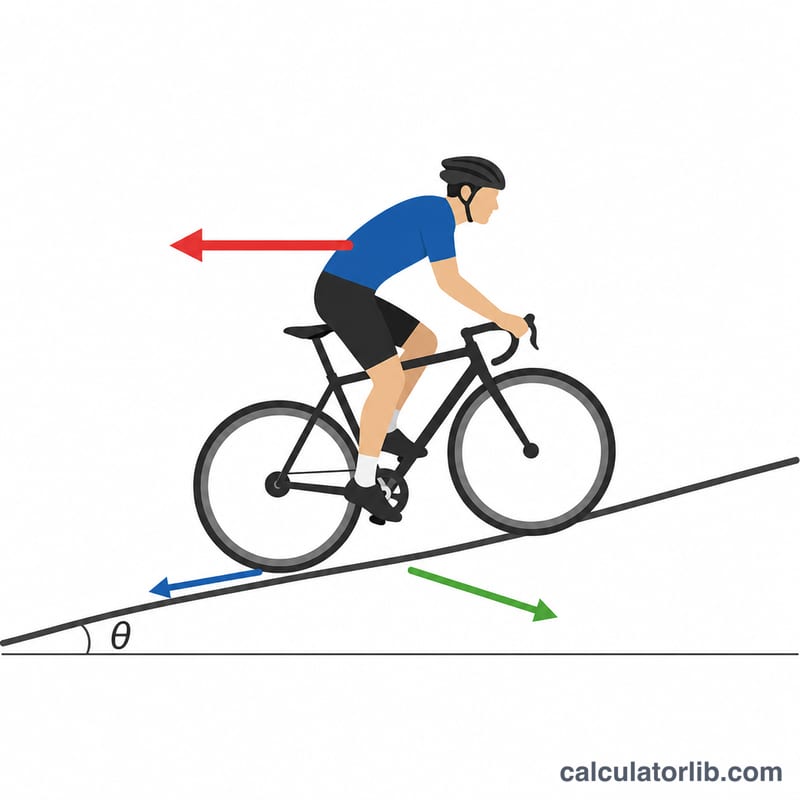
Worked example
For a rider of 80 kg riding at 30 km/h (8.333 m/s) on flat ground with Crr 0.005, CdA 0.3, \(\rho\) 1.225 and g 9.8067: rolling \(= 0.005\cdot80\cdot9.8067\cdot8.333 \approx 32.69\) W; aero \(= 0.5\cdot1.225\cdot0.3\cdot8.333^{3} \approx 106.34\) W; gravity \(= 0\) W. Wheel power \(\approx 139.04\) W, and dividing by 0.98 for a 2% drivetrain loss gives about 141.9 W at the pedals.
Typical Crr, CdA and Air Density Values
The calculator needs three inputs that are hard to measure directly. The values below are approximate, commonly cited ranges. Real figures vary with tyre model, pressure, road surface, rider build, clothing and bike setup.
Rolling resistance coefficient (Crr)
| Tyre / surface | Typical Crr |
|---|---|
| Road tyres on smooth asphalt | 0.004 – 0.006 |
| Gravel tyres on mixed surfaces | 0.008 – 0.012 |
| MTB / dirt / rough trail | 0.010 – 0.020 |
Drag area (CdA) by riding position
| Position | Typical CdA (m²) |
|---|---|
| Time-trial / aero tuck | 0.20 – 0.25 |
| Road bike, drops | 0.25 – 0.32 |
| Road bike, hands on hoods | 0.30 – 0.36 |
| Upright (commuter / city bike) | 0.40 – 0.50 |
Air density (ρ)
| Condition | Approx. air density (kg/m³) |
|---|---|
| Sea level, 15 °C (standard atmosphere) | 1.225 |
| About 1000 m altitude | 1.11 |
| About 2000 m altitude | 1.01 |
Air density also falls as temperature rises. Hot days are slightly "faster" than cold days at the same altitude. All values here are approximate, and your local weather and altitude will shift them.
Power Required: Flat vs Climbing Scenarios
Fixed assumptions: total mass (rider + bike + kit) 80 kg, Crr 0.005, CdA 0.30 m², air density 1.225 kg/m³, drivetrain loss 2%, no wind. Results are pedal power in watts, from the formula with g = 9.8067 m/s².
Substitution for 30 km/h, flat: v = 30 / 3.6 = 8.333 m/s.
$$P = \frac{0.005 \times 80 \times 9.8067 \times 8.333 + 0.5 \times 1.225 \times 0.3 \times 8.333^3 + 0}{1 - 0.02} = \frac{32.69 + 106.34}{0.98} \approx 141.9\ \text{W}$$
Adding a 3% grade: the gravity term is \(80 \times 9.8067 \times 0.03 \times 8.333 = 196.13\) W, so \(P = (32.69 + 106.34 + 196.13)/0.98 \approx 342.0\) W.
Notice that on the flat, aerodynamic power grows with the cube of speed. Going from 20 to 40 km/h (twice the speed) takes about 5.5 times the power. On steep climbs, gravity dominates instead.
Interpreting Your Wattage Result
The result is an estimate of the steady-state power at the pedals needed to hold the chosen speed on a constant grade. It assumes no wind, no acceleration or braking, and no drafting. Power is rounded and depends heavily on the Crr, CdA and air density you enter.
Watts per kilogram
Divide the power by the rider's body mass (not the total system mass):
$$\text{W/kg} = \frac{P}{m_{\text{rider}}}$$
Example: 342 W from a 72 kg rider (80 kg total with bike and kit) gives \(342 / 72 \approx 4.75\) W/kg.
Power zones
Coaches commonly use the published Coggan power zones, expressed as a percentage of functional threshold power (FTP):
| Zone | Name | % of FTP |
|---|---|---|
| 1 | Active recovery | < 55% |
| 2 | Endurance | 56 – 75% |
| 3 | Tempo | 76 – 90% |
| 4 | Lactate threshold | 91 – 105% |
| 5 | VO₂max | 106 – 120% |
| 6 | Anaerobic capacity | 121 – 150% |
| 7 | Neuromuscular power | maximal short efforts |
Comparing your result with these zones shows roughly how hard a given speed and grade would be relative to your own FTP, if you know it from a test.
Limitations
- Headwinds, tailwinds and drafting change aerodynamic power substantially; this model ignores them.
- Real speed changes (accelerating, cornering, braking) add or remove power.
- Crr and CdA are estimates; a small error in CdA changes the flat-ground result noticeably.
- The grade term uses grade as a simple fraction, which is an accurate approximation for typical road gradients.
- Drivetrain loss varies with chain condition, lubrication and gearing.
This tool gives general information for planning and comparison only. It is not personal training, medical or health advice.
FAQ
Why does the breakdown not include drivetrain loss? The three breakdown rows are wheel-side power; the headline total adds the drivetrain loss on top.
What CdA should I use? Roughly 0.4 upright, 0.3 on the hoods, 0.25 in the drops, and 0.20 or lower in a time-trial position.
Does wind matter? Yes — a headwind effectively raises the air speed in the aero term. This basic model assumes still air.