
What Is Save Percentage?
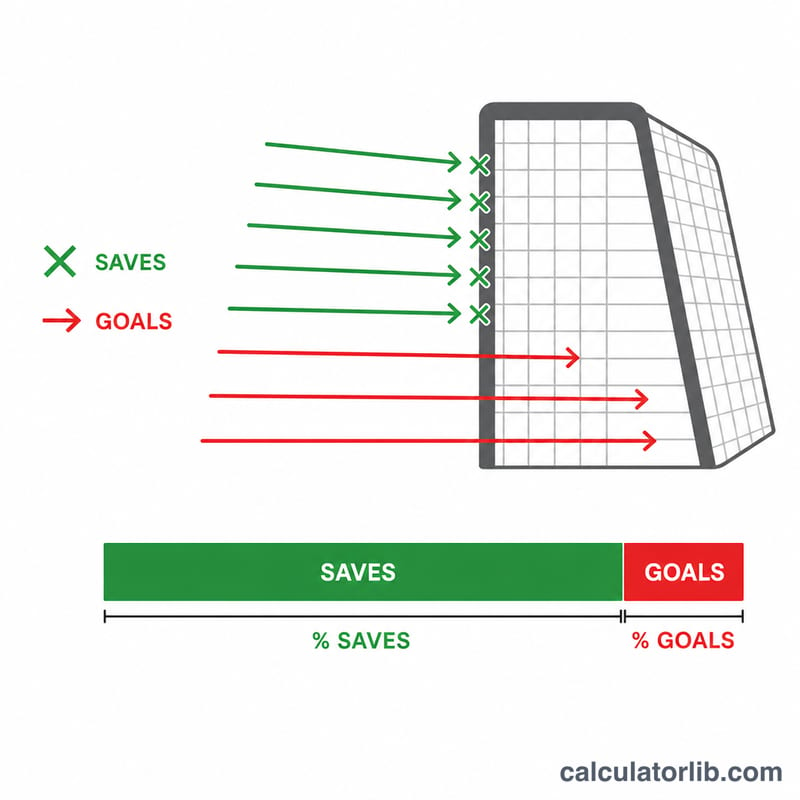
Save percentage (SV%) is a core goaltending statistic in hockey, soccer, lacrosse, and other goal-scoring sports. It measures the proportion of shots on goal that a goalkeeper successfully stops. A higher save percentage indicates a more effective goaltender, and it is one of the most reliable individual metrics because it adjusts for how many shots a goalie actually faces.
How to Use This Calculator
Enter the number of saves the goalie made and the number of goals allowed (goals against). The calculator adds these to get the total shots faced, then divides saves by total shots to produce the save percentage. The result is shown both as a decimal (the form used in hockey, e.g. 0.917) and as a true percentage (91.7%).
The Formula Explained
The formula is simple: $$\text{SV\%} = \frac{\text{Saves}}{\text{Saves} + \text{Goals Allowed}} \times 100$$ The denominator, saves plus goals allowed, equals the total number of shots on goal the keeper faced. Because every shot on goal is either saved or results in a goal, this captures every shot the goalie had to deal with.
Worked Example
Suppose a hockey goalie makes 30 saves and allows 3 goals. Total shots faced = \(30 + 3 = 33\). Save percentage = $$\frac{30}{33} = 0.909 \approx 90.9\%$$ In hockey this would typically be written as .909.
FAQ
What is a good save percentage? In the NHL, a save percentage of .910 or higher is generally considered solid, while .920 and up is elite. In soccer, around 70% (0.70) is respectable for a goalkeeper.
Does save percentage include shots that miss the net? No. Only shots on goal (those that would have scored without a save) count. Shots wide or over the bar are not included.
How is it different from goals-against average? Goals-against average measures goals per game, while save percentage measures efficiency relative to shot volume, making it less dependent on team defense.