
What Is the Ski Size Calculator?
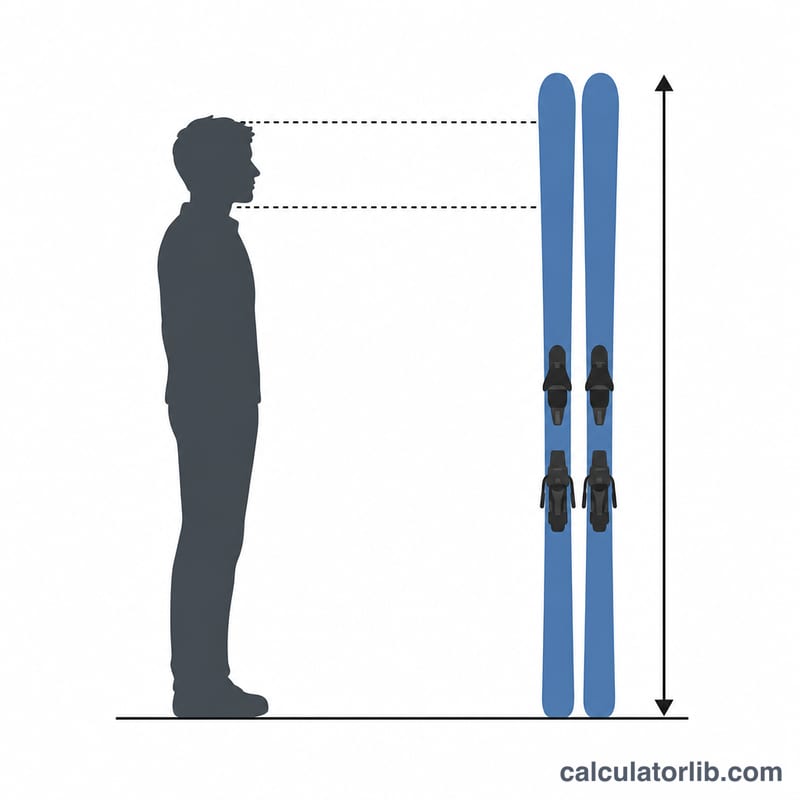
This tool estimates the right downhill ski length for you based on your height and skill level. The most common guideline is that a ski should reach somewhere between your chin and the top of your head, which corresponds to roughly 85% to 95% of your body height. Shorter skis are easier to turn and more forgiving; longer skis are faster and more stable at speed.
How to Use It
Enter your height in centimeters and select your skill level. The calculator multiplies your height by a sizing factor — 0.85 for beginners, 0.90 for intermediates, and 0.95 for advanced skiers — and shows a recommended length plus the full suggested range so you can fine-tune your choice.
The Formula Explained
The core equation is $$\text{Ski Length} = \text{Height} \times \text{factor}$$ The factor reflects how aggressively you ski: less experienced skiers benefit from shorter, more maneuverable skis (a lower factor), while advanced skiers favor longer skis for stability (a higher factor). The shorter and longer bounds of the range come from the \(0.85\) and \(0.95\) multipliers.
Worked Example
Suppose you are 180 cm tall and ski at an intermediate level. The factor is 0.90, so $$\text{Ski Length} = 180 \times 0.90 = \textbf{162 cm}.$$ Your suggested range runs from \(180 \times 0.85 = 153\) cm (shorter, more playful) up to \(180 \times 0.95 = 171\) cm (longer, faster).
FAQ
Should I round to a real ski length? Yes — skis come in fixed lengths (e.g. 160, 165, 170 cm). Pick the nearest available size to your result.
Does weight matter? It can. Heavier skiers may size up slightly, lighter skiers down, but height and skill are the primary factors used here.
What about ski type? Powder and freeride skis are often sized longer, while park skis are sized shorter. Use this as a baseline for all-mountain skis.