
What this calculator does
This tool estimates how many calories you burn while playing handball. It uses the universal MET (metabolic equivalent) energy-expenditure formula, where the intensity of an activity is expressed as a MET value and combined with your body weight and exercise time. The MET values offered here come from the revised "METs table of physical activities" published by the Japanese National Institute of Health and Nutrition, but the underlying formula applies anywhere in the world.
How to use it
Pick the handball activity that best matches what you did: a match or competition (7.0 METs), team practice (8.0 METs), or general handball (12.0 METs). Enter how long you played in minutes and your body weight in kilograms, then read off the estimated calories burned.
The formula explained
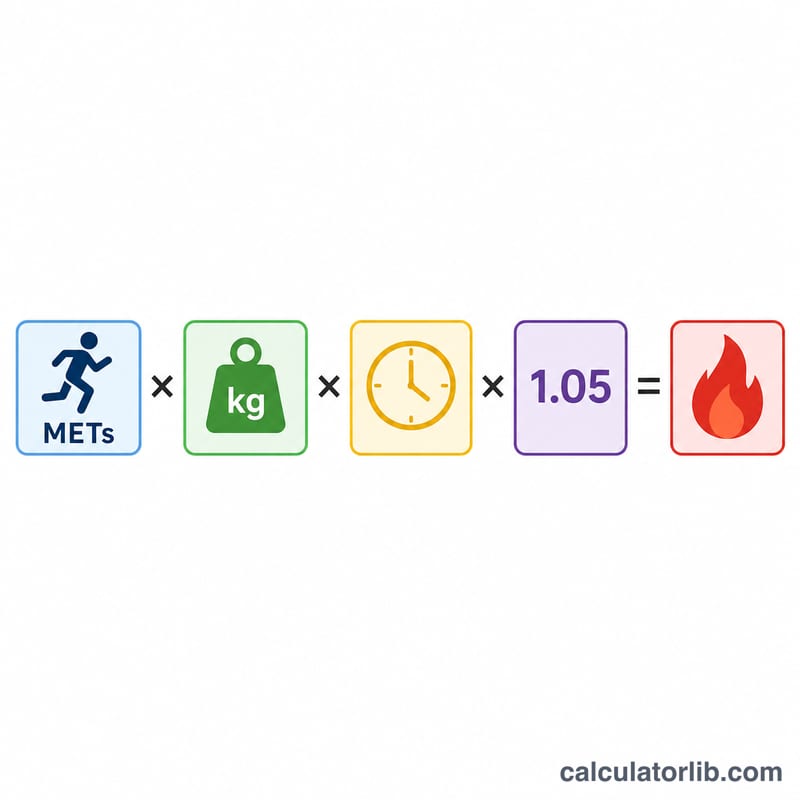
The energy used is calculated as:
$$\text{Calories (kcal)} = \text{METs} \times \text{body weight (kg)} \times \text{duration (hours)} \times 1.05$$
Because you enter time in minutes, it is first converted to hours by dividing by 60. The constant 1.05 reflects that one MET-hour for a one-kilogram person is approximately 1.05 kcal. This figure represents gross energy expenditure, meaning it includes the resting metabolism that occurs during the activity rather than only the "extra" calories above rest.
Worked example
Suppose you do 60 minutes of team practice (8.0 METs) and weigh 60 kg. The duration in hours is \(60 / 60 = 1.0\). Calories: $$8.0 \times 60 \times 1.0 \times 1.05 = 504 \text{ kcal}$$ For a 45-minute match (7.0 METs) at 70 kg: hours = 0.75, so calories: $$7.0 \times 70 \times 0.75 \times 1.05 = 385.9 \text{ kcal}$$
FAQ
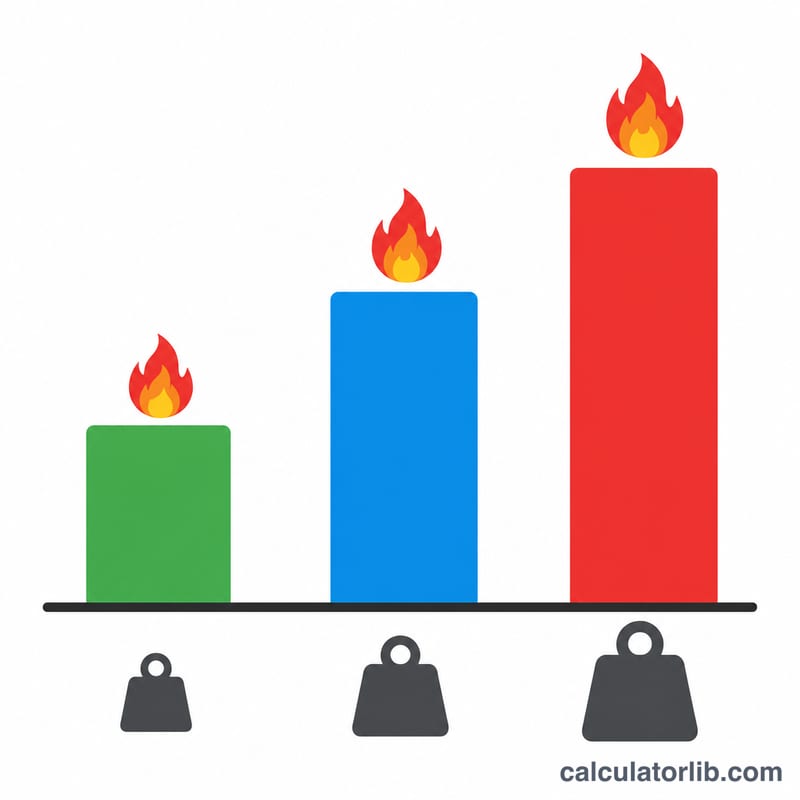
Why does heavier body weight burn more? Moving more mass requires more energy, so calorie burn scales directly with body weight.
Is this exact? No. MET-based estimates are approximations; real burn varies with fitness, intensity, and individual metabolism. Use it as a useful guide, not a precise measurement.
Does it subtract resting calories? No. This calculator reports gross calories using the full MET value. If you want net "activity-only" calories, some references subtract about 1 MET.