
What is the Bike Cadence Calculator?
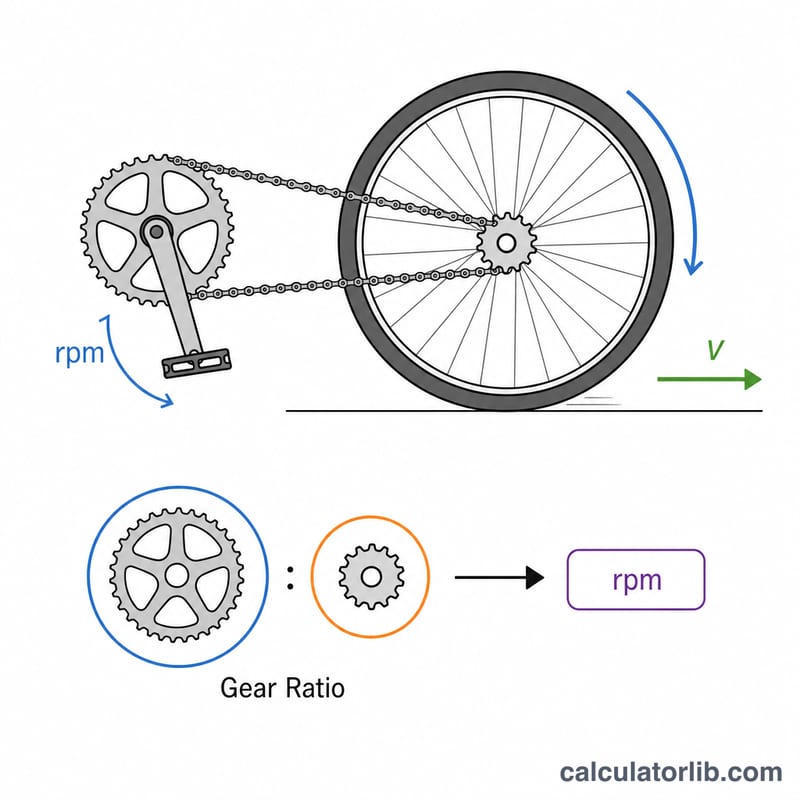
Cadence is the rate at which a cyclist turns the pedals, measured in revolutions per minute (RPM). This calculator works out your cadence from your riding speed, your wheel circumference, and your current gear (chainring and cog teeth). It helps you choose the right gear to keep a comfortable, efficient pedaling rhythm.
How to use it
Enter your speed in km/h, your wheel circumference in millimeters (a common 700×25c road wheel is about 2105 mm — check your tire chart), and the number of teeth on your front chainring and rear cog. The calculator returns your cadence in RPM along with your gear ratio.
The formula explained
The wheel travels one circumference per wheel rotation, and the gear ratio (chainring ÷ cog) tells you how many wheel rotations happen per pedal stroke. So distance per pedal revolution = circumference × gear ratio. Dividing your speed (converted to meters per minute) by that distance gives pedal revolutions per minute:
$$\text{RPM} = \frac{\text{Speed (m/min)}}{\text{Circumference} \times \text{GearRatio}}$$
Worked example
Riding at 30 km/h = 500 m/min. Wheel circumference 2.105 m. Gearing 50/15 = a gear ratio of 3.333. Distance per pedal revolution = \(2.105 \times 3.333 = 7.017\) m. Cadence = \(500 \div 7.017 \approx 71.3\) RPM.
Typical Cadence Ranges by Rider Type
Cadence is a personal preference shaped by fitness, fiber type and terrain, but riders tend to cluster into recognizable bands. Use these as orientation, not strict rules.
| Rider / Situation | Typical Cadence (RPM) | Character |
|---|---|---|
| Recreational / casual rider | 60–80 | Comfortable, often gear-limited |
| Trained road cyclist (endurance) | 80–100 | Efficient "spinning" range |
| Sprinters / track cyclists | 100–120+ | Brief high-power efforts |
| Climbing (seated, steep grade) | 60–80 | Lower cadence under high torque |
High cadence (90–100+ RPM): shifts load away from the muscles and onto the cardiovascular system, reducing per-stroke pedal force and muscular fatigue — favored for long efforts and rapid accelerations, but it raises heart rate and oxygen cost and can feel inefficient if you're not conditioned for it.
Low cadence (50–70 RPM): reduces breathing rate but increases the force on each pedal stroke, loading the leg muscles and knees more heavily. It can be economical at steady moderate efforts but raises injury and fatigue risk on long climbs.
Most coaches suggest training a comfortable self-selected cadence and occasionally practicing both higher and lower cadences to broaden your range. This is general information, not professional or medical advice — consult a coach or physiotherapist for guidance tailored to you. To connect cadence with training intensity, pair this tool with the Cycling Power Zones Calculator.
FAQ
What is a good cycling cadence? Most road cyclists aim for 80–100 RPM, while many recreational riders sit around 60–80 RPM. Higher cadence reduces muscle strain but raises cardiovascular effort.
Where do I find my wheel circumference? It depends on tire size; you can measure the rolling distance of one wheel turn, or use a tire size table (e.g. 700×23c ≈ 2096 mm, 700×25c ≈ 2105 mm).
Why does gearing matter? A bigger chainring or smaller cog raises the gear ratio, so each pedal stroke moves you farther — meaning a lower cadence at the same speed.