What This Calculator Does
The Calories Burned Weight Lifting Calculator estimates how much energy you expend during a resistance-training session. It uses the standard MET (Metabolic Equivalent of Task) formula, the same method used in exercise physiology and fitness trackers, to convert your body weight, workout duration, and effort level into an approximate calorie figure.
How to Use It
Choose your lifting intensity, enter your body weight in kilograms, and set the duration of your session in minutes. The calculator returns total calories burned along with your calorie-per-minute rate. Light effort (machines, slow tempo) uses a MET of about 3.5, general moderate lifting uses 5, and vigorous, high-effort training such as powerlifting or circuit work uses about 6.
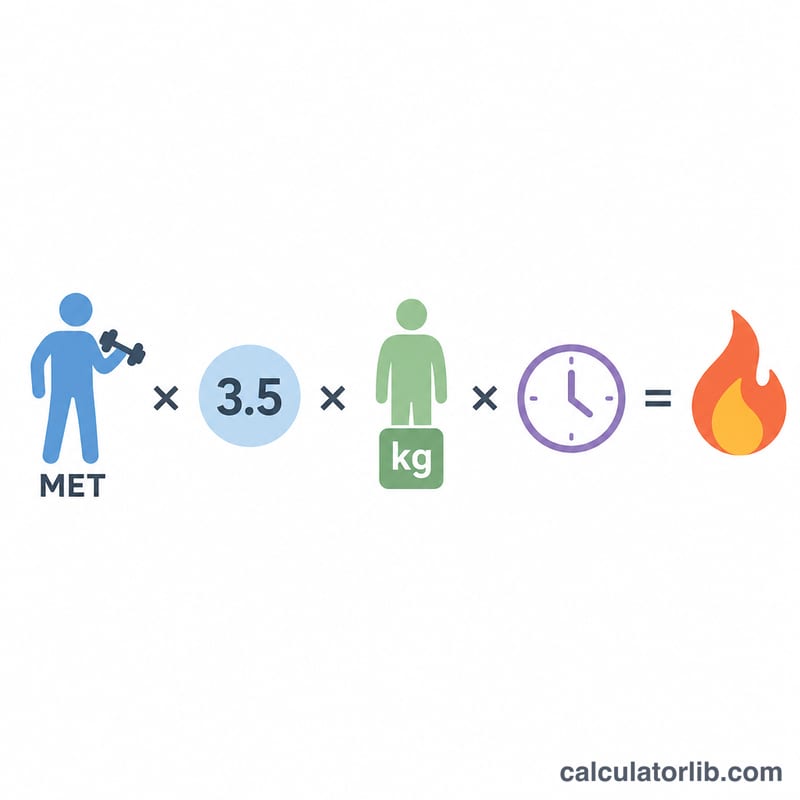
The Formula Explained
$$\text{Calories} = \frac{\text{MET} \times 3.5 \times \text{Weight(kg)}}{200} \times \text{Minutes}$$ The MET expresses the activity's intensity relative to sitting at rest. Multiplying by 3.5 and dividing by 200 converts the MET-based oxygen consumption into kilocalories per minute per kilogram, then multiplying by your weight and minutes gives total energy used.
Worked Example
A 70 kg person doing 30 minutes of moderate weight lifting (MET 5): $$5 \times 3.5 \times 70 \div 200 = 6.125 \text{ kcal/min}$$ Over 30 minutes that is $$6.125 \times 30 = 183.75 \text{ kcal burned}$$
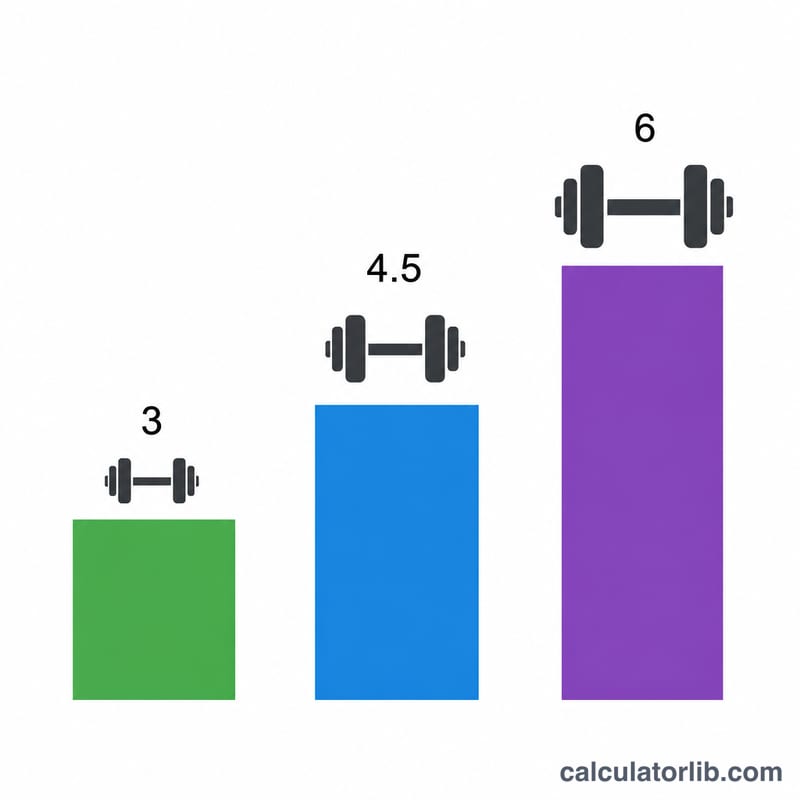
Calories Burned by Body Weight and Intensity
The table applies \(\text{kcal} = \frac{ \text{MET} \times 3.5 \times \text{kg}}{200} \times \text{minutes}\) for MET values of 3.5, 5 and 6. Values are rounded to one decimal place and are gross estimates (they include resting energy use).
| Body weight | MET 3.5 | MET 5 | MET 6 | |||
|---|---|---|---|---|---|---|
| 30 min | 60 min | 30 min | 60 min | 30 min | 60 min | |
| 55 kg | 101.1 | 202.1 | 144.4 | 288.8 | 173.3 | 346.5 |
| 70 kg | 128.6 | 257.3 | 183.8 | 367.5 | 220.5 | 441.0 |
| 85 kg | 156.2 | 312.4 | 223.1 | 446.3 | 267.8 | 535.5 |
| 100 kg | 183.8 | 367.5 | 262.5 | 525.0 | 315.0 | 630 |
Example substitution (70 kg, MET 6, 30 minutes): \(\frac{6 \times 3.5 \times 70}{200} \times 30 = 7.35 \times 30 = 220.5\) kcal. Doubling the duration doubles the result, and the result rises in direct proportion to both body weight and MET value.
Interpreting Your Result
The number produced by this calculator is a population-level estimate, not a measurement of your own energy use. MET (metabolic equivalent of task) values come from the Compendium of Physical Activities, which lists average energy costs for activities. By definition, 1 MET is roughly 1 kcal per kg of body weight per hour (the resting reference of 3.5 mL O2/kg/min used in the formula).
- Gross, not net. The estimate includes the energy your body would have used at rest anyway during those minutes. The extra calories attributable to lifting alone are lower: roughly the result minus about 1 MET × body weight (kg) × hours.
- Rest intervals. The MET value is an average over a session. Long pauses between sets lower the true average intensity, so a 60-minute session with extended rests may burn less than the same duration of continuous, vigorous lifting. Higher MET choices suit shorter rests and harder effort.
- Training style. Light or moderate resistance work, heavy low-repetition lifting, and circuit-style training have different average energy costs, which is why different MET values exist for resistance training.
- Muscle mass and body composition. The formula uses total body weight only. Two people of equal weight but different muscle mass or fitness can differ in actual expenditure, and individual efficiency varies.
- Why trackers differ. Wearables typically estimate energy from heart rate, motion and profile data, and lifting produces little rhythmic movement and a heart-rate pattern different from steady cardio. Tracker results can therefore differ noticeably from a MET-based figure, and neither is exact.
Treat the result as a rough guide for comparing sessions, not a precise value. This is general information only.
FAQ
Is this exact? No — it is an estimate. Actual burn varies with muscle mass, rest intervals, fitness level, and individual metabolism.
Does rest between sets count? The MET values used are session averages that already account for typical rest periods, so enter your total session time.
Which intensity should I pick? If unsure, choose moderate (MET 5). Pick vigorous only for sustained, heavy, or fast-paced training with short rests.