
What Is the Sunglasses Size Calculator?
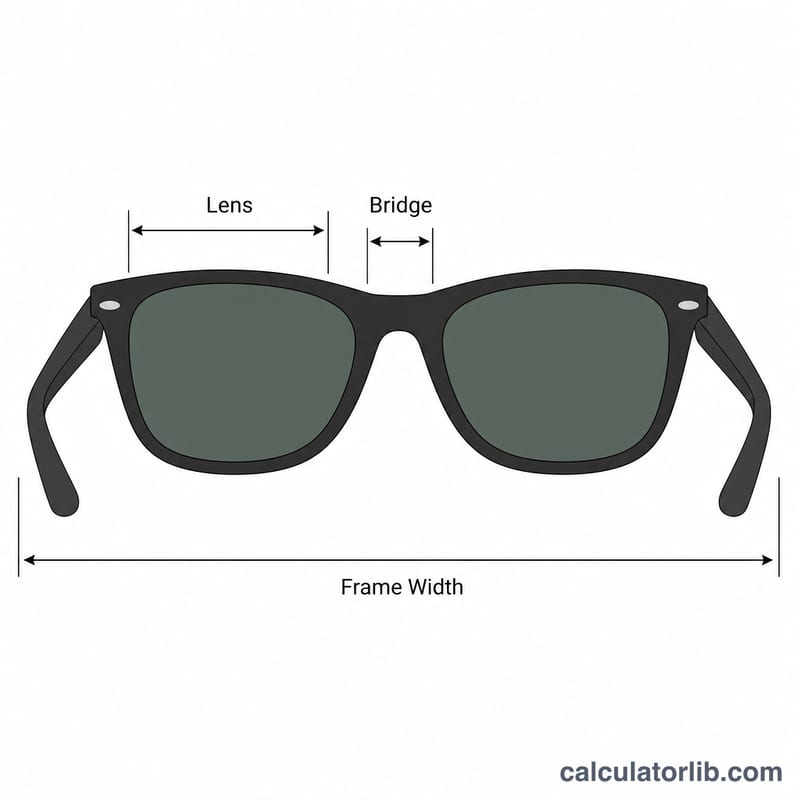
Sunglasses and eyeglass frames are sized using three numbers usually printed inside the temple arm: the lens width, the bridge width, and the temple length (for example 52–18–140). This calculator turns those numbers into the actual front width of the frame and tells you whether that width suits your face. It is a universal geometry tool and applies anywhere — measurements are in millimeters, the standard used by every eyewear brand.
How to Use It
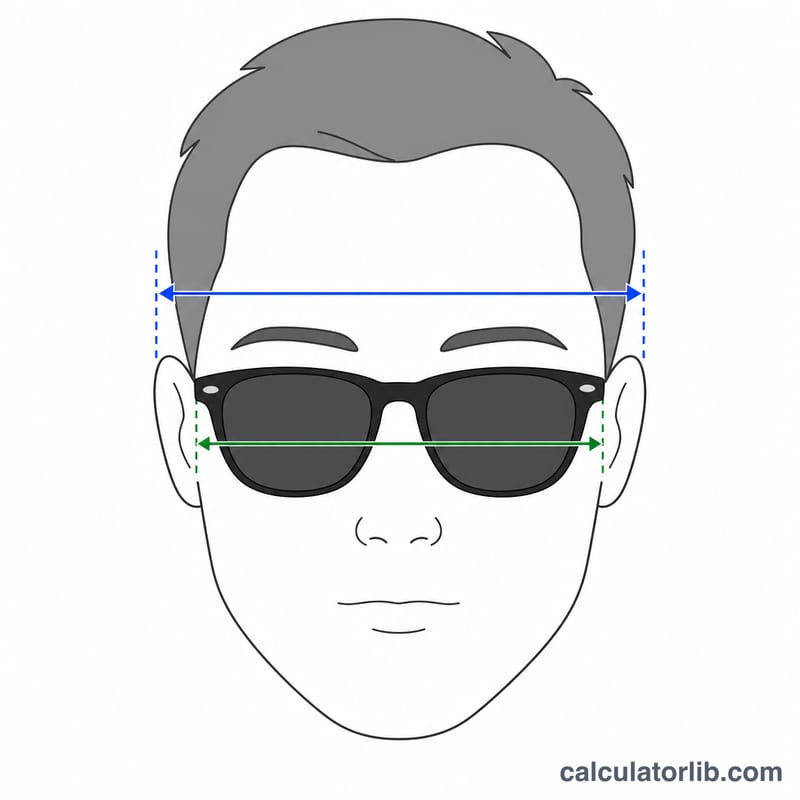
Enter the lens width, bridge width and temple length from the inside of your current glasses or from a product listing. Then measure your own face width — the straight-line distance from one temple (the side of your head in front of the ear) to the other — and enter it in millimeters. The calculator returns the frame front width, an estimated total span including hinge flare, and a fit verdict.
The Formula Explained
The frame front width is simply two lens widths plus the bridge: \(W = 2L + B\). The temple length does not add to the front width; it runs back toward your ears, so it is reported separately. We add about 8 mm total (roughly 4 mm per side) for the hinge and frame flare to estimate the full outer span. Fit is judged by the difference between frame width and face width: within +3 mm is a good fit, narrower than -2 mm is snug, and more than +6 mm is too wide.
$$\text{Frame Width} = 2 \times \text{Lens (mm)} + \text{Bridge (mm)}$$$$\text{Total Width} = \left(2 \times \text{Lens (mm)} + \text{Bridge (mm)}\right) + 8$$
Worked Example
For a 52–18–140 frame: frame width = \(52 \times 2 + 18 = \) 122 mm. Total span \(\approx 122 + 8 = 130\) mm. If your face width is 135 mm, the difference is \(122 - 135 = -13\) mm, which is "Too Small" — you'd want a wider frame.
FAQ
Where do I find these numbers? They are usually printed on the inside of one temple arm, like 52□18 140.
What is a good fit? Ideally the frame front width is within a few millimeters of your face width, so the lenses center over your eyes and the temples sit comfortably.
Does temple length affect width? No — temple length only affects how far the arms reach to your ears, not the front width.