What Is the How Many Tables Calculator?
Planning a wedding, banquet, conference, or party means making sure every guest has a place to sit. The How Many Tables Calculator tells you exactly how many tables to set up based on your total guest count and how many people each table seats. It removes the guesswork so you can finalize your floor plan, rental order, and budget with confidence.
How to Use It
Enter two numbers: the total number of guests attending, and the number of seats available at each table. The calculator divides the guests by the seats per table and rounds up — because even one extra guest needs a whole additional table. It also shows the total seats provided and how many will be left empty, which helps you plan place settings and centerpieces.
The Formula Explained
The core math is a ceiling division:
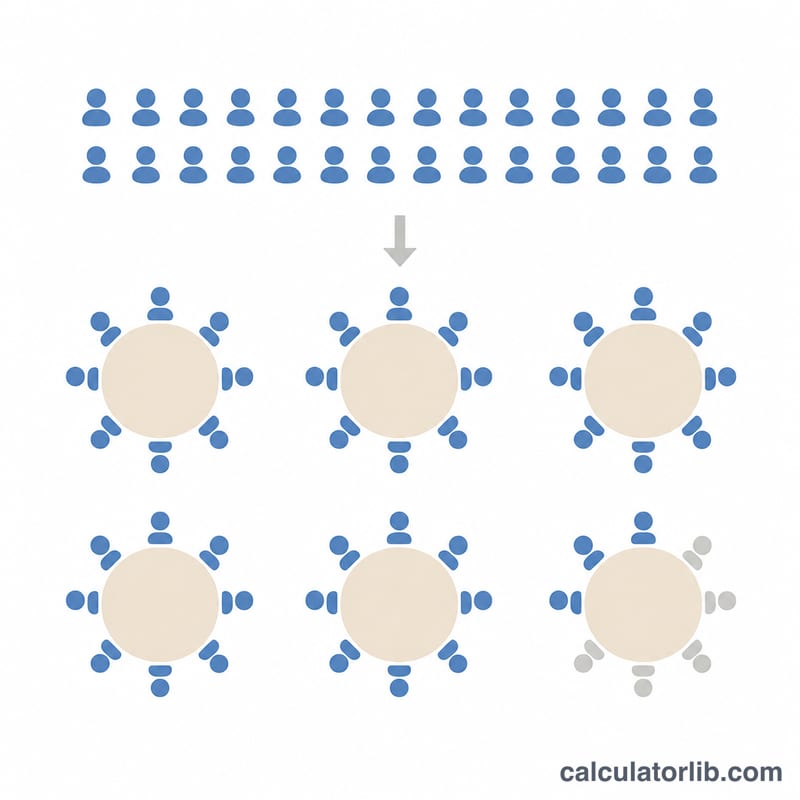
$$\text{Tables} = \left\lceil \frac{\text{Guests}}{\text{Seats per Table}} \right\rceil$$The ceiling function (⌈ ⌉) always rounds up to the next whole number. If you have 50 guests and tables of 8, then \(50 \div 8 = 6.25\), which rounds up to 7 tables. Those 7 tables provide 56 seats, leaving 6 empty.
Worked Example
Suppose you are hosting 120 guests at round tables that seat 10 each. Dividing gives \(120 \div 10 = 12\) exactly, so you need 12 tables. There are no empty seats because the numbers divide evenly. If you instead had 125 guests, \(125 \div 10 = 12.5\) rounds up to 13 tables, providing 130 seats with 5 empty.
Practical Planning Tips for Table Counts
- Add a buffer. Plan 1-2 spare tables, or roughly a 5-10% buffer, for late RSVPs, plus-ones, and last-minute changes. Example: 120 guests at 8 per table is \(\lceil 120/8 \rceil = 15\) tables. Planning for 5-10% more guests (126-132) gives 16-17 tables.
- Reserve tables for non-guest uses. Count separate tables for the head or sweetheart table, gifts and cards, the DJ or band, buffet or food stations, the cake, and the guest book. These are not included in the guest-seating result.
- Allow enough floor space. A common rule of thumb for banquet-style seating is about 10-12 sq ft per guest. This includes room for tables, chairs, and walking space, but not a dance floor, stage, or buffet lines, which need additional area.
- Confirm with the venue. Ask for the maximum legal occupancy, approved table layouts, and required aisle widths. These are set by the venue and local fire code.
- Seat slightly under capacity. Seating 8 at a 10-seat table gives guests more elbow room and space for centerpieces. If you do this, enter 8 as the seats per table instead of 10.
- Mix table sizes if useful. Using the calculator's empty-seat result, you can see whether swapping one table size for another leaves fewer unused chairs.
Table Count Comparison by Guest Count and Table Size
Tables needed are found with ceiling division: \(\text{Tables} = \lceil \text{Guests} / \text{Seats} \rceil\). Empty seats are \(\text{Tables} \times \text{Seats} - \text{Guests}\). For example, 100 guests at 8 seats per table: \(\lceil 100/8 \rceil = \lceil 12.5 \rceil =\) 13 tables, which gives \(13 \times 8 - 100 = 4\) empty seats.
| Guests | 6 seats: tables / empty | 8 seats: tables / empty | 10 seats: tables / empty |
|---|---|---|---|
| 50 | 9 / 4 | 7 / 6 | 5 / 0 |
| 75 | 13 / 3 | 10 / 5 | 8 / 5 |
| 100 | 17 / 2 | 13 / 4 | 10 / 0 |
| 150 | 25 / 0 | 19 / 2 | 15 / 0 |
| 200 | 34 / 4 | 25 / 0 | 20 / 0 |
These figures cover guest seating only. Add extra tables for a head table, gifts, food, and any buffer for late guests.
FAQ
Should I add extra tables? Many planners add 1–2 spare tables for last-minute guests, a head table, or vendors. This calculator gives the minimum required.
What if my tables seat different numbers? Run the calculator separately for each table size, or use an average seats-per-table value.
Does it account for a dance floor or buffet space? No — it only counts seating. Reserve additional floor area for those features in your venue layout.