

What Is Winning Percentage?
Winning percentage measures how often a team or player wins relative to the total number of games played. It is one of the most common metrics used to rank teams in standings across sports such as baseball, basketball, football, and soccer. Because some sports allow draws, ties are typically counted as half a win, which keeps the percentage fair when no clear winner is decided.
How to Use This Calculator
Enter the number of wins, losses, and ties (leave ties at 0 if your sport has none). The calculator instantly returns the winning percentage and shows the total number of games played for context.
The Formula Explained
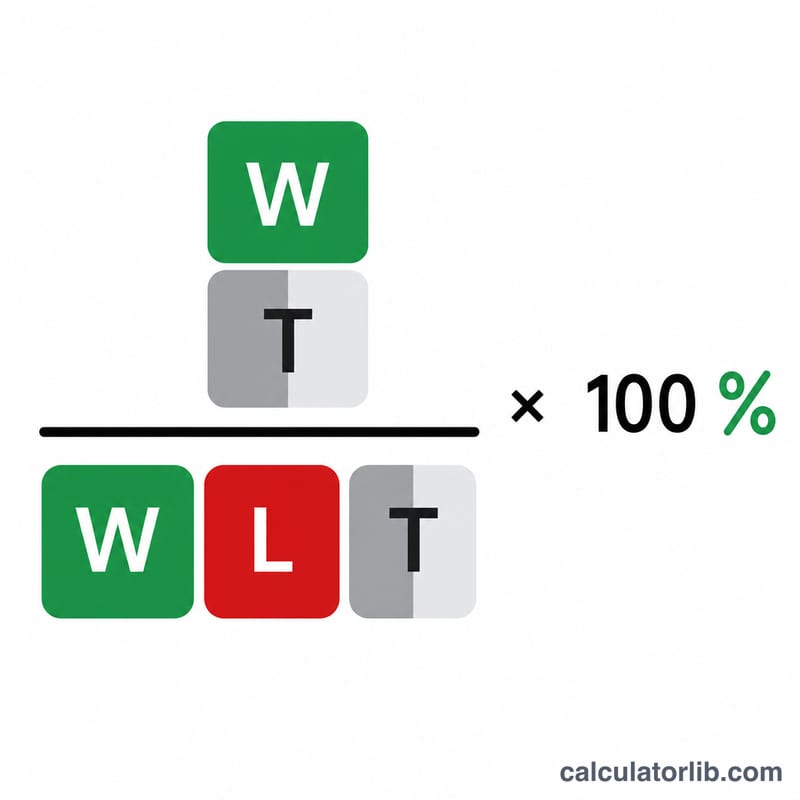
The standard formula is:
$$\text{Win \%} = \frac{\text{Wins} + 0.5 \times \text{Ties}}{\text{Wins} + \text{Losses} + \text{Ties}} \times 100$$
Each tie contributes half a win to the numerator while still counting as a full game in the denominator. If you have no ties, this simplifies to wins divided by total games.
Worked Example
Suppose a team has 10 wins, 6 losses, and 0 ties. Total games = 16. \(\text{Win\%} = (10 + 0) \div 16 \times 100 = 62.5\%\). Now add 4 ties: total games = 20, and \(\text{Win\%} = (10 + 2) \div 20 \times 100 = 60\%\).
FAQ
Why do ties count as half a win? A tie is neither a win nor a loss, so giving it half a win produces a balanced, widely accepted rating.
What if I have no games played? The percentage is undefined (division by zero), so the calculator returns 0% until at least one game is entered.
Is this the same as win rate? Yes — winning percentage and win rate refer to the same idea, usually shown as a percentage or a three-digit decimal like .625.