
What this calculator does
The Annual Income to Hourly Wage Calculator converts a yearly income figure into the equivalent hourly, daily, and monthly wage. It is a pure arithmetic conversion that works with any currency and is not tied to any country, tax system, or national labor rules. Enter your annual income, how many hours and minutes you work each day, and how many days you work each month — the tool does the rest.
How to use it
Enter your annual income in your own currency. Set your working hours per day and any extra working minutes per day (for example 7 hours 30 minutes). Then enter the working days per month you typically work. The number of months per year is fixed at 12. Results are rounded to the nearest whole currency unit (round half up).
The formula explained
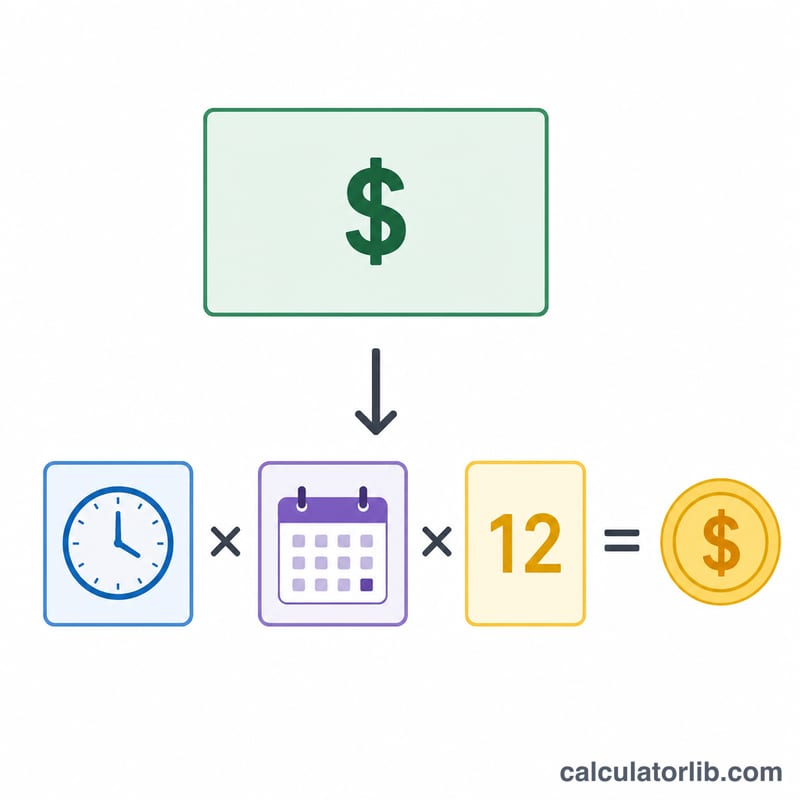
First the daily working time is converted to decimal hours: hours worked per day = hours + minutes / 60. Working hours per year then equal that figure times working days per month times 12. The conversions are:
- Monthly wage = annual income / 12
- Daily wage = annual income / (days per month x 12)
- Hourly wage = annual income / (hours worked per day x days per month x 12)
$$\text{Hourly Wage} = \frac{\text{Annual Income}}{\left(\text{Hours/Day} + \dfrac{\text{Minutes/Day}}{60}\right) \times \text{Days/Month} \times 12}$$
Worked example
Suppose your annual income is 3,600,000, you work 8 hours 0 minutes per day, and 20 days per month. Daily working time is 8 hours. Monthly wage = \(3{,}600{,}000 / 12 = 300{,}000\). Daily wage = \(3{,}600{,}000 / (20 \times 12) = 15{,}000\). Hourly wage:
$$\text{Hourly Wage} = \frac{3{,}600{,}000}{8 \times 20 \times 12} = \frac{3{,}600{,}000}{1{,}920} = 1{,}875$$
Hourly Wage Across Different Work Schedules
The same annual income translates into very different hourly, daily, and monthly wages depending on how many hours you work each day and how many days you work each month. The table below holds the annual income fixed at 3,600,000 (any currency) and varies the schedule using the formula:
$$\text{Hourly Wage} = \frac{\text{Annual Income}}{\left(\text{Hours/Day} + \dfrac{\text{Minutes/Day}}{60}\right) \times \text{Days/Month} \times 12}$$Here the monthly wage is simply the annual income divided by 12 (300,000 in every row, since income is fixed). The daily wage is the monthly wage divided by days/month, and the hourly wage is the daily wage divided by hours/day.
| Hours/Day | Days/Month | Total Annual Hours | Monthly Wage | Daily Wage | Hourly Wage |
|---|---|---|---|---|---|
| 6 | 18 | 1,296 | 300,000 | 16,667 | 2,778 |
| 6 | 22 | 1,584 | 300,000 | 13,636 | 2,273 |
| 7.5 | 20 | 1,800 | 300,000 | 15,000 | 2,000 |
| 8 | 18 | 1,728 | 300,000 | 16,667 | 2,083 |
| 8 | 20 | 1,920 | 300,000 | 15,000 | 1,875 |
| 8 | 22 | 2,112 | 300,000 | 13,636 | 1,705 |
| 9 | 20 | 2,160 | 300,000 | 15,000 | 1,667 |
| 9 | 22 | 2,376 | 300,000 | 13,636 | 1,515 |
Notice the monthly wage never changes because it depends only on the fixed annual income. The hourly wage falls as either hours/day or days/month rises — working more total hours for the same yearly pay lowers the value of each hour worked.
Definitions & Glossary
- Annual income — The total gross pay you earn over one full year before taxes and deductions. This is the starting figure that is broken down into smaller pay periods.
- Working hours per day — The whole number of hours you actively work in a typical working day (for example, 8). It excludes unpaid breaks unless your pay arrangement counts them.
- Working minutes per day — Any additional minutes worked beyond the whole hours, expressed out of 60. For instance, a 7.5-hour day is entered as 7 hours plus 30 minutes; the minutes are converted to a fraction of an hour (\(30/60 = 0.5\)) before calculating.
- Working days per month — The number of days you work in an average month, commonly between 18 and 22 for a standard five-day week. Multiplying by 12 gives total working days per year.
- Hourly wage — The pay attributable to one hour of work, found by dividing annual income by the total hours worked in a year. It answers "what is each hour of my time worth?"
- Daily wage — The pay attributable to one working day, equal to the hourly wage multiplied by hours worked per day, or equivalently the monthly wage divided by working days per month.
- Monthly wage — The pay attributable to one month, equal to the annual income divided by 12. It is independent of how many hours or days you work and depends only on yearly pay.
Income and jobs: United States
Average income and unemployment in United States compared with the world, from the World Bank: a benchmark for the figures you enter above.
- GNI per capita 2025
- 88,810 USD
- GDP per capita, PPP 2025
- 90,027 intl. $
- World: 25,704
- Unemployment 2025
- 4.2%
- World: 4.8%
Latest change Up +7.1% 2025: 88,810 USD, against 82,910 USD in 2024. CalculatorLib computes this change from the two published figures.
In 2025, gross national income per person in United States was 88,810 US dollars a year, about 7,401 US dollars a month. World: 14,244 USD
| Year | GNI per capita (USD) | GDP per capita, PPP (intl. $) | Unemployment |
|---|---|---|---|
| 2025 | 88,810 | 90,027 | 4.2% |
| 2024 | 82,910 | 86,170 | 4.0% |
| 2023 | 79,950 | 82,587 | 3.6% |
| 2022 | 77,230 | 78,009 | 3.7% |
| 2021 | 71,510 | 71,441 | 5.3% |
| 2020 | 64,630 | 64,465 | 8.1% |
| 2019 | 65,840 | 65,228 | 3.7% |
| 2018 | 63,040 | 62,876 | 3.9% |
| 2017 | 58,860 | 60,048 | 4.4% |
| 2016 | 56,830 | 57,977 | 4.9% |
GNI per capita (Atlas method) is the average of all income in the economy, not a typical salary; PPP dollars adjust for local prices.
Income tax and social security: United States
- Top income tax rate 2025
- 43.65%
- from 8.7 × the average wage
- Employee social security 2025
- 7.65% · 1.45%
In 2025, the top statutory personal income tax rate in United States (central and local government combined) was 43.65%. It applies from 8.7 times the average wage of 73,520 USD, that is from about 642,101 USD a year.
Employee social security contribution rates for successive earnings bands, lowest band first; the band limits are not shown.
Top income tax rates in OECD countries
| Country | Top rate | Applies from (× average wage) | Year |
|---|---|---|---|
| Japan | 55.95% | 7.7 | 2025 |
| France | 55.37% | 12.9 | 2025 |
| South Korea | 49.5% | 19.0 | 2025 |
| Germany | 47.48% | 4.4 | 2025 |
| United Kingdom | 45% | 2.2 | 2025 |
| United States | 43.65% | 8.7 | 2025 |
| Türkiye | 40.76% | 5.6 | 2025 |
| Mexico | 35% | 20.6 | 2025 |
The top rate is the statutory rate on the highest earnings, not the rate most workers pay. OECD figures cover OECD member countries only.
United States and other countries
GNI per capita in current US dollars (Atlas method) — each country’s latest published year.
- United States 88,810 USD (2025)
- France 48,630 USD (2025)
- Japan 38,340 USD (2025)
- South Korea 37,880 USD (2025)
- Saudi Arabia 36,070 USD (2025)
- Türkiye 16,300 USD (2025)
- Russia 15,960 USD (2025)
- World 14,244 USD (2025)
- China 14,230 USD (2025)
- Mexico 13,730 USD (2025)
- Vietnam 4,970 USD (2025)
- India 2,760 USD (2025)
No published figure yet for Taiwan.
Years can differ between rows: each figure is shown with its own year. The same World Bank indicator for every country.
Latest figure: 2025 Data last updated 2026-10-18 · current
Source: The World Bank Group CC BY 4.0; OECD, Tax Database CC BY 4.0
Monthly figures are computed by CalculatorLib from these data. The top-rate threshold in national currency (multiple × average wage) is computed by CalculatorLib from these data.
Source details and methodology
- The World Bank Group — World Development Indicators (NY.GNP.PCAP.CD, NY.GDP.PCAP.PP.CD, SL.UEM.TOTL.ZS)
- OECD, Tax Database — Top statutory personal income tax rate; employee social security contribution rates
FAQ
Why is months per year fixed at 12? A year always has 12 calendar months, so monthly wage is simply annual income divided by 12. You control variation through working days and hours.
What currency does it use? Any. The tool performs unit-free arithmetic, so all outputs are in the same currency you enter for annual income.
What if I enter 0 working days or 0 hours? Those cases cause division by zero and are guarded — the related result is shown as 0. Use realistic positive values for an accurate wage.