What the motorcycle tire size calculator does
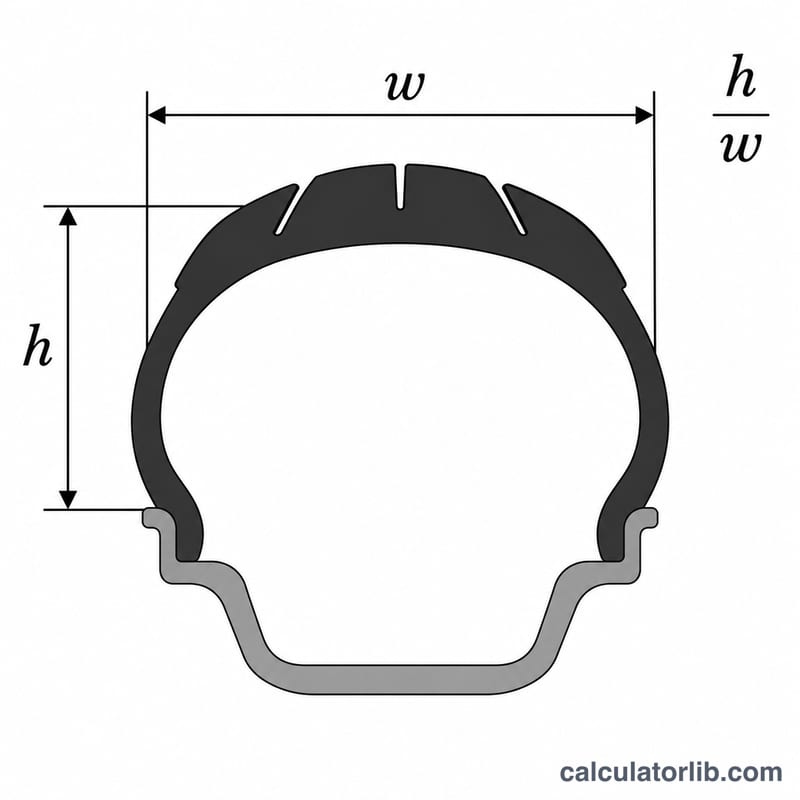
A motorcycle tire code such as 180/55 R17 packs three numbers: section width in millimetres, aspect ratio (sidewall height as a percentage of width) and rim diameter in inches. This calculator turns that code into the real overall diameter, sidewall height, circumference and revolutions per kilometre, and lets you compare a second tire so you can judge fitment before you buy.
How to use it
Enter the width, aspect ratio and rim diameter of your current tire (Tire A) and of the alternative (Tire B). The results show both tires side by side plus the diameter difference in millimetres and percent, and the true speed when your speedometer reads 100.
The formula explained
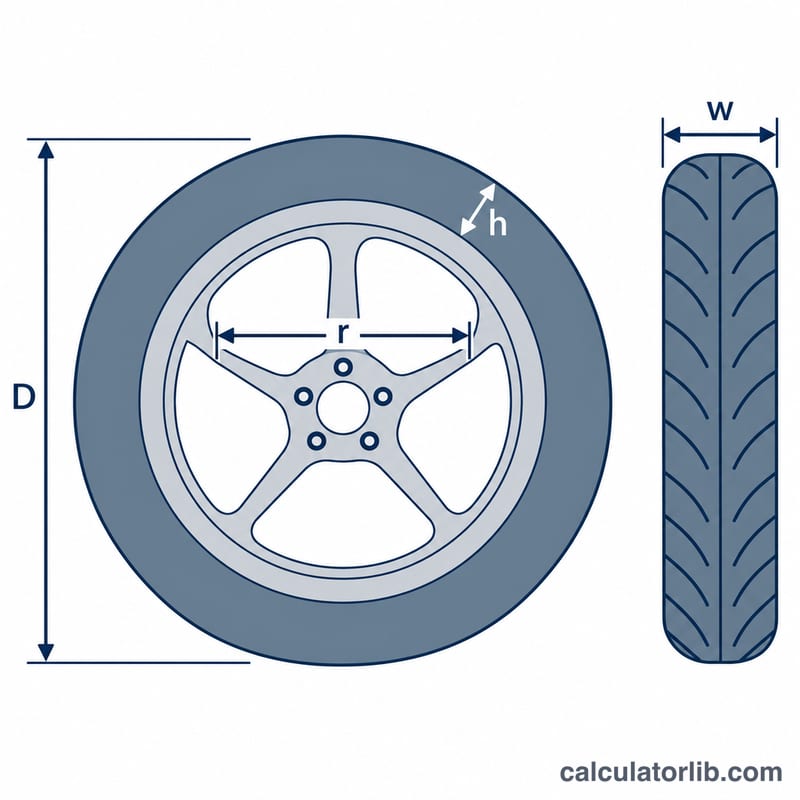
Sidewall height is \(W \times A / 100\), where \(W\) is the section width in mm and \(A\) is the aspect ratio. The overall diameter adds two sidewalls to the rim diameter \(R\) converted from inches to mm:
$$D = 25.4\,R + 2\,\frac{W \times A}{100}$$Circumference is \(\pi D\), and the speedometer-true speed scales with the diameter ratio \(D_B / D_A\).
Worked example
Compare a 180/55 R17 with a 190/50 R17.
$$D_A = 25.4 \times 17 + 2 \times \frac{180 \times 55}{100} = 431.8 + 198 = 629.8\,\text{mm}$$$$D_B = 431.8 + 2 \times 95 = 621.8\,\text{mm}$$$$\frac{D_B - D_A}{D_A} = \frac{-8}{629.8} \approx -1.27\%$$The 190/50 tire is about 8 mm smaller in diameter, so with a speedometer reading of 100 you are really travelling about 98.7. Gearing becomes slightly shorter and ground clearance drops by about 4 mm.
Typical Tire Size Ranges and Diameter Tolerances
| Parameter | Typical range (road bikes) | Notes |
|---|---|---|
| Front section width | 110–130 mm | 110/70, 120/70 and 120/60 are very common on sport and touring bikes. |
| Rear section width | 150–200 mm | Roughly 150–180 mm for middleweight and touring; 180–200 mm for large sport and performance bikes. |
| Aspect ratio | 50–70% | Sport bikes tend toward 50–60%, touring and adventure toward 60–70% or more. |
| Rim diameter | 16–19 in | 17 in is the most common on sport bikes. 16 in is common on cruisers, and 19 in is common on fronts for adventure and touring bikes. |
Diameter tolerance: a commonly cited rule of thumb is to keep the overall diameter within about 2–3% of the original size. This limits speedometer and odometer error, keeps gearing and traction or ABS behavior close to what the manufacturer intended, and helps preserve clearance to the swingarm, fender and chain. For example, a 2% change at a true 100 km/h shifts the reading by roughly 2 km/h.
Important: this is only a rule of thumb, not a standard. The motorcycle manufacturer's approved tire sizes, and the tire maker's approved rim width range for each size, always take precedence. A tire that fits on paper may still be unsuitable if the rim is too narrow or wide for it, or if clearance, load or speed ratings are not met. Check your owner's manual and the tire manufacturer's fitment data, and consult a qualified tire fitter before changing sizes.
FAQ
Does a wider tire change diameter?
Only if the aspect ratio stays the same: a wider tire with the same ratio has a taller sidewall and a larger diameter.
How much diameter difference is safe?
Many riders keep within about 2 to 3 percent of the original, but always check clearance, chain and swingarm room and the manufacturer approved sizes.
Are real tires exactly this size?
No. Tire diameter varies by brand, rim width, inflation and load, so treat the result as a close theoretical estimate.