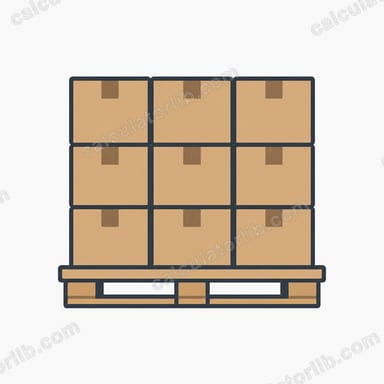
What is a 3D pallet load calculator?
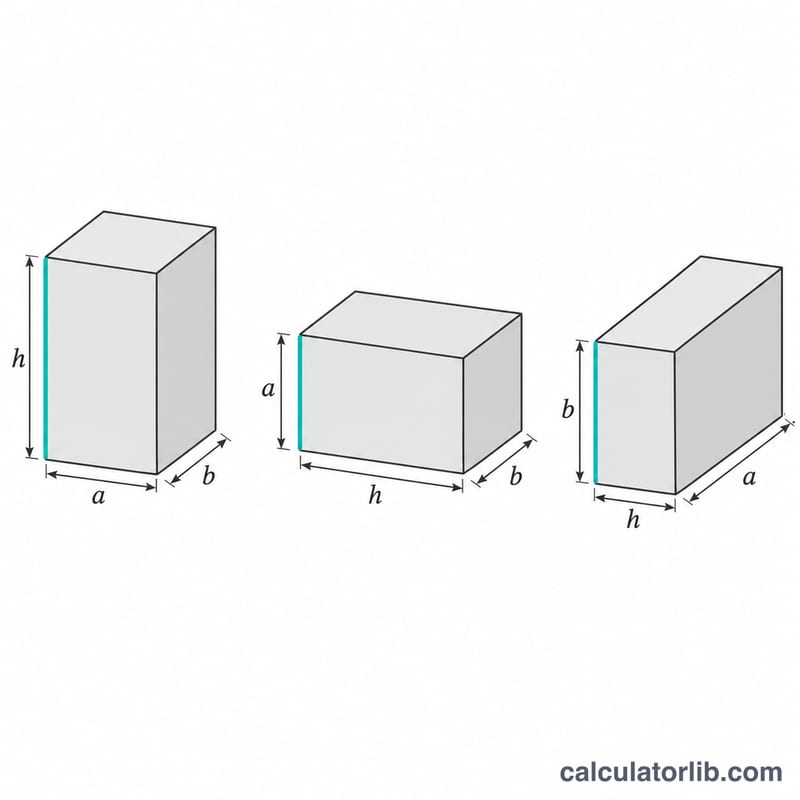
This calculator estimates how many identical rectangular boxes you can place on a pallet when you account for all three dimensions: length, width and height. It tests every way of standing the box (each of its three sides can be vertical) and both ways of turning the layer, then reports the arrangement that fits the most boxes.
How to use it
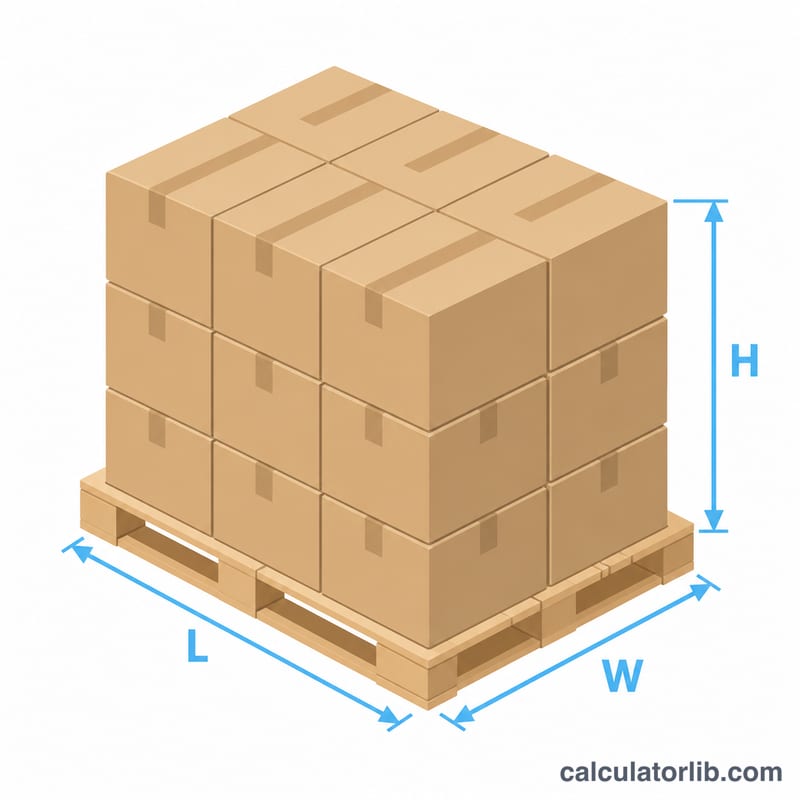
Enter the pallet length and width, and the maximum load height (including any limits from your carrier or warehouse racking, minus the pallet deck height). Then enter the box length, width and height. All values should use the same unit; the tool is labelled in centimetres, but any consistent unit works. The result shows total boxes, boxes per layer, number of layers, the grid pattern and volume utilization.
The formula explained
For a chosen vertical box side \(h\), the footprint is \(a \times b\). With pallet length \(L\), width \(W\) and height limit \(H\):
$$N = \left\lfloor \frac{H}{h} \right\rfloor \times \max\left(\left\lfloor \frac{L}{a} \right\rfloor \left\lfloor \frac{W}{b} \right\rfloor,\ \left\lfloor \frac{L}{b} \right\rfloor \left\lfloor \frac{W}{a} \right\rfloor\right)$$This is repeated for the three choices of vertical side and the largest \(N\) wins. Utilization is \(N\,lwh / (LWH)\).
Worked example
Pallet 120 × 100 cm, height limit 150 cm, box 40 × 30 × 25 cm. Standing the box with its 30 cm side vertical gives a 40 × 25 footprint:
$$N = \lfloor 150/30 \rfloor \times \lfloor 120/40 \rfloor \times \lfloor 100/25 \rfloor = 5 \times 3 \times 4 = 60$$The other orientations give only 54 or 48 boxes, so 60 is best. Utilization is \(60 \times 30000 / 1800000 = 100\%\).
Standard Pallet Sizes and Typical Load Heights
Enter the pallet footprint as length × width in the calculator. The sizes below are widely used standards. Which one applies depends on region and industry: EUR/EPAL is common in Europe, GMA in North America, and 1100 × 1100 mm in parts of Asia.
| Pallet type | Length × width (mm) | Length × width (cm) | Length × width (in) |
|---|---|---|---|
| EUR / EPAL 1 | 1200 × 800 | 120 × 80 | 47.2 × 31.5 |
| EUR 2 (EPAL 2) | 1200 × 1000 | 120 × 100 | 47.2 × 39.4 |
| GMA / North American standard | about 1219 × 1016 (48 × 40 in) | about 121.9 × 101.6 | 48 × 40 |
| ISO / Asian standard | 1100 × 1100 | 110 × 110 | 43.3 × 43.3 |
| 1200 × 1200 | 1200 × 1200 | 120 × 120 | 47.2 × 47.2 |
Deck height and maximum load height
- Pallet deck height: typically about 144-150 mm (roughly 5.7-5.9 in). A EUR pallet is 144 mm high.
- Road freight: a total stacked height of about 1.8-2.2 m is common, depending on the vehicle, the carrier's rules and the cargo's stability.
- Air freight: the limit is usually lower and is set by the aircraft and the unit load device (ULD). Confirm it with the airline or forwarder.
- Racking: the limit is set by beam spacing and clearance. Use the actual opening height minus a safety clearance.
Important: the Max Load Height input should be the height available for the goods only, so exclude the pallet deck height. For example, if the total limit is 2.0 m and the deck is 0.15 m, enter about 185 cm. Use the same unit (cm) for every field.
Practical Tips for Palletizing Boxes
- Allow a small safety margin. Cartons bulge and vary slightly in size. A box that is 1-2% larger than its nominal size can cost you a whole column. Consider entering slightly larger box dimensions than the nominal ones, or reduce the pallet size input slightly.
- Avoid overhang. Cartons that extend past the pallet edge lose a significant share of their stacking strength and are more easily damaged. Keep the load within the pallet footprint where possible.
- Compare orientations. If cartons are marked This Side Up, the height must stay vertical, so the calculator's best result may not be allowed. Run the numbers with the permitted orientation only and compare it with the unrestricted result.
- Check weight and crush strength separately. This tool counts only geometry. Verify the pallet's rated load, the weight of the full stack, and the compression strength of the bottom cartons.
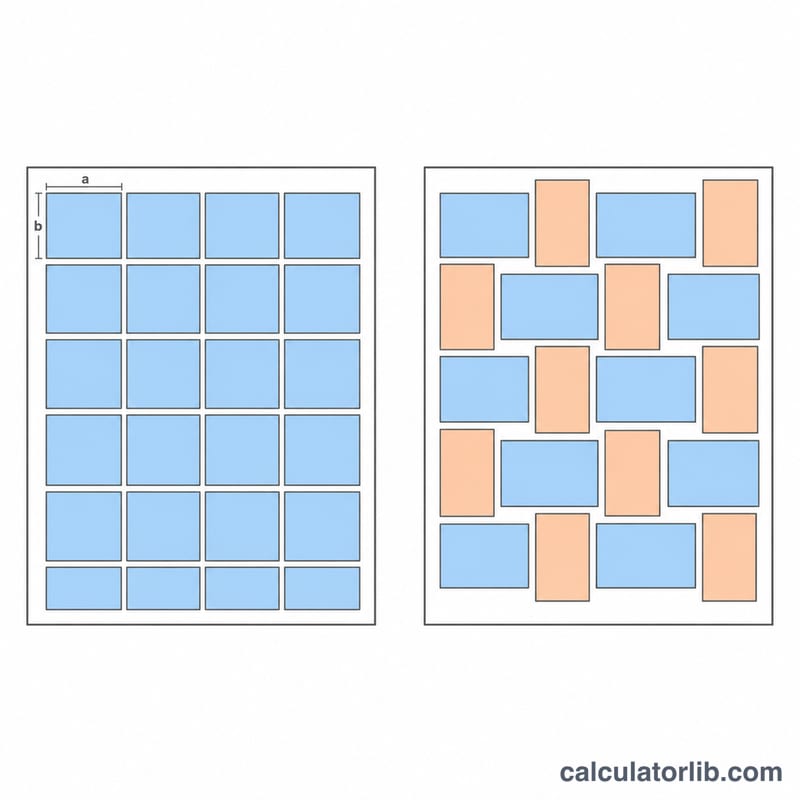
- Consider interlocking or pinwheel patterns. Alternating the layer pattern ties the stack together and improves stability. It can change the count per layer, so check it against the simple grid result. Use stretch wrap, straps or corner boards as needed.
- Re-check the limits before finalizing. Confirm the final stack height against the carrier or rack height limit. Also confirm the pallet footprint against the container or trailer interior, since some pallet sizes fit more efficiently than others.
This is general information, not professional packaging or transport engineering advice. Follow your carrier's and packaging supplier's specifications.
FAQ
Does it use mixed patterns such as pinwheel?
No. It uses uniform block stacking within each layer, so real pinwheel or interlocking patterns may fit slightly more boxes.
Does it check weight?
No. Always verify the pallet weight rating and stack crush strength of your cartons separately.
Can boxes be laid on any side?
Yes, the calculator assumes any side may face up. If your cartons are marked This Side Up, set the box height as the upright dimension and compare results manually.