What is the Dog Body Surface Area Calculator?
This tool estimates a dog's body surface area (BSA) in square meters from its body weight. Many chemotherapy and other narrow-therapeutic-index drugs are dosed per square meter of body surface rather than per kilogram, because BSA scales more closely with metabolic rate than weight alone. Veterinarians use BSA to convert a mg/m² protocol into a practical per-patient dose.
The formula explained
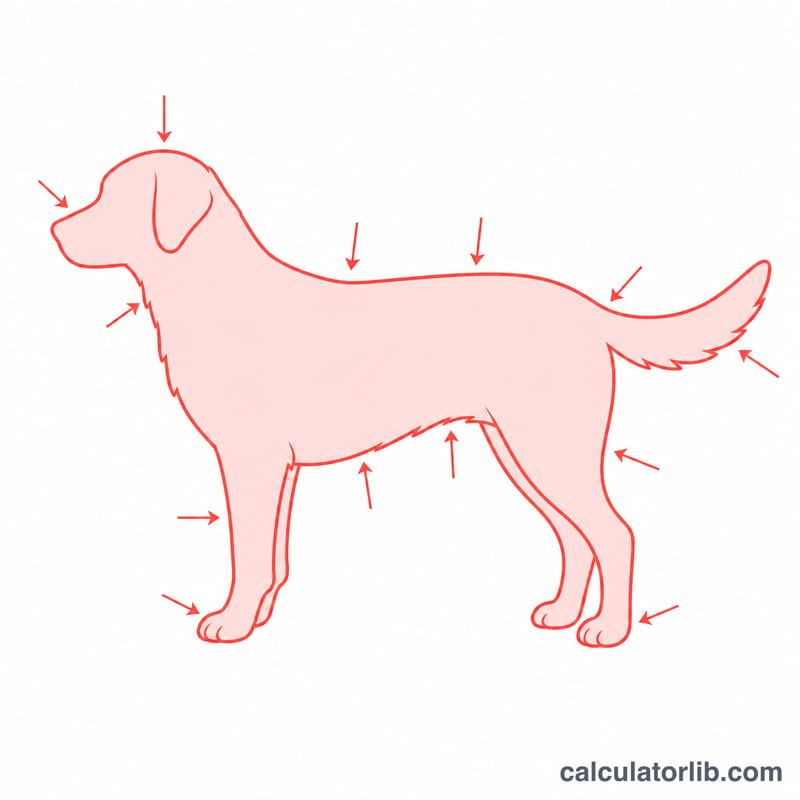
The calculator uses the Meeh-type allometric equation with the canine constant \(K = 10.1\):
$$\text{BSA} = \frac{10.1 \times W^{2/3}}{100}$$Here \(\text{BSA}\) is the body surface area in square meters and \(W\) is the body weight in kilograms. The exponent \(\tfrac{2}{3}\) reflects how surface area grows more slowly than mass as an animal gets larger.
How to use it
Enter the dog's current weight in kilograms and read the estimated BSA in square meters. Multiply that value by the protocol dose (for example mg/m²) to obtain the total dose to administer.
Worked example
For a \(10\,\text{kg}\) dog:
$$\text{BSA} = \frac{10.1 \times 10^{2/3}}{100} = \frac{10.1 \times 4.6416}{100} = 0.469\,\text{m}^2$$So a protocol of \(250\,\text{mg/m}^2\) would give roughly \(0.469 \times 250 \approx 117\,\text{mg}\).
Dog Weight to BSA Reference Table
Body surface area is estimated here with the Meeh-type formula \(\text{BSA (m}^2\text{)} = \frac{10.1 \times W^{2/3}}{100}\), where \(W\) is body weight in kilograms. The values below are rounded formula estimates, not measured surface areas.
| Weight (kg) | BSA (m²) |
|---|---|
| 2 | 0.160 |
| 5 | 0.295 |
| 10 | 0.469 |
| 15 | 0.614 |
| 20 | 0.744 |
| 25 | 0.864 |
| 30 | 0.975 |
| 40 | 1.181 |
| 50 | 1.371 |
Example substitution for 20 kg: \(10.1 \times 20^{2/3} / 100 = 10.1 \times 7.368 / 100 \approx 0.744\) m².
Pounds to Kilograms Conversion for BSA
The formula needs weight in kilograms. Convert pounds with 1 lb = 0.45359 kg, then apply the BSA formula. Values are rounded estimates.
| Weight (lb) | Weight (kg) | BSA (m²) |
|---|---|---|
| 5 | 2.268 | 0.174 |
| 10 | 4.536 | 0.277 |
| 20 | 9.072 | 0.439 |
| 30 | 13.608 | 0.576 |
| 50 | 22.680 | 0.809 |
| 70 | 31.751 | 1.013 |
| 100 | 45.359 | 1.285 |
Example: 50 lb × 0.45359 = 22.680 kg, so \(\text{BSA} = 10.1 \times 22.680^{2/3} / 100 = 10.1 \times 8.012 / 100 \approx 0.809\) m².
Interpreting Your BSA Result
BSA is a scaling estimate. Some protocols, notably many chemotherapy protocols, state doses in mg/m². The total dose is then the protocol's mg/m² value multiplied by the dog's BSA. The calculator only supplies the BSA figure and does not decide a dose.
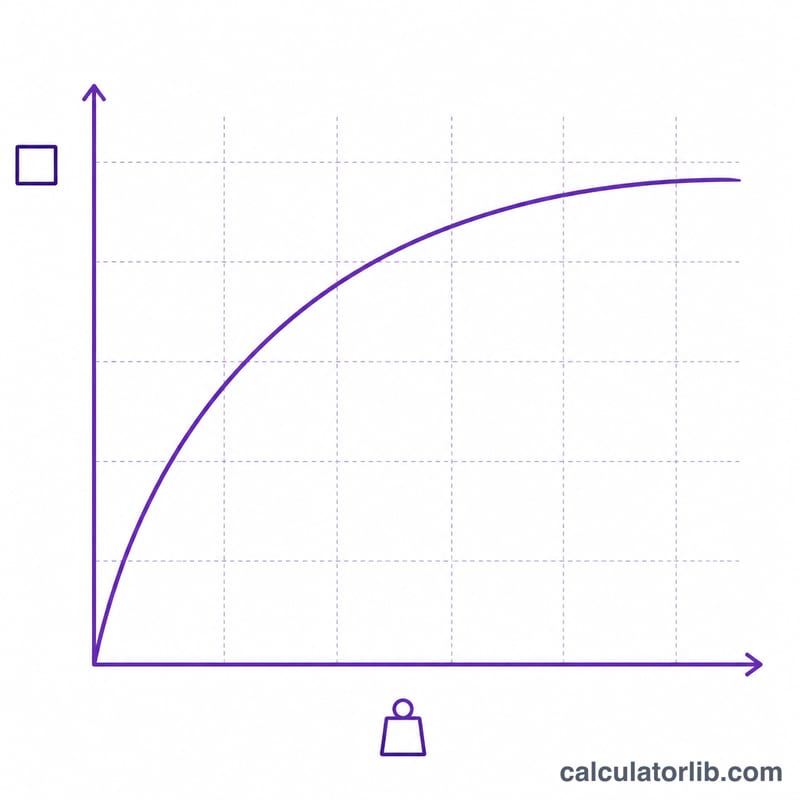
BSA does not rise in proportion to weight, because it scales with weight to the power 2/3. Doubling a dog's weight multiplies BSA by \(2^{2/3} \approx 1.587\), an increase of about 59%, not 100%. For example, 10 kg gives 0.469 m² and 20 kg gives 0.744 m². Because of this, per-kg and per-m² dosing methods give different results, especially at the extremes of size.
Limitations:
- The formula is an estimate based on an average body shape. It does not measure the actual skin surface.
- Body condition matters. In obese or very thin dogs, weight may not reflect lean body mass, and the estimate may be less representative.
- Breed conformation (for example sighthounds versus short-legged or stocky breeds) changes the true surface-to-weight relationship.
- Very small dogs and very large or giant breeds are where scaling approximations are least reliable, and some protocols apply separate rules for them.
Always use an accurate, current weight in kilograms. Dosing decisions, any adjustments, and the choice of protocol rest with the treating veterinarian, who works from current protocols and the individual patient. This is general information, not veterinary advice.
FAQ
Is the result exact? No. BSA formulas are population estimates; body condition and breed conformation cause variation. Always confirm doses against clinical judgment and current protocols.
Why use BSA instead of weight for some drugs? BSA tracks metabolic scaling better, which reduces relative overdosing in very large dogs and underdosing in very small dogs for certain cytotoxic agents.
What units are used? Weight is entered in kilograms and BSA is returned in square meters (m²).