
What is Maximum Operating Depth (MOD)?
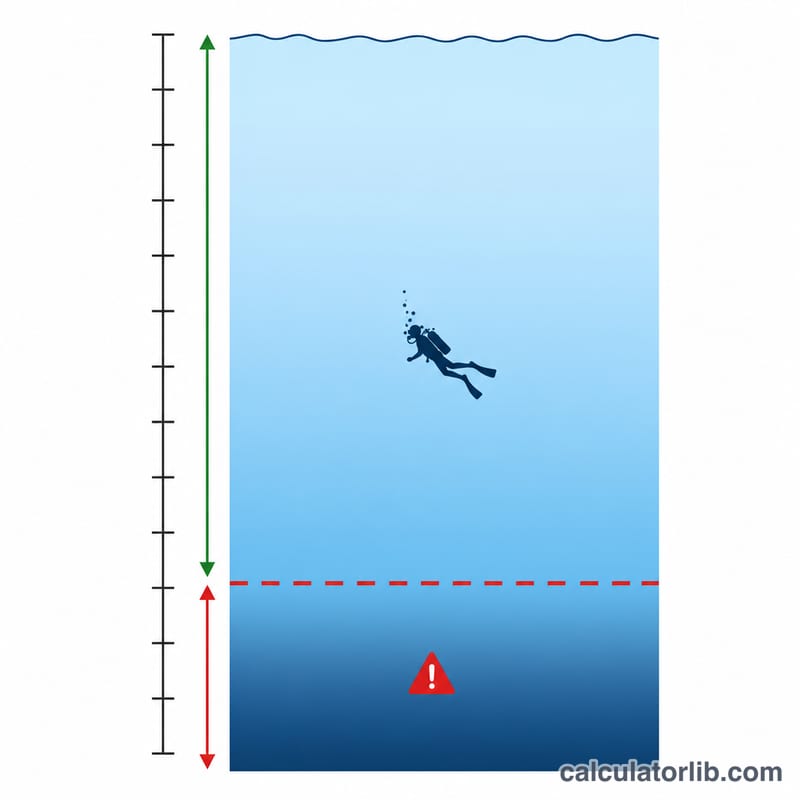
The Maximum Operating Depth (MOD) is the deepest depth at which a given breathing gas can be used before the partial pressure of oxygen (ppO₂) exceeds a safe limit. When diving with enriched air nitrox — a gas with a higher oxygen fraction than the 21% found in air — the richer oxygen content reduces nitrogen narcosis and decompression obligations, but it also raises the risk of central nervous system (CNS) oxygen toxicity at depth. The MOD tells you exactly how deep you can safely go.
How to use this calculator
Enter the oxygen fraction of your blend as a percentage (for example, 32 for EAN32) and your chosen maximum ppO₂ limit in bar. Most recreational agencies use a working limit of 1.4 bar, with 1.6 bar reserved as a contingency or for decompression stops. The calculator returns the MOD in both meters and feet of seawater.
The formula explained
The relationship comes from the fact that pressure increases by approximately 1 bar (1 atmosphere) for every 10 meters of seawater. At the surface the absolute pressure is 1 ata, so the partial pressure of oxygen is fO₂ × (depth/10 + 1). Setting this equal to the ppO₂ limit and solving for depth gives:
$$\text{MOD}_{m} = \left(\frac{\text{ppO}_2}{\text{O}_2\%/100} - 1\right) \times 10$$For feet, replace 10 with 33, the conventional feet-per-atmosphere value.
$$\text{MOD}_{ft} = \left(\frac{\text{ppO}_2}{\text{O}_2\%/100} - 1\right) \times 33$$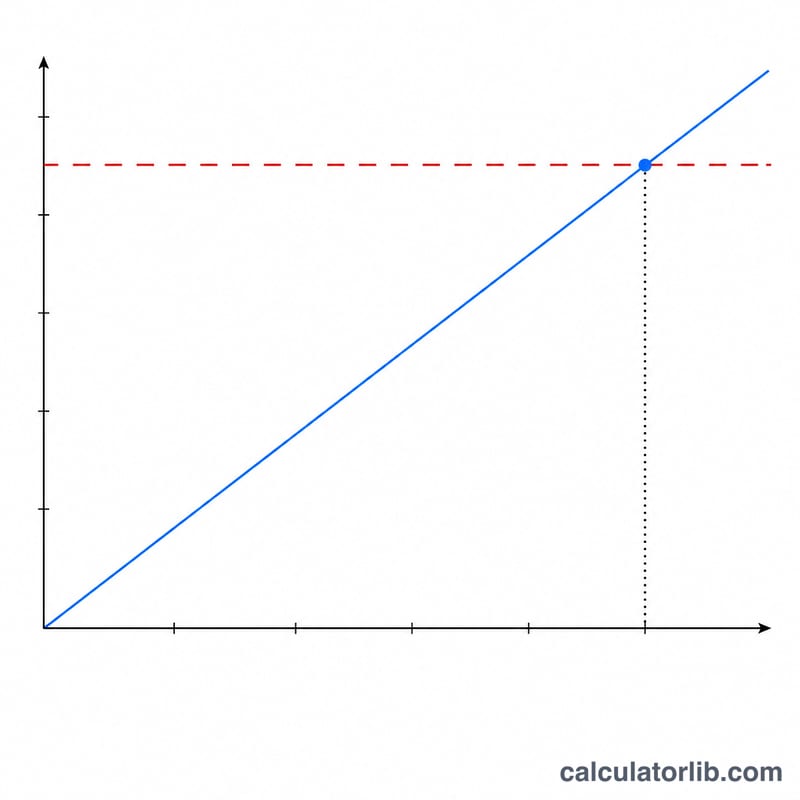
Worked example
For EAN32 (fO₂ = 0.32) with a ppO₂ limit of 1.4 bar:
$$\text{MOD} = \left(\frac{1.4}{0.32} - 1\right) \times 10 = (4.375 - 1) \times 10 = 33.75 \text{ meters}$$So an EAN32 diver should not exceed roughly 33.8 m using a 1.4 bar limit.
FAQ
What ppO₂ limit should I use? 1.4 bar is the standard working limit for the active part of a dive; 1.6 bar is a commonly accepted maximum for resting/deco situations. Always follow your training and agency guidelines.
Does this work for pure oxygen or trimix? The formula uses oxygen fraction only, so it works for any oxygen percentage, including 100% O₂ and the oxygen component of trimix.
Are these depths exact? The 10 m/bar and 33 ft/atm values are practical approximations used throughout dive planning. Conservative divers round MOD down to the nearest meter or foot.