What this calculator does
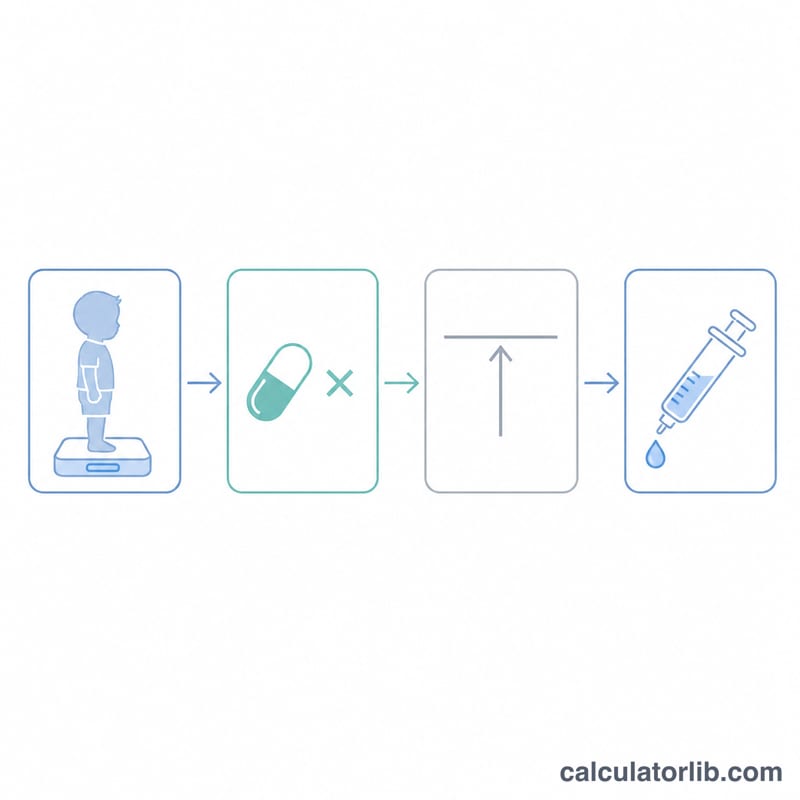
Most medicines for children are not prescribed as a fixed tablet strength but as a rate per kilogram of body weight, because a 6 kg infant and a 40 kg pre-teen need very different amounts of the same drug. This tool performs that conversion: you enter the child weight, the prescribed rate in milligrams per kilogram per dose, how many doses are given each day, an optional maximum single dose, and the strength of the liquid product. It returns the milligrams per dose, the total daily milligrams, the exposure per kilogram per day, and the exact volume to draw into an oral syringe.
The formula explained
The core calculation is a single multiplication:
$$D_{dose} = W_{kg} \times R$$where \(W_{kg}\) = body weight in kilograms and \(R\) = the prescribed rate in mg/kg per dose. Pounds are converted first with \(W_{kg} = W_{lb} \times 0.45359237\). Because weight-based rates keep rising with body size while drug ceilings do not, a cap is applied: \(D_{dose} = \min(W_{kg} \times R,\ D_{max})\). The daily total is \(D_{day} = D_{dose} \times n\) for \(n\) doses. For a syrup of strength \(C_{mg}\) per \(C_{mL}\) millilitres the measured volume is
$$V = \frac{D_{dose} \times C_{mL}}{C_{mg} }$$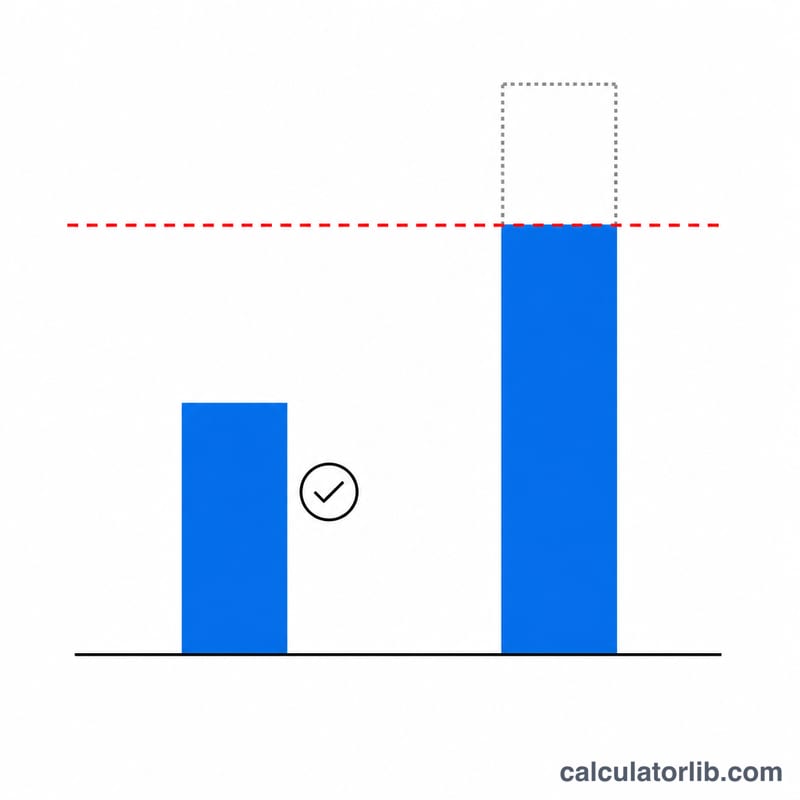
Worked example
A child weighs 18 kg and is prescribed 15 mg/kg per dose, four times a day, using a suspension of 160 mg per 5 mL:
$$D_{dose} = 18 \times 15 = 270\,\text{mg}$$$$V = \frac{270 \times 5}{160} = 8.44\,\text{mL}$$The daily total is \(270 \times 4 = 1080\) mg, which is 60 mg/kg/day. The dose is below a 1000 mg single-dose ceiling, so no cap applies.
Common Pediatric mg/kg Dosing Rates and Ceilings
The table below lists widely published oral dosing rates for common pediatric medicines. These are reference values taken from product labelling and standard formularies — principally manufacturer labelling, the BNF for Children (United Kingdom) and US pediatric references such as the American Academy of Pediatrics Red Book and US package inserts. Because these sources are national, figures differ between countries for the same drug; where they differ materially it is noted.
| Drug (oral) | mg/kg per dose | Usual interval / doses per day | Max single dose | Max daily amount |
|---|---|---|---|---|
| Acetaminophen (paracetamol) | 10–15 mg/kg | Every 4–6 h (4–5 doses/day) | 1000 mg | 75 mg/kg/day, not exceeding 4000 mg/day (US references). UK BNFc practice is normally 4 doses in 24 h, i.e. about 60 mg/kg/day |
| Ibuprofen | 5–10 mg/kg | Every 6–8 h (3–4 doses/day) | 400 mg | 40 mg/kg/day; over-the-counter adult ceiling 1200 mg/day |
| Amoxicillin (standard dose) | Total 20–45 mg/kg/day divided | Every 8 or 12 h (2–3 doses/day) | Commonly 500–1000 mg | Typically 2–4 g/day depending on reference |
| Amoxicillin (high-dose otitis media regimens) | Total 80–90 mg/kg/day divided | Every 12 h (2 doses/day) | Commonly 1000 mg | Usually capped near 4 g/day |
| Cefalexin (cephalexin) | Total 25–50 mg/kg/day divided | Every 6–12 h (2–4 doses/day) | Commonly 500–1000 mg | Usually 4 g/day (higher totals used for severe infection under specialist direction) |
| Azithromycin (5-day course) | 10 mg/kg day 1, then 5 mg/kg days 2–5 | Once daily | 500 mg on day 1; 250 mg on days 2–5 | Same as single dose (once-daily drug) |
Important limits on using any of these rows:
- Age and maturity matter. Neonates and young infants often have entirely separate schedules (lower mg/kg, longer intervals) because of immature clearance; several of the rates above do not apply below a stated age or weight.
- Organ function matters. Renal impairment changes the interval or dose for drugs cleared by the kidney (including amoxicillin and cefalexin); hepatic impairment, malnutrition or chronic low intake lowers the safe acetaminophen ceiling.
- Body habitus matters. In obesity, weight-based scaling on total body weight can overshoot; some references specify dosing on ideal body weight or an adult cap.
- The written order wins. This table exists so you can sanity-check arithmetic. Where it disagrees with the prescriber's written order or the dispensed label, the prescription and the pharmacist's instruction govern — not the table.
Interpreting Your Result
The calculator returns four related numbers. Each answers a different question.
- mg per dose — the amount for one administration, computed as \(W \times R\) and then limited by the single-dose cap. It is not the amount for the day.
- mg per day — the per-dose amount multiplied by the number of doses in 24 hours, \(D_{\text{day}} = D_{\text{dose}} \times f\).
- mg/kg/day — the exposure figure, \(D_{\text{day}} / W\). This is the number you compare against the published daily ceiling for the drug (for example 75 mg/kg/day for acetaminophen in US references, or 40 mg/kg/day for ibuprofen). A per-dose rate inside the normal range can still exceed the daily ceiling if the doses are given too frequently.
- mL per dose — the liquid volume, \(V = D_{\text{dose}} / S\), where \(S\) is the concentration in mg per mL.
Worked example
A child weighing 14 kg, acetaminophen at 15 mg/kg per dose, four doses per day, single-dose cap 1000 mg, suspension 160 mg per 5 mL (32 mg/mL):
$$D_{\text{dose}} = \min(14 \times 15,\; 1000) = \min(210,\; 1000) = 210\ \text{mg}$$So the dose is 210 mg per dose.
$$D_{\text{day}} = 210 \times 4 = 840\ \text{mg/day} \qquad \frac{840}{14} = 60\ \text{mg/kg/day}$$$$V = \frac{210\ \text{mg}}{32\ \text{mg/mL}} = 6.5625 \approx 6.6\ \text{mL}$$60 mg/kg/day sits below the 75 mg/kg/day US reference ceiling and well below 4000 mg/day, and 6.6 mL is a measurable volume in a standard 10 mL oral syringe.
What a capped result means
If the output is flagged as capped, weight-based scaling has reached the adult maximum. For a 70 kg adolescent at 15 mg/kg, \(70 \times 15 = 1050\) mg, which the 1000 mg cap reduces to 1000 mg. Beyond that weight the dose stops growing: further weight gain does not increase the amount given, and the patient has effectively moved onto adult fixed dosing.
When the mL volume looks wrong
A volume far outside the usual measurable range — roughly under 0.5 mL or over 10 mL for a single oral dose — is almost always a data-entry problem rather than a real dose:
- Volume too large: the concentration entered is too dilute for the child's size. A typical cause is entering 160 mg/5 mL (infant/children's acetaminophen) when the bottle in hand is a more concentrated product, or entering a low-strength antibiotic suspension when a double-strength one was dispensed.
- Volume too small: the concentration entered is too high — for example 500 mg/5 mL when the product is actually 250 mg/5 mL, or a concentrated infant drop strength used for a children's suspension. Doses under about 0.5 mL usually need an oral syringe graduated in 0.1 mL increments, and for very small volumes a pharmacist may need to dilute or supply a different strength.
- Unit confusion: weight entered in pounds while the unit selector says kilograms roughly doubles every output.
If the number disagrees with the label
If the computed dose differs from the instruction printed on the dispensed bottle, do not simply follow the larger or the more familiar figure. Stop and resolve the difference with the prescriber or the dispensing pharmacist, who can see the actual product strength, the child's current weight and the indication. Legitimate reasons for a difference include age-band (rather than weight-band) dosing, renal dose adjustment, rounding to a convenient syringe mark, or an indication that uses a different rate from the general one.
This calculator performs arithmetic verification only. It is general information, not medical advice, and not a substitute for a prescription, a professional dose check or the product labelling. Dosing decisions for a child should be made by a qualified prescriber or pharmacist.
Weight and Concentration Conversions
Pounds to kilograms
Weight-based dosing is defined in kilograms, so a weight recorded in pounds must be converted first, using the exact factor \(1\ \text{lb} = 0.45359237\ \text{kg}\).
| Weight (lb) | Weight (kg) |
|---|---|
| 5 | 2.268 |
| 10 | 4.536 |
| 15 | 6.804 |
| 20 | 9.072 |
| 30 | 13.608 |
| 40 | 18.144 |
| 50 | 22.680 |
| 60 | 27.216 |
| 80 | 36.287 |
| 100 | 45.359 |
For neonates and small infants whose weight is charted in grams, divide by 1000: \(3450\ \text{g} \div 1000 = 3.45\ \text{kg}\). Use the most recent measured weight, not a birth weight or an estimate, since a few hundred grams changes the dose meaningfully at this size.
Liquid concentration equivalents
Oral suspensions are labelled as milligrams per 5 mL, but the dose volume formula needs milligrams per millilitre. Divide the labelled strength by 5.
| Labelled strength | Concentration (mg/mL) | Volume for a 200 mg dose |
|---|---|---|
| 100 mg / 5 mL | 20 mg/mL | 10 mL |
| 125 mg / 5 mL | 25 mg/mL | 8 mL |
| 160 mg / 5 mL | 32 mg/mL | 6.25 mL |
| 200 mg / 5 mL | 40 mg/mL | 5 mL |
| 250 mg / 5 mL | 50 mg/mL | 4 mL |
| 400 mg / 5 mL | 80 mg/mL | 2.5 mL |
| 500 mg / 5 mL | 100 mg/mL | 2 mL |
Two cautions on concentration:
- Infant drops and children's suspensions of the same drug can differ in strength, and the same brand name may be sold at different strengths in different countries or pack sizes. Always read the mg per mL (or mg per 5 mL) off the bottle you are actually holding rather than from memory or from an older bottle.
- A strength mismatch scales the whole dose. Using 250 mg/5 mL figures with a 500 mg/5 mL bottle delivers double the intended milligrams at the same volume. Confirm the strength before measuring, and measure with an oral syringe or the supplied dosing device — never a kitchen spoon.
General information only, not medical advice. Confirm any dose and product strength with the prescriber or pharmacist.
Frequently asked questions
Should I use actual or ideal body weight? Standard pediatric orders use recent measured weight. For children with obesity some drugs are dosed on adjusted or lean body weight; follow the prescriber instruction rather than assuming.
Why does my big child get an adult dose? Once weight-based dosing reaches the adult maximum, the ceiling governs. That is exactly what the single-dose cap field models.
Can I round the millilitres? Round only to the graduations on the supplied syringe, and never round upward past the calculated dose. Confirm with a pharmacist.
Is this medical advice? No. It is arithmetic support for an existing prescription and must always be double-checked.