What this calculator does
The Pediatric Weight-Based Dose Calculator converts a prescribed weight-based dose (in mg/kg) into the actual milligram dose for a child of a given body weight, then calculates the liquid volume (in mL) to measure out based on the medication's concentration. It also totals the dose and volume across all doses given in a day. This is an educational aid only — always confirm the final dose, maximum limits, and product concentration with a pharmacist or prescriber before administering any medication.
How to use it
Enter the child's weight in kilograms, the prescribed dose per kilogram (mg/kg), and the concentration of the liquid medication printed on the bottle (mg/mL). Optionally enter how many doses are given per day to see the daily totals. The calculator returns the dose per administration in milligrams and the matching volume in milliliters.
The formula explained
The per-dose amount is simply Dose = Weight × Dose per kg. To turn that milligram amount into a measurable liquid volume, divide by the concentration: Volume = Dose ÷ Concentration. Multiplying each by the number of doses per day gives the daily dose and daily volume, which is useful for checking against a maximum daily dose limit.
$$\text{Dose (mg)} = \text{Weight}_{kg} \times \text{Dose}_{mg/kg}, \quad \text{Volume (mL)} = \frac{\text{Dose}}{\text{Concentration}_{mg/mL}}$$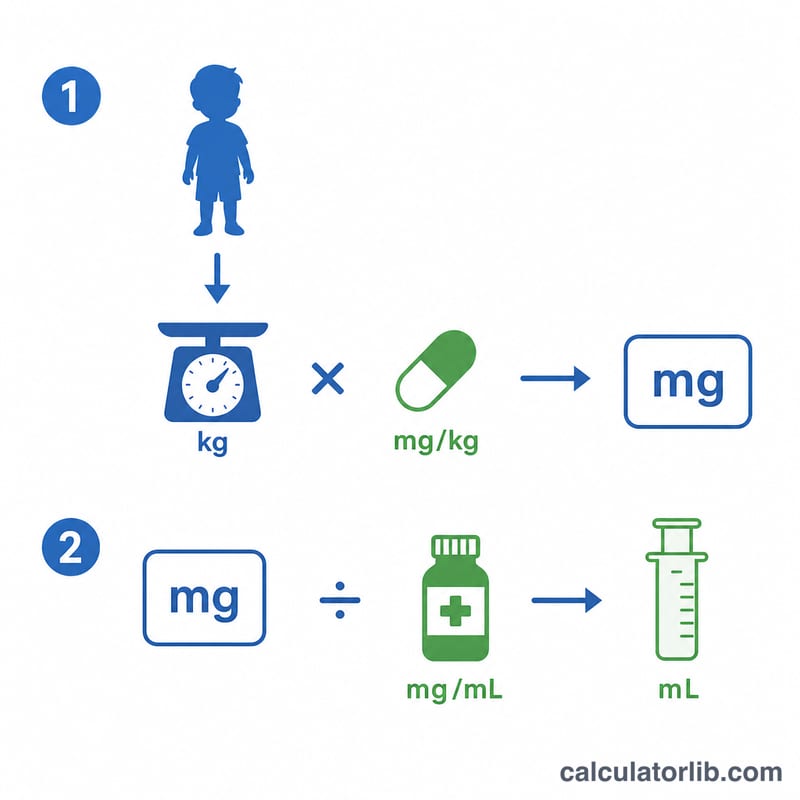
Worked example
A 20 kg child is prescribed 15 mg/kg of acetaminophen, available as a 100 mg/mL suspension, given 3 times daily. Dose = \(20 \times 15 = \) 300 mg. Volume = \(300 \div 100 = \) 3 mL per dose. Daily dose = \(300 \times 3 = 900\) mg, and daily volume = \(3 \times 3 = 9\) mL.
Common Pediatric Liquid Concentrations and Reference mg/kg Doses
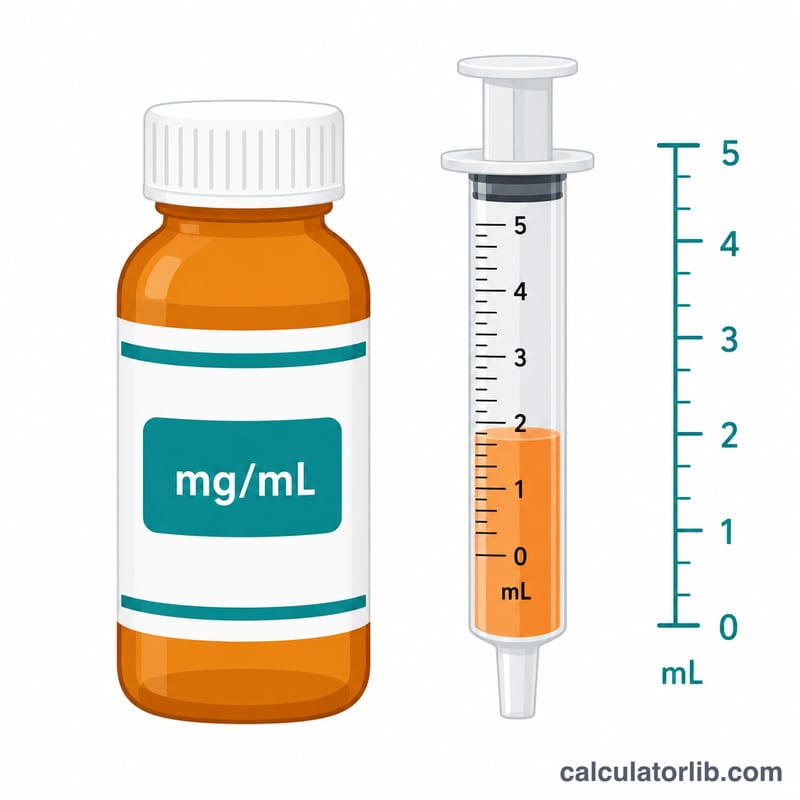
Weight-based dosing needs two numbers that are easy to confuse: the dose in mg/kg, and the concentration of the liquid in mg/mL. Bottles are usually labelled per 5 mL (or per 1.25 mL for infant drops), so the concentration must be converted before it is entered into the calculator: \(\text{mg/mL} = \dfrac{\text{mg on the label}}{\text{mL on the label}}\). The table below shows widely published oral liquid strengths with that division already carried out.
| Medicine | Label strength | Worked conversion | Concentration (mg/mL) |
|---|---|---|---|
| Acetaminophen (paracetamol) suspension | 160 mg/5 mL | 160 ÷ 5 | 32 |
| Acetaminophen infant concentrate | 100 mg/mL (e.g. 80 mg/0.8 mL) | 100 ÷ 1 | 100 |
| Ibuprofen suspension | 100 mg/5 mL | 100 ÷ 5 | 20 |
| Ibuprofen infant drops | 50 mg/1.25 mL | 50 ÷ 1.25 | 40 |
| Amoxicillin suspension | 125 mg/5 mL | 125 ÷ 5 | 25 |
| Amoxicillin suspension | 250 mg/5 mL | 250 ÷ 5 | 50 |
| Amoxicillin suspension | 400 mg/5 mL | 400 ÷ 5 | 80 |
| Cetirizine oral solution | 5 mg/5 mL | 5 ÷ 5 | 1 |
Commonly referenced weight-based doses
The figures below are the dose ranges and intervals most often quoted in manufacturer labeling and standard pediatric drug references (for example the pediatric dosage handbooks used in hospital pharmacy, and — where noted — American Academy of Pediatrics guidance). They are reference values for understanding a calculated number, not a prescription.
| Medicine | Typical dose (mg/kg) | Interval | Daily ceiling commonly cited | Source type |
|---|---|---|---|---|
| Acetaminophen (oral) | 10–15 mg/kg per dose | every 4–6 h, usually no more than 5 doses in 24 h | 75 mg/kg/day, not exceeding the adult maximum of 4 g/day (many US over-the-counter labels state 3 g/day) | Manufacturer labeling + pediatric drug references |
| Ibuprofen (oral, age 6 months and older) | 5–10 mg/kg per dose | every 6–8 h | 40 mg/kg/day, not exceeding 1.2 g/day for over-the-counter use | Manufacturer labeling + pediatric drug references |
| Amoxicillin (common oral regimens) | 20–45 mg/kg/day divided every 8–12 h; high-dose 80–90 mg/kg/day divided every 12 h for acute otitis media (AAP, United States) | 2–3 doses per day | Indication- and product-specific; prescriber sets the total | Prescribing information + national guidelines |
| Cetirizine (oral) | Dosed by age, not weight: US labeling gives 2.5 mg once daily for ages 2–5 (up to 5 mg/day) and 5–10 mg once daily from age 6 | once daily (sometimes split) | 10 mg/day in older children and adults | Manufacturer labeling |
Important limitations. Liquid strengths differ by country, brand, pack size and reformulation, and products are reformulated over time — in the United States, for instance, infant acetaminophen drops were standardised to 160 mg/5 mL in 2011, while 100 mg/mL concentrates remain available in some other markets. The amoxicillin and cetirizine rows above reference regimens and labeling common in the United States; other countries' labels and national formularies may differ. Always read the strength printed on the bottle in hand and use that number, because the label overrides this table. Note also that not every pediatric medicine is weight-based (cetirizine above is an example), and many prescriptions cap the pediatric dose at the adult dose once a child is large enough.
This is general educational information, not professional or medical advice. A prescriber or pharmacist determines the correct medicine, dose and interval for an individual child.
FAQ
Where do I find the concentration? It is printed on the medication label, e.g. "100 mg/5 mL" equals 20 mg/mL — divide the mg by the mL.
Does this check the maximum safe dose? No. It only performs the arithmetic. You must verify per-dose and per-day maximums against the drug reference for the child's age and weight.
What if my weight is in pounds? Convert to kilograms first by dividing pounds by 2.205, or enter the kilogram value directly.