What is boat fuel economy?
Boat fuel economy tells you how far your vessel travels for each unit of fuel it burns. Unlike cars, boats are affected by hull design, load, sea state, and throttle setting, so knowing your real-world economy helps you plan range, budget for a trip, and spot maintenance issues early. This calculator reports economy two ways: miles per gallon (mpg) for Imperial users and liters per nautical mile (L/nm) for metric users.
The formula explained
The core relationship is distance divided by fuel:
$$\text{Economy} = \frac{\text{Distance}}{\text{Fuel}}$$Here \(\text{Distance}\) is the run length and \(\text{Fuel}\) is the volume consumed. In Imperial mode economy is \(\text{mpg} = \frac{\text{miles}}{\text{gallons}}\). In metric mode boaters usually track burn rate instead, so economy is expressed as \(\text{L/nm} = \frac{\text{liters}}{\text{nautical miles}}\), a smaller-is-better number.
How to use it
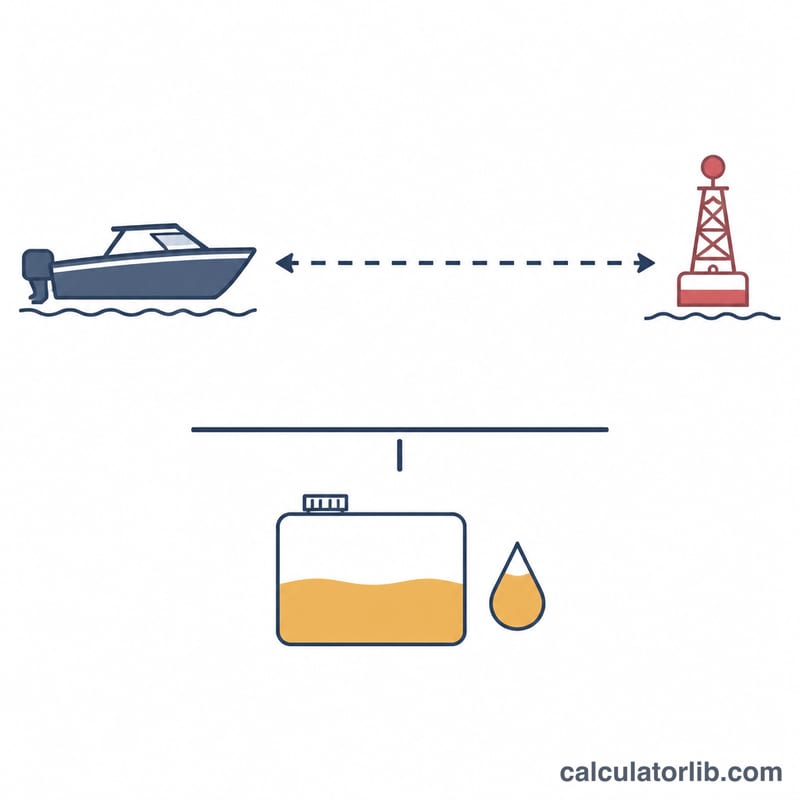
Pick your unit system, then enter the fuel you consumed and the distance you traveled over the same leg. Use a full tank-to-tank measurement for the most accurate figure. The calculator also shows an inverse metric so you can estimate consumption over a set distance.
Worked example
Suppose you burn 20 gallons over a 100 statute mile run in Imperial mode:
$$\text{mpg} = \frac{100}{20} = 5\ \text{mpg}$$The consumption figure is then \(\frac{20}{100}\times 100 = 20\) gallons per 100 miles.
Unit & Distance Conversions
Boat fuel economy is quoted in two very different ways: miles per gallon (MPG), common in North America, and liters per nautical mile (L/nm) or liters per 100 nautical miles (L/100nm), common in metric and marine contexts. Use the factors below to move between them. Note that whether a "mile" means a statute mile or a nautical mile, and whether a "gallon" is US or Imperial, changes the result — always state which you mean.
| Convert | Multiply by | Example |
|---|---|---|
| US gallons → liters | 3.785 | \(10\ \text{gal} \times 3.785 = 37.85\ \text{L}\) |
| Imperial gallons → liters | 4.546 | \(10\ \text{gal} \times 4.546 = 45.46\ \text{L}\) |
| Liters → US gallons | 0.2642 | \(40\ \text{L} \times 0.2642 = 10.57\ \text{gal}\) |
| Statute miles → nautical miles | 0.86898 | \(60\ \text{mi} \times 0.86898 = 52.14\ \text{nm}\) |
| Nautical miles → statute miles | 1.15078 | \(50\ \text{nm} \times 1.15078 = 57.54\ \text{mi}\) |
To convert an economy figure from US MPG (statute miles per US gallon) into L/nm, combine the two factors:
$$\text{L/nm} = \frac{3.785 \times 1.15078}{\text{MPG}} = \frac{4.356}{\text{MPG}}$$
So a boat getting \(3\ \text{MPG}\) burns \(4.356 / 3 = 1.45\ \text{L/nm}\), or about \(145\ \text{L/100nm}\). If your MPG is measured in Imperial gallons instead, use \(4.546 \times 1.15078 = 5.231\) in the numerator, giving \(5.231 / 3 = 1.74\ \text{L/nm}\).
US vs Imperial gallons matters. One Imperial gallon (4.546 L) is about 20% larger than one US gallon (3.785 L). The same fuel burn and distance therefore yield a numerically higher MPG when expressed in Imperial gallons than in US gallons — the fuel used is identical, only the unit differs. US gallons are standard in the United States; the Imperial gallon is used in the UK and some Commonwealth countries. Always confirm which gallon a stated MPG figure refers to before comparing boats.
Economy Across Common Boating Scenarios
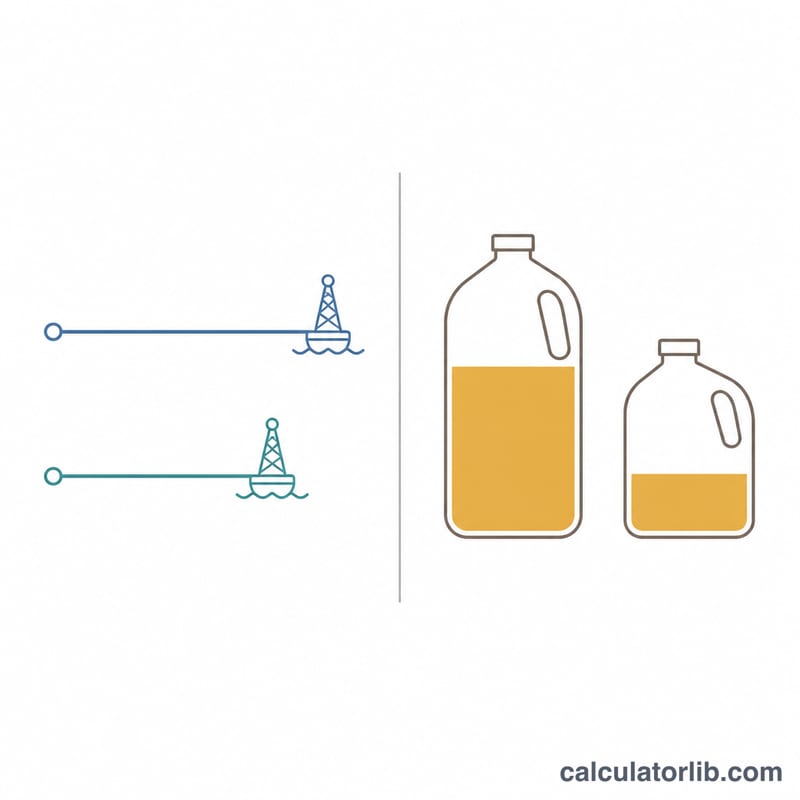
Real fuel economy swings widely with sea state, load, and throttle setting even for the same boat. The table below shows illustrative figures for one hypothetical planing powerboat over the same \(60\)-mile run, using US gallons and statute miles. MPG is computed as \(\text{MPG} = \text{distance} \div \text{fuel}\); the L/nm column uses the \(4.356 / \text{MPG}\) relationship from the conversion section. These values are examples to show the magnitude of each effect, not measurements of any specific vessel — always calculate from your own logged fuel and distance.
| Scenario | Fuel (US gal) | Distance (mi) | Economy (MPG) | Economy (L/nm) |
|---|---|---|---|---|
| Calm water, cruise RPM, light load | 20 | 60 | 3.00 | 1.45 |
| Calm water, cruise RPM, heavy load | 27 | 60 | 2.22 | 1.96 |
| Choppy water, cruise RPM, light load | 30 | 60 | 2.00 | 2.18 |
| Choppy water, cruise RPM, heavy load | 36 | 60 | 1.67 | 2.61 |
| Wide-open throttle, calm water | 60 | 60 | 1.00 | 4.36 |
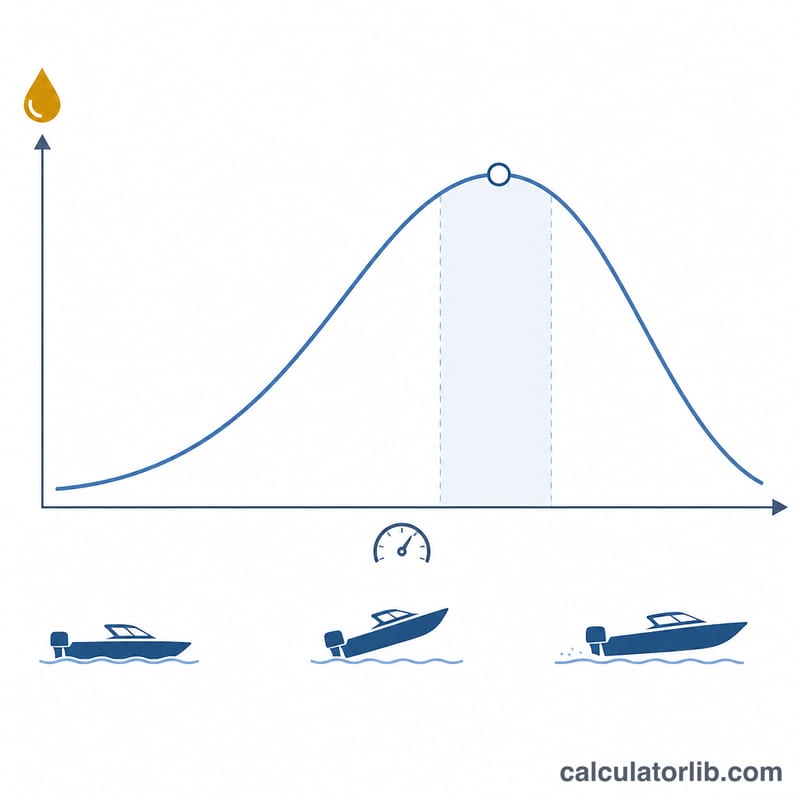
Reading down the table, moving from calm to choppy water at the same cruise RPM cuts economy by roughly a third (\(3.00 \to 2.00\ \text{MPG}\)), adding a heavy load costs a further chunk, and running wide-open throttle can more than triple fuel burn versus an efficient cruise (\(3.00 \to 1.00\ \text{MPG}\)). For most planing boats the best economy sits at the lowest RPM that keeps the hull comfortably on plane — well below full throttle. Log fuel and distance for each trip and run the numbers under your own conditions rather than relying on a single rated figure.
FAQ
Why is my economy lower than expected? Heavy loads, choppy water, a dirty hull, and running above cruising rpm all cut economy sharply.
Should I measure at cruise or wide-open throttle? Measure at your normal cruising speed; most boats reach best economy well below top speed.
Can I mix units? No. Keep fuel and distance in the units shown for the chosen system so the result stays valid.