What This Calculator Does
The Boat Fuel Range Calculator estimates how far a vessel can travel on the fuel it currently carries. It combines three key numbers every skipper should know: the fuel on board, the burn rate at cruise, and the cruising speed. It also lets you hold back a safety reserve so your planning distance reflects fuel you will actually use, not the last drop in the tank.
The Formula Explained
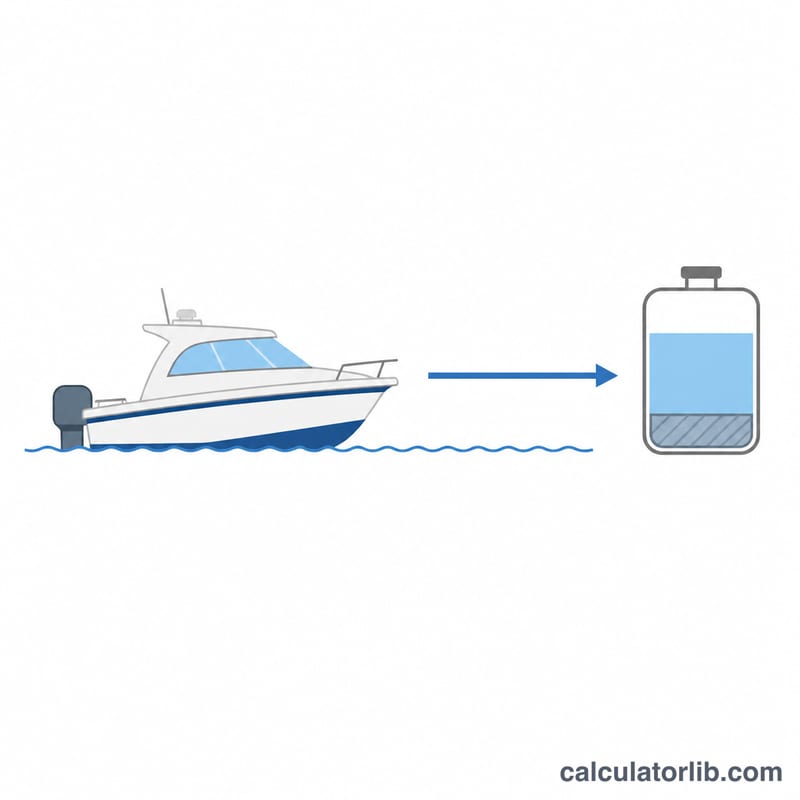
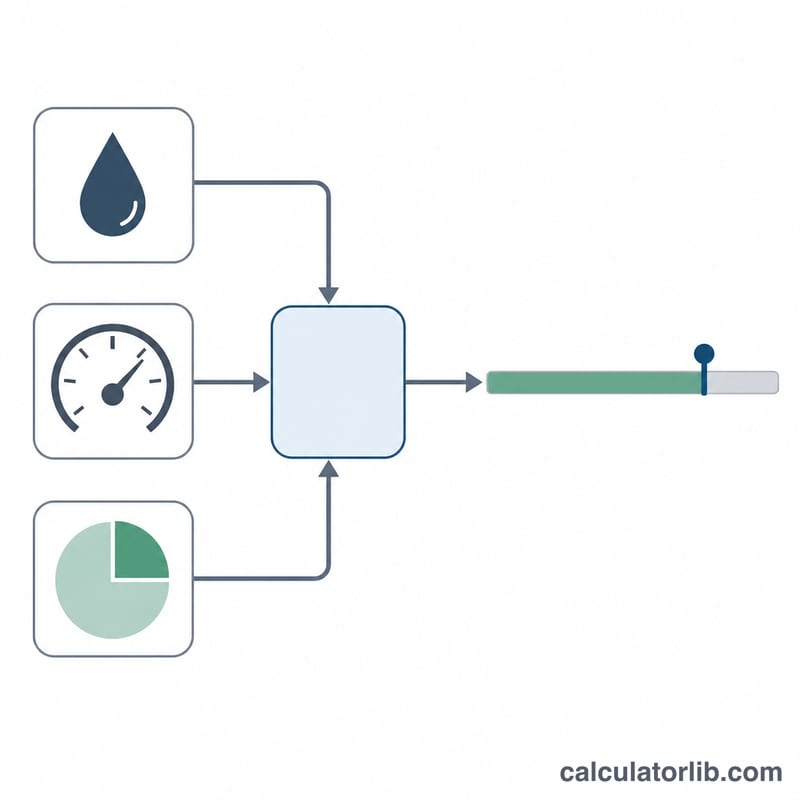
First the calculator determines usable fuel after your reserve, then converts that to hours of running time (endurance), and finally to distance:
$$\text{Usable} = \text{Fuel} \times \left(1 - \tfrac{\text{Reserve}}{100}\right)$$$$\text{Range} = \frac{\text{Usable}}{\text{Consumption}} \times \text{Speed}$$Here \(\text{Fuel}\) is gallons on board, \(\text{Consumption}\) is gallons burned per hour at cruise, \(\text{Speed}\) is cruising speed in knots, and \(\text{Range}\) is the result in nautical miles. Because speed is in knots (nautical miles per hour) and consumption is per hour, the hours cancel cleanly.
How To Use It
Enter your total fuel on board, your average consumption in gallons per hour, and your typical cruising speed in knots. Add a reserve percentage (many boaters use the rule of thirds, keeping one third in reserve) and read the estimated range and endurance.
Worked Example
Suppose you carry 100 gallons, burn 10 gallons per hour, cruise at 20 knots, and keep a 10% reserve:
$$\text{Usable} = 100 \times (1 - 0.10) = 90\,\text{gal}$$$$\text{Range} = \frac{90}{10} \times 20 = 180\,\text{nm}$$That gives 9 hours of endurance and 180 nautical miles of range.
Range Across Common Cruising Scenarios
Every row below starts from the same tank — 100 gallons of fuel with a 10% reserve held back — so only speed and the fuel-burn that goes with it change. Because the reserve is fixed, the usable fuel is the same in every case:
$$U = 100 \times \left(1 - \frac{10}{100}\right) = 90\ \text{gal}$$For the displacement row (8 knots at 4 gal/hr), endurance and range work out as:
$$\text{Endurance} = \frac{90}{4} = 22.5\ \text{hr} \qquad \text{Range} = \frac{90}{4} \times 8 = 180\ \text{nm}$$The table shows what happens as you throttle up. Notice that range is driven by fuel efficiency (nautical miles per gallon), not raw speed — pushing the boat onto the plane and beyond burns fuel far faster than it adds speed, so the achievable range steadily shrinks.
| Cruising mode | Speed (kn) | Consumption (gal/hr) | Efficiency (nm/gal) | Endurance (hr) | Range (nm) |
|---|---|---|---|---|---|
| Displacement / slow | 8 | 4 | 2.00 | 22.5 | 180 |
| Efficient cruise | 18 | 12 | 1.50 | 7.5 | 135 |
| Wide-open throttle | 30 | 24 | 1.25 | 3.75 | 112.5 |
The consumption figures here are illustrative examples for a typical planing powerboat; your own boat's burn rate at each speed is the number that matters, so measure it rather than assuming.
Useful Boating Unit Conversions
This calculator works in nautical units, but charts, road maps, fuel docks and imported specs often mix in statute miles, kilometres, litres and imperial gallons. Use the conversions below to translate between them.
| Quantity | 1 unit equals |
|---|---|
| Distance | 1 nautical mile (nm) = 1.15 statute miles = 1.852 kilometres |
| Speed | 1 knot = 1.15 mph = 1.852 km/h |
| Fuel volume | 1 US gallon = 3.785 litres = 0.833 imperial gallon |
Note: the range this tool returns is in nautical miles because the speed input is in knots (one knot is one nautical mile per hour). If you want the answer in statute miles or kilometres, multiply the nautical-mile result by 1.15 or 1.852 respectively. Likewise, if your fuel is measured in litres or imperial gallons, convert it to US gallons before entering it so the volume matches the consumption rate in gal/hr.
Planning Your Trip With the Result
The range figure is a planning estimate made under steady, ideal conditions. Turn it into a safe passage plan with these steps:
- Apply the rule of thirds. Budget one-third of your fuel for the outbound leg, one-third to get home, and keep the final third untouched as reserve. A round trip should not use more than two-thirds of your usable fuel.
- Round the range down, never up. If the calculator returns 180 nm, plan around a smaller working figure. Rounding down builds in a margin for the many things that raise real-world burn.
- Recalculate against the real trip after refueling. Note gallons added at the pump versus hours and distance actually run, work out your true burn rate, and re-run the numbers. Measured consumption beats any factory or estimated figure.
- Raise the reserve percentage for tougher conditions. Open water, headwinds, adverse current, rough seas, a fouled hull, or a heavily loaded boat all cut range — increase the reserve input (for example from 10% to 20–25%) so the estimate reflects the day you actually face.
This is general planning information, not professional or safety advice, and it is not a substitute for on-board fuel monitoring. Watch your gauges and fuel-flow instruments throughout the trip, keep an independent record of hours run, and always carry enough margin to divert or return if conditions change.
FAQ
Why use a fuel reserve? Wind, current, and rough water raise real-world burn. A 10 to 33 percent reserve protects against running dry.
Are the units nautical or statute miles? Because speed is entered in knots, the range is in nautical miles. Multiply by about 1.15 for statute miles.
Does higher speed extend range? Not usually. Faster cruising typically burns much more per hour, so consumption rises faster than speed, shrinking range.