What this calculator does
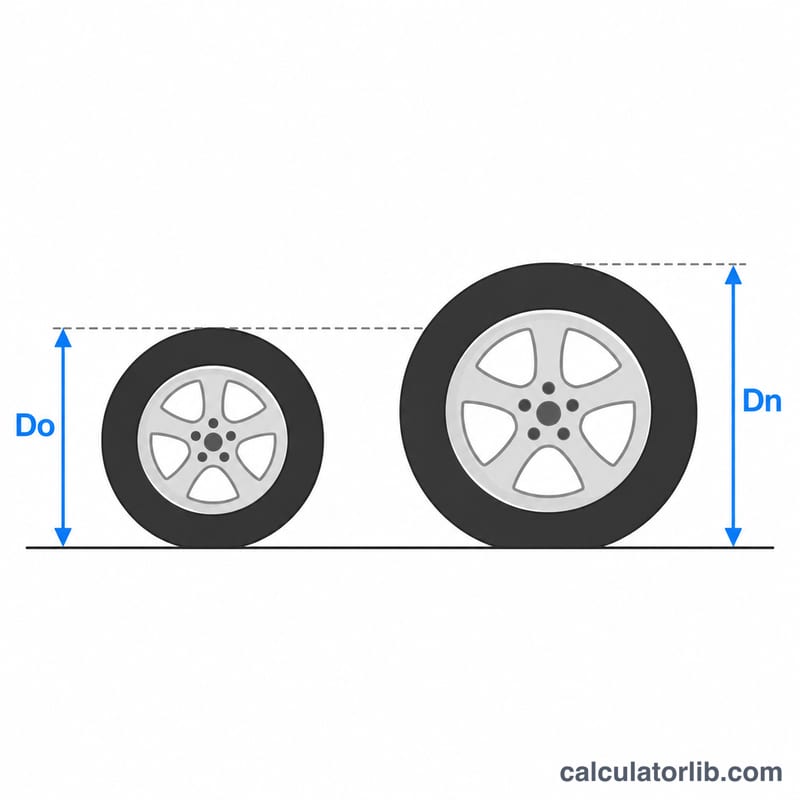
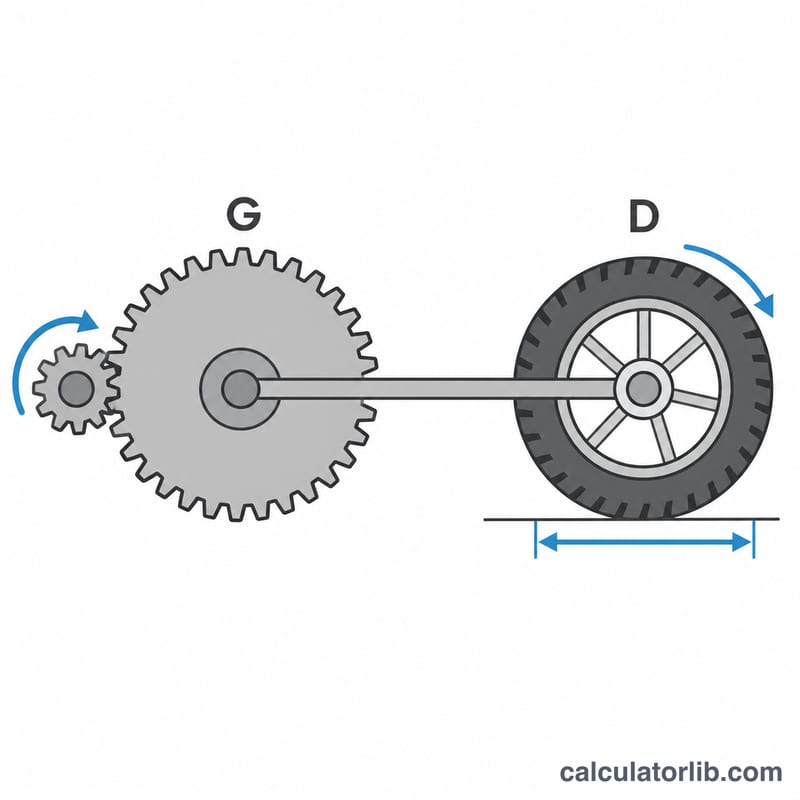
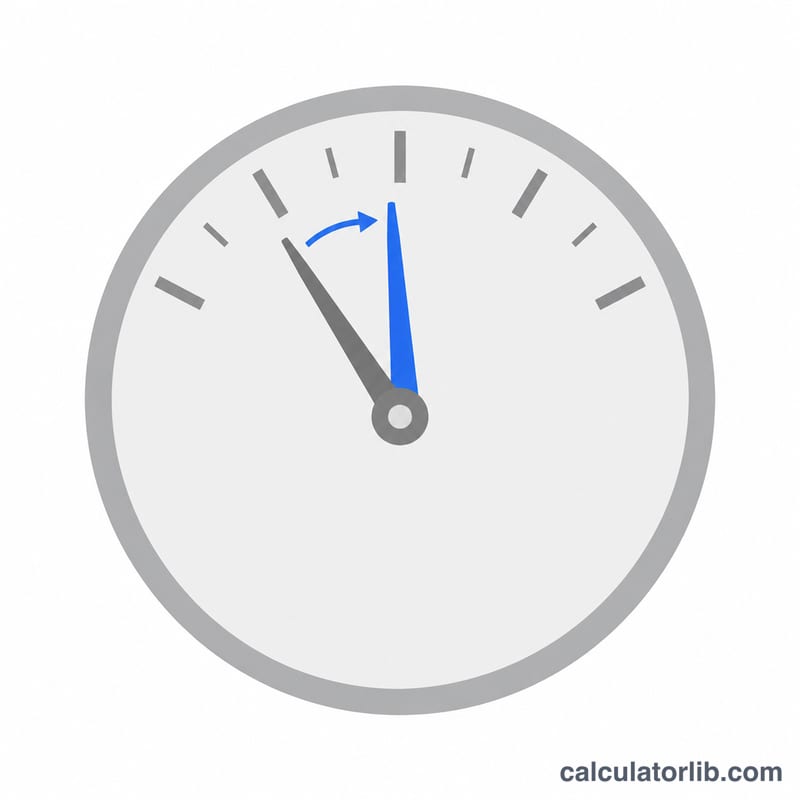
When you fit a different wheel or tire size, you change how far the vehicle travels per driveshaft revolution. A taller tire effectively lowers your gear ratio (fewer engine revs per mile) and makes the speedometer read slower than you are actually going, while a shorter tire does the opposite. This tool quantifies that change: enter your original and new tire diameters, your stock gear ratio, and a speedometer reading to see the effective gear ratio, the ratio needed to restore stock performance, your true speed, and the speedometer error.
How to use it
Measure or look up the overall diameter of your original and new tires in inches (not just the wheel/rim size). Enter your stock axle or final-drive ratio, such as 3.73. Enter any speed shown on your speedometer. The results update instantly.
The formula explained
Let \(G\) be the stock gear ratio, \(D_{old}\) the original tire diameter, \(D_{new}\) the new diameter, and \(v_{ind}\) the indicated speed. The effective gear ratio is
$$G_{eff} = G \times \frac{D_{old}}{D_{new}}$$The gear ratio that restores stock behavior and the true road speed are
$$G_{restore} = G \times \frac{D_{new}}{D_{old}}, \qquad v_{true} = v_{ind} \times \frac{D_{new}}{D_{old}}$$and the speedometer error is \(\left(\frac{D_{new}}{D_{old}} - 1\right) \times 100\%\).
Worked example
Going from a \(28\) in tire to a \(33\) in tire with a \(3.73\) gear while the speedometer reads \(60\) mph:
$$G_{eff} = 3.73 \times \frac{28}{33} \approx 3.165$$$$v_{true} = 60 \times \frac{33}{28} \approx 70.7\ \text{mph}$$To restore performance you would want \(3.73 \times \tfrac{33}{28} \approx 4.396\), and the speedometer under-reads by about \(17.9\%\).
Overall Diameter of Common Tire Sizes
A metric tire size such as 265/70R17 gives three numbers. The first is the section width in millimetres. The second is the aspect ratio, which is the sidewall height as a percentage of that width. The third is the rim diameter in inches. The overall diameter is the rim plus two sidewalls. Because the sidewall is in millimetres, divide it by 25.4 to convert it to inches:
$$D\,(\text{in}) = R + \frac{2 \times W \times (A/100)}{25.4}$$Here \(R\) is the rim diameter in inches, \(W\) is the section width in mm and \(A\) is the aspect ratio.
Example, 265/70R17: each sidewall is \(265 \times 0.70 = 185.5\) mm. Two sidewalls are \(2 \times 185.5 = 371\) mm, which is \(371 / 25.4 \approx 14.61\) in. Adding the rim gives \(17 + 14.61 \approx 31.6\) in.
Flotation sizes, which are common on off-road tires, state the overall diameter directly as the first number. A 33x12.50R15 is a nominal 33 in tall, 12.50 in wide, and fits a 15 in rim.
| Tire size | Sidewall height (mm) | Rim (in) | Overall diameter (in) |
|---|---|---|---|
| 225/65R17 | 146.25 | 17 | ≈ 28.5 |
| 245/75R16 | 183.75 | 16 | ≈ 30.5 |
| 265/70R17 | 185.5 | 17 | ≈ 31.6 |
| 285/70R17 | 199.5 | 17 | ≈ 32.7 |
| 285/75R16 | 213.75 | 16 | ≈ 32.8 |
| 315/70R17 | 220.5 | 17 | ≈ 34.4 |
| 33x12.50R15 (flotation) | — | 15 | 33 (nominal) |
| 35x12.50R17 (flotation) | — | 17 | 35 (nominal) |
These numbers are calculated from the size code alone. A tire's real diameter varies by brand, tread design, inflation and load. A mounted tire under vehicle weight also has a smaller "loaded radius" than its unloaded size, and many flotation tires measure a little under their nominal size. For the most accurate gearing and speedometer numbers, use the overall diameter from the manufacturer's spec sheet.
FAQ
Should I use rim size or tire diameter? Use overall tire diameter. Rim size ignores sidewall height, which is what actually changes the rolling distance.
Why does a bigger tire feel sluggish? It lowers the effective ratio, so the engine turns fewer times per mile, reducing available torque at the wheels.
Does this fix my speedometer? No, it shows the error so you can recalibrate or mentally adjust your reading.