What is a pet food portion calculator?
This calculator estimates how much commercial food a dog or cat should eat each day. Instead of relying on the vague feeding chart on a bag, it starts from the animal body weight and life stage, works out its daily energy need in kilocalories, and converts that into grams and cups of the specific food you feed.
How to use it
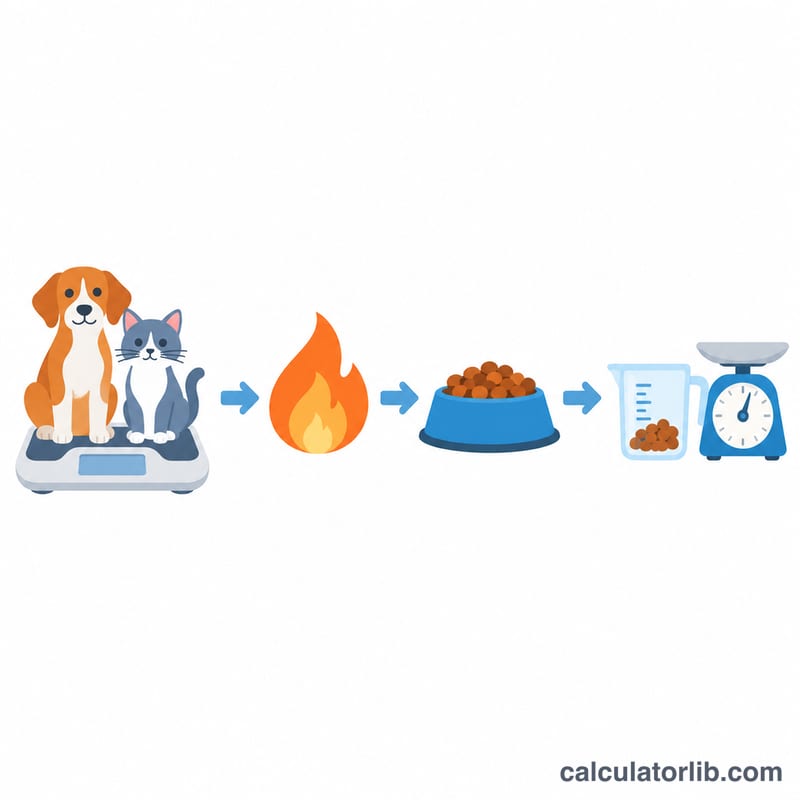
Enter your pet weight in kilograms, choose the life stage that best matches your pet, then type the food energy density (kcal per 100 g, found on the packaging or manufacturer website) and the weight of one cup of that food. Finally, choose how many meals you feed daily. The tool returns grams and cups per day and per meal.
The formula explained
The resting energy requirement (RER) is the energy a pet needs at rest:
$$\text{RER} = 70 \times W^{0.75}$$Here \(W\) is body weight in kg. This is multiplied by a life-stage factor \(k\) (about 1.6 for a neutered adult, 1.8 for an intact adult, 1.0 for weight loss, 2.0 to 3.0 for growth) to give the daily energy requirement. Dividing by the food energy density \(E\) (kcal per 100 g) gives the portion:
$$\text{Grams/day} = \frac{70 \times W^{0.75} \times k}{E} \times 100$$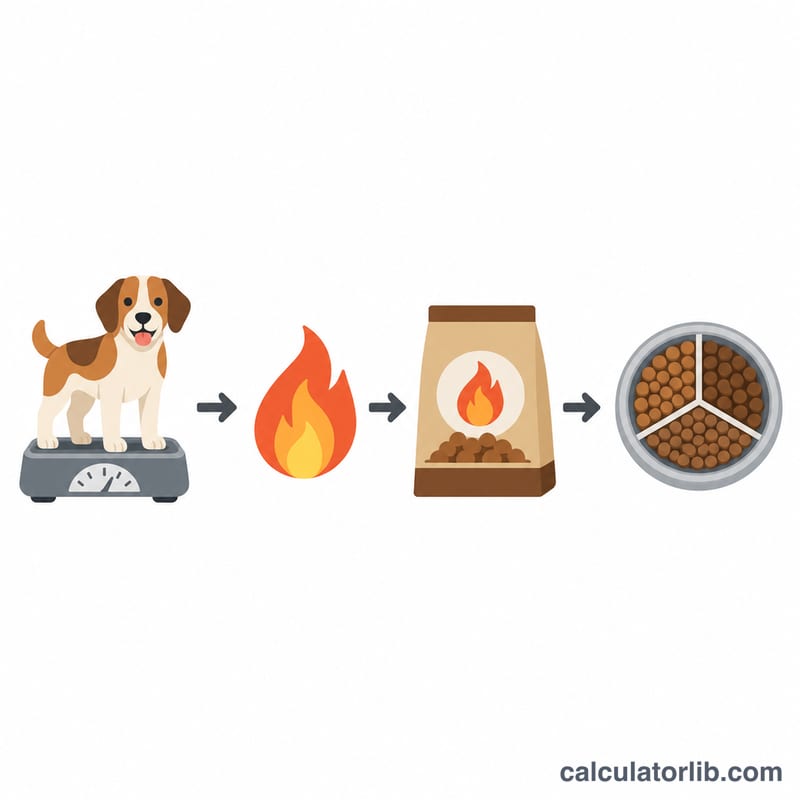
Worked example
A neutered adult dog weighs \(W = 16\) kg. Because \(16^{0.75} = 8\), the RER is:
$$\text{RER} = 70 \times 8 = 560\,\text{kcal}$$With an inactive factor of \(k = 1.2\), the daily need is \(560 \times 1.2 = 672\) kcal. If the food has \(E = 400\) kcal per 100 g:
$$\text{Grams/day} = \frac{672}{400} \times 100 = 168\,\text{g}$$Split over 3 meals, that is 56 g per meal.
Life-Stage Energy Factors (k) for Dogs and Cats
Daily energy requirement (DER) is estimated by multiplying resting energy requirement, \(RER = 70 \times W^{0.75}\) (W in kg), by a life-stage factor k. The table lists commonly cited starting multipliers.
| Life stage / condition | Dog k | Cat k |
|---|---|---|
| Neutered adult | about 1.6 | about 1.2 |
| Intact adult | about 1.8 | about 1.4 |
| Inactive or obesity-prone | 1.2–1.4 | – |
| Active | – | about 1.6 |
| Weight loss | about 1.0 | about 0.8–1.0 |
| Puppy under 4 months | about 3.0 | – |
| Puppy from 4 months to adult size | about 2.0 | – |
| Kitten | – | about 2.5 |
| Working dog | 2.0 or more | – |
Notes: These are starting estimates drawn from veterinary nutrition guidelines (WSAVA, NRC, AAHA). Individual animals vary, so adjust based on body condition and weight trends. Choose Dog or Cat first: the selector then offers the dog factors (1.0, 1.2, 1.6, 1.8, 2.0, 3.0) or the cat factors (0.8, 1.0, 1.2, 1.4, 2.5). The worked example's k = 1.2 is an inactive-dog factor, which is lower than the 1.6 used for a typical neutered adult dog.
FAQ
Is the result exact?
No. Individual metabolism, breed, climate and activity vary, so treat it as a starting point and adjust every few weeks according to body condition.
Should I count treats?
Yes. Treats should stay under roughly 10 percent of daily calories, so reduce the meal portion accordingly.
Does it work for cats?
The RER equation is widely used for both dogs and cats. Pick the factor that matches your cat, such as 1.2 for a typical neutered adult or 1.0 for weight loss, and consult your veterinarian for medical diets.