What Is the Homebrew ABV Calculator?
This calculator estimates the alcohol by volume (ABV) of a home-brewed beer, cider, or wine from two hydrometer readings: the original gravity (OG) measured before fermentation and the final gravity (FG) measured after fermentation completes. As yeast converts sugar into alcohol and CO₂, the density of the liquid drops — and that change is what reveals how much alcohol was produced.
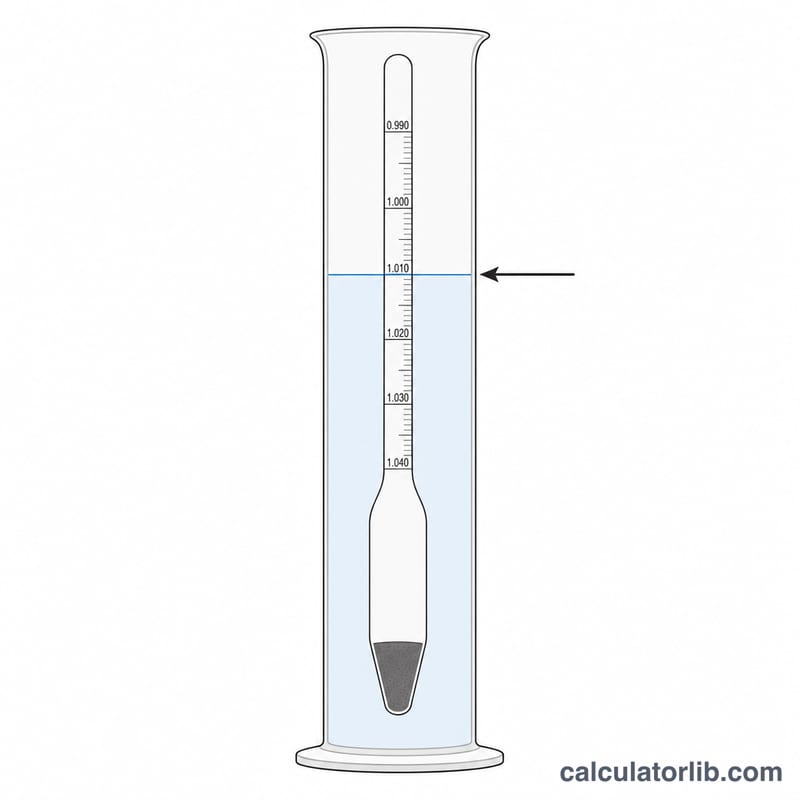
How to Use It
Take a hydrometer or refractometer reading of your unfermented wort and enter it as the Original Gravity (typically 1.030–1.090). After fermentation, take another reading and enter it as the Final Gravity (typically 1.000–1.020). The calculator returns your estimated ABV and the apparent attenuation.
The Formula Explained
The widely used homebrew approximation is:
$$\text{ABV\%} = (\text{OG} - \text{FG}) \times 131.25$$where \(\text{OG}\) = original specific gravity and \(\text{FG}\) = final specific gravity. The constant 131.25 converts the gravity drop into a percentage of alcohol. We also report apparent attenuation:
$$\text{AA\%} = \frac{\text{OG} - \text{FG}}{\text{OG} - 1} \times 100$$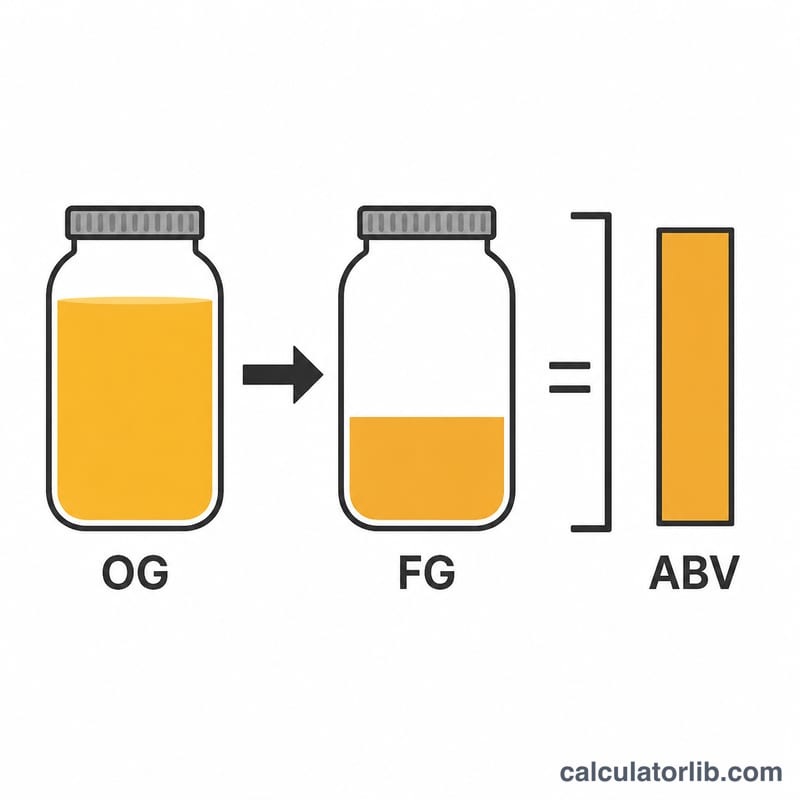
Worked Example
Suppose your wort started at \(\text{OG} = 1.050\) and finished at \(\text{FG} = 1.010\). Then:
$$\text{ABV\%} = (1.050 - 1.010) \times 131.25 = 0.040 \times 131.25 = 5.25\%$$And the attenuation:
$$\text{AA\%} = \frac{1.050 - 1.010}{1.050 - 1} \times 100 = \frac{0.040}{0.050} \times 100 = 80\%$$Typical OG, FG & ABV by Beer Style
The values below are typical ranges you can expect for common beverage styles. Original gravity (OG) is set by the amount of fermentable sugar in the wort, while final gravity (FG) depends on how much of that sugar the yeast converts to alcohol. The ABV column uses the standard estimate \(\text{ABV} = (\text{OG} - \text{FG}) \times 131.25\).
| Style | Typical OG | Typical FG | Expected ABV |
|---|---|---|---|
| Light Lager | 1.028–1.040 | 0.998–1.008 | 2.8–4.5% |
| Pale Ale | 1.045–1.060 | 1.010–1.015 | 4.5–6.2% |
| IPA | 1.056–1.075 | 1.008–1.018 | 5.5–7.5% |
| Stout | 1.036–1.075 | 1.007–1.022 | 4.0–7.0% |
| Barleywine | 1.080–1.120 | 1.016–1.030 | 8.0–12.0% |
| Cider | 1.045–1.070 | 0.995–1.010 | 5.0–9.0% |
As a worked check, a Pale Ale at OG 1.052 finishing at FG 1.012 gives \((1.052 - 1.012) \times 131.25 = \) 5.25% ABV, squarely within the Pale Ale range above.
Definitions & Glossary
- Original Gravity (OG): The specific gravity of the wort measured before fermentation begins. It reflects the total dissolved sugars available for the yeast to ferment.
- Final Gravity (FG): The specific gravity measured after fermentation is complete. Because alcohol is less dense than water and much of the sugar is gone, FG is lower than OG.
- Specific Gravity: The density of a liquid relative to water, which is defined as 1.000. Sugary wort reads above 1.000; the presence of alcohol can pull a finished beer below 1.000.
- Apparent Attenuation: The percentage of gravity points that were consumed during fermentation, calculated as \(\frac{\text{OG} - \text{FG}}{\text{OG} - 1} \times 100\%\). "Apparent" because the hydrometer is skewed by dissolved alcohol.
- ABV (Alcohol By Volume): The volume of pure ethanol as a percentage of the total volume of the beverage, estimated here from the gravity drop.
- Wort: The sweet, unfermented liquid produced by mashing grains (or dissolving extract), which becomes beer once yeast ferments it.
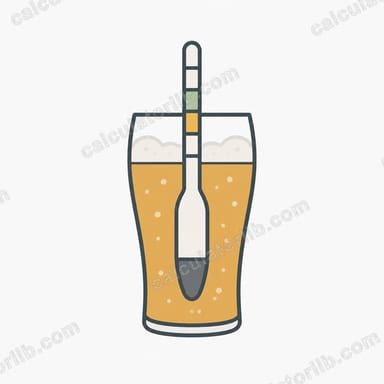
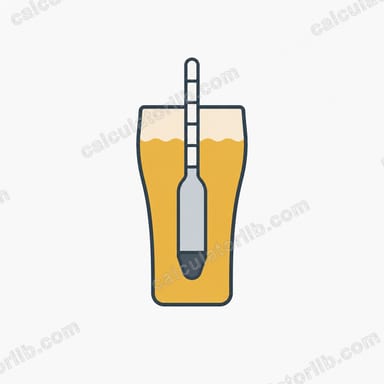
- Hydrometer: A weighted glass float that measures specific gravity by how deeply it sinks in a sample of wort or beer.
- Refractometer: An optical instrument that estimates gravity from how a few drops of liquid bend light; it needs a correction factor once alcohol is present.
- Gravity Points: The digits after the decimal in a specific gravity reading (e.g. 1.048 = 48 points). Attenuation and ABV are driven by the drop in these points.
ABV Across Different Gravity Scenarios
The table below applies \(\text{ABV} = (\text{OG} - \text{FG}) \times 131.25\) and \(\text{Apparent Attenuation} = \frac{\text{OG} - \text{FG}}{\text{OG} - 1} \times 100\%\) to four common brew scenarios. Higher OG combined with a low FG produces both a stronger beer and a higher attenuation.
| OG | FG | ABV | Apparent Attenuation |
|---|---|---|---|
| 1.040 | 1.010 | 3.94% | 75.0% |
| 1.050 | 1.012 | 4.99% | 76.0% |
| 1.065 | 1.015 | 6.56% | 76.9% |
| 1.080 | 1.020 | 7.88% | 75.0% |
Worked example for the third row: \((1.065 - 1.015) \times 131.25 = 0.050 \times 131.25 = 6.5625 \approx 6.56\%\) ABV, with attenuation \(\frac{1.065 - 1.015}{1.065 - 1} \times 100 = \frac{0.050}{0.065} \times 100 \approx 76.9\%\).
FAQ
Is this ABV exact? No — it is an estimate. The ×131.25 formula is accurate for beers up to about 6–7% ABV. Stronger brews drift higher, and more complex equations exist for high-gravity beers.
What is a typical final gravity? Most ales finish between 1.008 and 1.015. A stuck fermentation may finish higher.
Do I need to temperature-correct my readings? Yes for best accuracy — hydrometers are usually calibrated at 20°C (68°F). Correct both readings to the calibration temperature before entering them.