
What is the Cockcroft-Gault Creatinine Clearance Calculator?
This tool estimates creatinine clearance (CrCl), an approximation of kidney filtration rate, using the classic Cockcroft-Gault equation published in 1976. It is widely used in clinical practice to guide drug dosing — particularly for medications cleared by the kidneys. The result is expressed in milliliters per minute (mL/min). This calculator is an educational aid and does not replace professional medical judgment.
How to use it
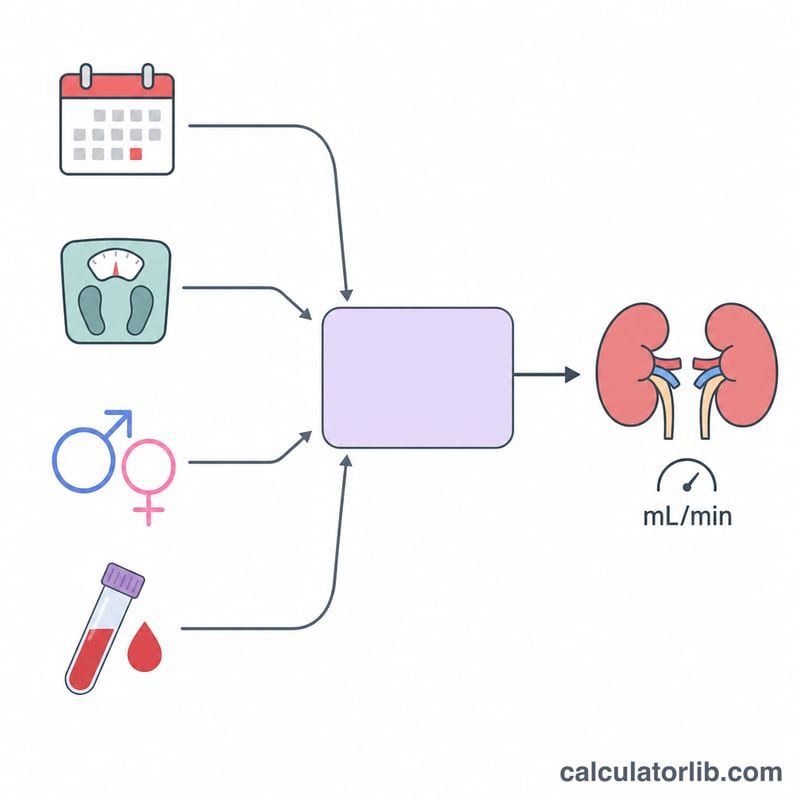
Enter the patient's sex, age in years, body weight in kilograms, and serum creatinine in mg/dL. The calculator applies the Cockcroft-Gault formula and, for females, the standard 0.85 correction factor. It then reports an estimated CrCl along with a general renal-function category for context.
The formula explained
The equation is: $$\text{CrCl} = \frac{(140 - \text{Age}) \times \text{Weight (kg)}}{72 \times \text{S}_{cr}\text{ (mg/dL)}}$$ multiplied by \(0.85\) for females. Clearance falls as age rises and as serum creatinine rises, and increases with body weight. The constant 72 and the female factor 0.85 are empirical values derived from the original study population. Many clinicians use actual, ideal, or adjusted body weight depending on the patient — this calculator uses the weight you enter directly.
Worked example
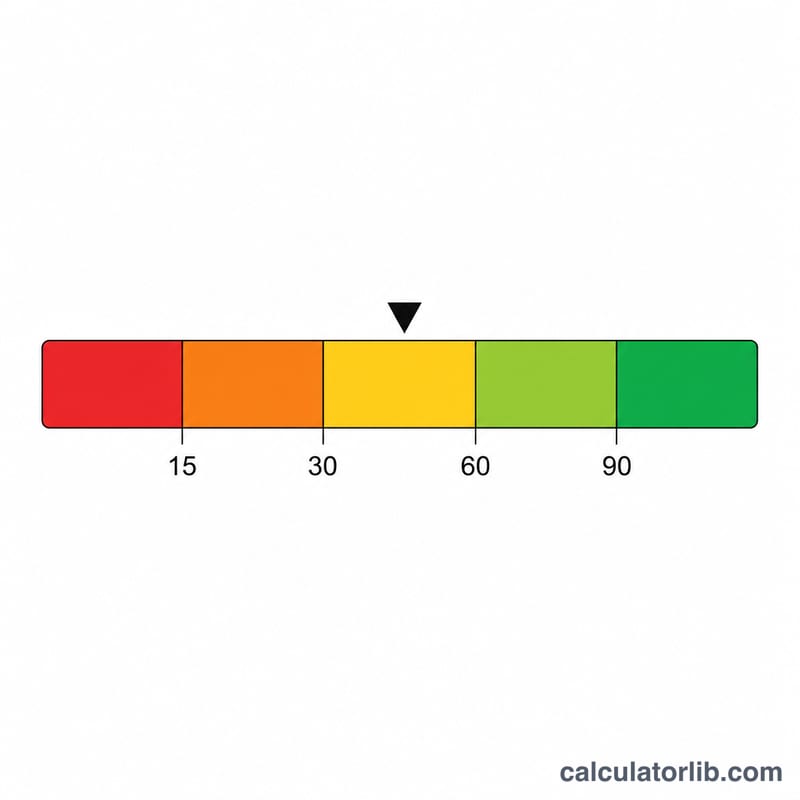
Consider a 60-year-old male weighing 80 kg with serum creatinine of 1.2 mg/dL. $$\text{CrCl} = \frac{(140 - 60) \times 80}{72 \times 1.2} = \frac{80 \times 80}{86.4} = \frac{6400}{86.4} \approx 74.07 \text{ mL/min}$$ which falls in the mildly decreased range.
FAQ
Does it differ from eGFR? Yes. Cockcroft-Gault estimates creatinine clearance, while eGFR (e.g., CKD-EPI, MDRD) estimates glomerular filtration rate normalized to body surface area. Drug labels often specify Cockcroft-Gault.
Which weight should I use? Clinical guidance varies; ideal or adjusted body weight is often preferred in obese patients. Enter the weight your protocol specifies.
Is the 0.85 factor always applied to females? Yes, the standard Cockcroft-Gault equation multiplies the female result by \(0.85\) to account for lower muscle mass.