
What is the Mifflin-St Jeor BMR Calculator?
Your Basal Metabolic Rate (BMR) is the number of calories your body burns at complete rest just to keep you alive — powering your heart, lungs, brain and other organs. This calculator uses the Mifflin-St Jeor equation, published in 1990 and widely regarded as one of the most accurate predictive formulas for healthy adults. It uses metric units (kilograms and centimetres) and works for both men and women.
How to use it
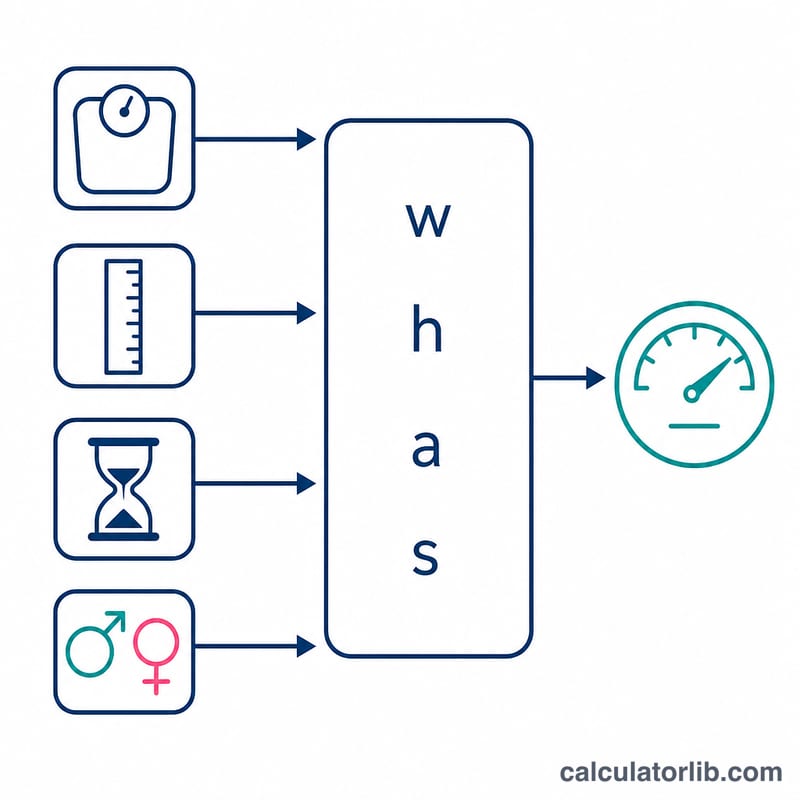
Choose your gender, then enter your body weight in kilograms, height in centimetres and age in years. The calculator instantly returns your BMR in calories per day, plus a table of Total Daily Energy Expenditure (TDEE) estimates for five activity levels. TDEE multiplies your BMR by an activity factor to estimate how many calories you actually burn including movement and exercise.
The formula explained
The equation shares a common base and only the final constant differs by sex:
Men: $$\text{BMR} = 10 \times \text{weight (kg)} + 6.25 \times \text{height (cm)} - 5 \times \text{age} + 5$$Women: $$\text{BMR} = 10 \times \text{weight (kg)} + 6.25 \times \text{height (cm)} - 5 \times \text{age} - 161$$
Activity multipliers: Sedentary \(\times 1.2\), Lightly active \(\times 1.375\), Moderately active \(\times 1.55\), Very active \(\times 1.725\), Extra active \(\times 1.9\).
Worked example
For a 30-year-old man weighing 70 kg at 175 cm: $$\text{BMR} = 10 \times 70 + 6.25 \times 175 - 5 \times 30 + 5 = 700 + 1093.75 - 150 + 5 = \textbf{1{,}648.75 calories/day}$$ His sedentary TDEE would be \(1{,}648.75 \times 1.2 \approx 1{,}979\) calories/day.
Interpreting Your BMR and TDEE Results
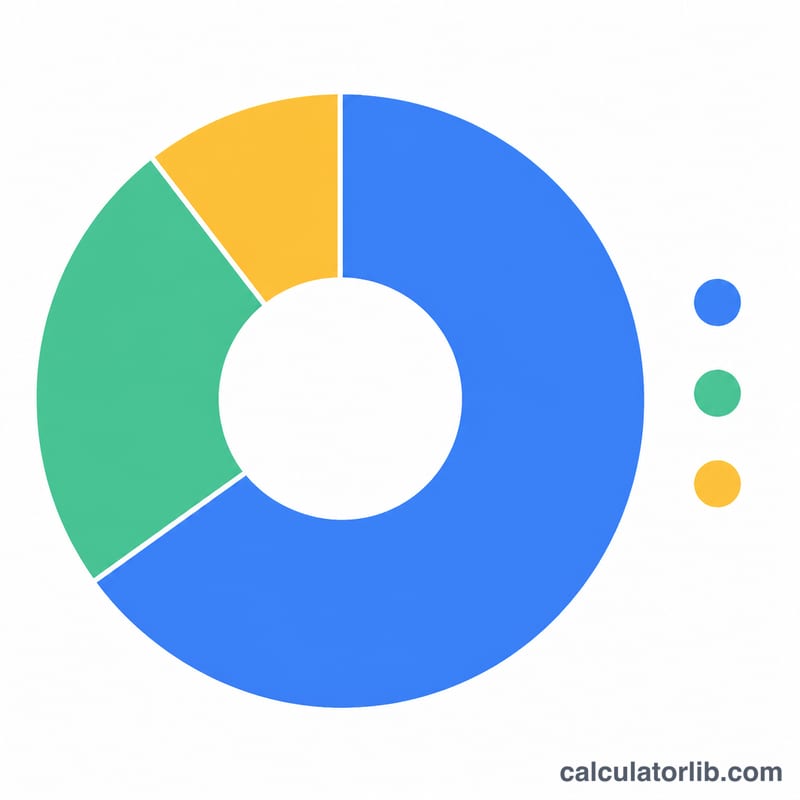
Your Basal Metabolic Rate (BMR) is the number of calories your body burns at complete rest — just to keep your heart beating, lungs breathing, brain working and cells functioning. It represents the energy you would expend if you stayed in bed all day and did nothing. For most people, BMR accounts for roughly 60–70% of total daily energy expenditure.
Your Total Daily Energy Expenditure (TDEE) is the bigger picture: it is your BMR multiplied by an activity factor that accounts for movement, exercise, digestion and everyday tasks. The activity-level TDEE figures you see represent estimated total burn at different lifestyle intensities:
- ×1.2 — Sedentary: little or no exercise, desk job.
- ×1.375 — Lightly active: light exercise 1–3 days/week.
- ×1.55 — Moderately active: moderate exercise 3–5 days/week.
- ×1.725 — Very active: hard exercise 6–7 days/week.
- ×1.9 — Extra active: very hard exercise or a physical job.
For context on body-weight change, roughly 3,500 kcal ≈ 0.45 kg (1 lb) of body fat. This means a daily deficit of 500 kcal below your TDEE corresponds to about 0.45 kg of fat loss per week, while a comparable surplus drives gain. These figures are a useful planning rule of thumb rather than an exact biological constant.
Keep in mind that the Mifflin-St Jeor equation is a population-based estimate. Studies show it predicts measured resting energy within about ±10% for most healthy adults, but individual metabolism varies with genetics, body composition, hormones and other factors. Use these numbers as a starting point and adjust based on real-world results over several weeks. This is general information, not medical or nutritional advice.
Key Terms Explained
- BMR (Basal Metabolic Rate)
- The minimum number of calories your body burns at complete rest to sustain vital functions, measured under strict laboratory conditions (fasted, fully rested, neutral temperature). This is what the Mifflin-St Jeor equation estimates.
- RMR (Resting Metabolic Rate)
- Closely related to BMR but measured under less restrictive conditions, so it is typically about 10% higher than true BMR. In everyday use the two terms are often treated as interchangeable, and many "BMR" calculators effectively estimate RMR.
- TDEE (Total Daily Energy Expenditure)
- The total calories you burn in a day, including BMR plus the energy used for physical activity, exercise and the thermic effect of digesting food. Calculated by multiplying BMR by an activity factor.
- Activity multiplier
- A factor (commonly 1.2 to 1.9) applied to BMR to estimate TDEE based on how active your lifestyle is. Higher activity levels use larger multipliers.
- Calorie deficit
- Consuming fewer calories than your TDEE, which prompts the body to use stored energy and leads to weight loss over time.
- Calorie surplus
- Consuming more calories than your TDEE, providing extra energy used for weight or muscle gain.
- Lean body mass (LBM)
- Total body weight minus fat mass — muscle, bone, organs and water. Because lean tissue is metabolically active, people with more lean mass generally have a higher BMR, which is one reason the equation's weight-based estimate is only an approximation.
FAQ
Is Mifflin-St Jeor better than Harris-Benedict? Studies generally find Mifflin-St Jeor more accurate for the modern population, which is why dietitians often prefer it.
Should I eat exactly my BMR? No. BMR is your resting requirement. To maintain weight, use your TDEE; to lose weight, eat below it; to gain, eat above it.
Does this account for body fat? No. Mifflin-St Jeor uses only weight, height, age and sex. For lean or very muscular individuals, the Katch-McArdle formula (based on lean body mass) may be more precise.