
What Is BMR?
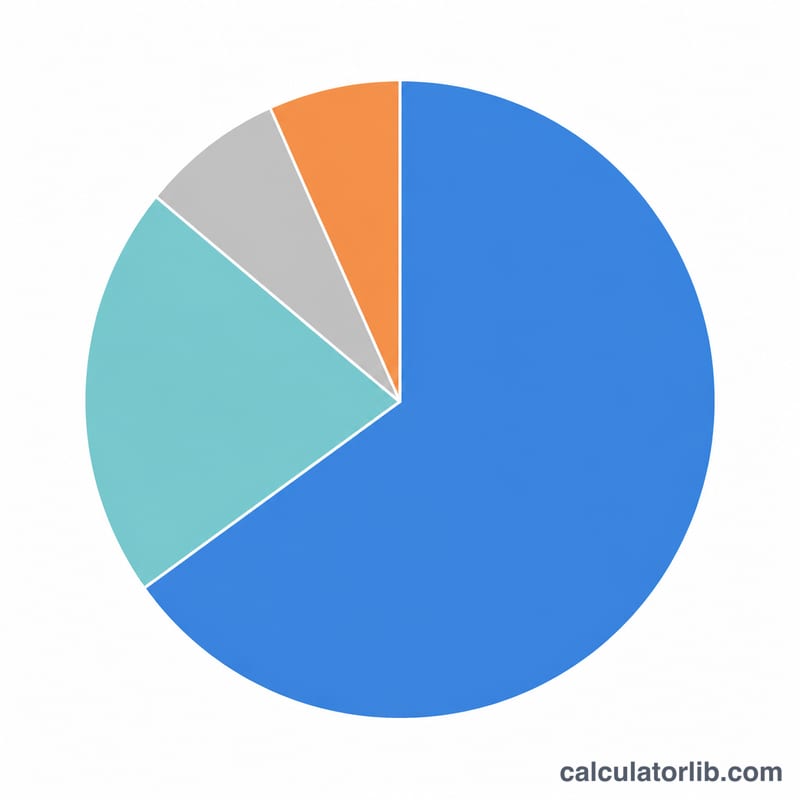
Your Basal Metabolic Rate (BMR) is the number of calories your body burns at complete rest just to keep essential functions running — breathing, circulation, cell repair and temperature regulation. It represents the minimum energy you need over 24 hours if you did nothing but lie still. BMR typically accounts for 60–70% of your total daily calorie expenditure, making it the foundation of any calorie or weight-management plan.
How to Use This Calculator
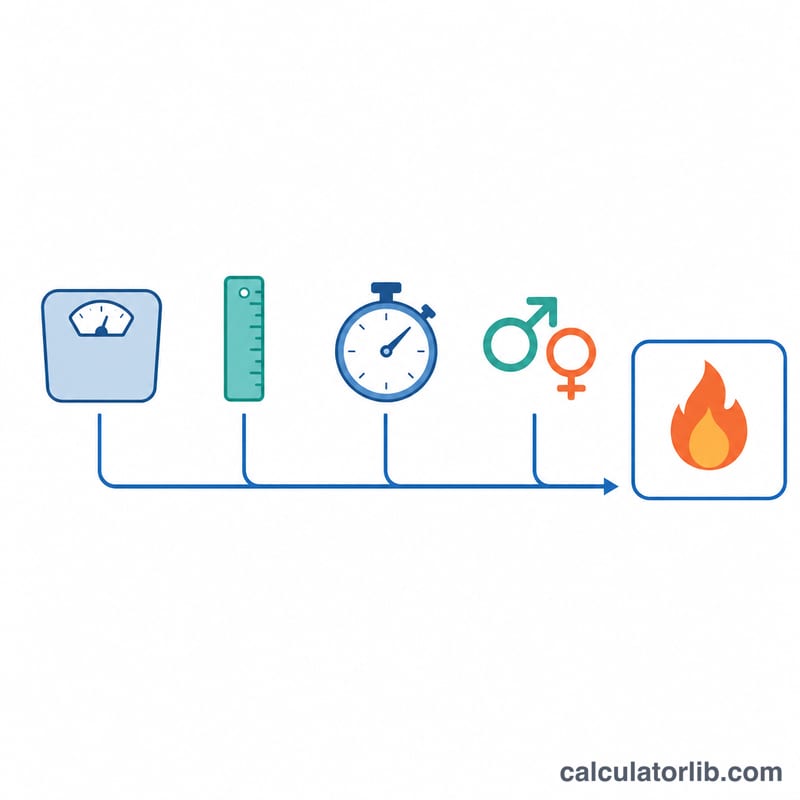
Select your gender, then enter your weight in kilograms, height in centimetres and age in years. The calculator instantly applies the Mifflin-St Jeor equation and returns your estimated resting calorie burn per day. To estimate your total daily energy expenditure (TDEE), multiply the BMR by an activity factor (1.2 sedentary, 1.55 moderately active, 1.725 very active).
The Formula Explained
The Mifflin-St Jeor equation, published in 1990, is widely regarded as the most accurate predictive BMR formula for the general population. It is calculated as:
$$\text{BMR} = 10 \times \text{weight (kg)} + 6.25 \times \text{height (cm)} - 5 \times \text{age (years)} + s$$
where s is +5 for men and −161 for women. The gender constant accounts for differences in average lean body mass.
Worked Example
Consider a 30-year-old man weighing 70 kg and standing 175 cm tall. The calculation is: \(10 \times 70 = 700\); \(6.25 \times 175 = 1093.75\); \(5 \times 30 = 150\). So $$\text{BMR} = 700 + 1093.75 - 150 + 5 = \textbf{1648.75 calories/day}.$$ For a woman with the same stats, $$\text{BMR} = 700 + 1093.75 - 150 - 161 = 1482.75 \text{ calories/day}.$$
Interpreting Your BMR Result
Your Basal Metabolic Rate (BMR) is the number of calories your body needs to keep its essential functions running at complete rest — circulation, breathing, cell repair, brain activity and maintaining body temperature. It is the energy you would burn if you spent a full 24 hours lying still, neither digesting food nor moving.
The figure produced by the Mifflin-St Jeor equation is an estimate. It is a predictive equation derived from population averages, so an individual's true resting metabolism can differ by roughly 10% in either direction depending on body composition, genetics, hormones and other factors. Two people with identical weight, height, age and sex can have measurably different real-world BMRs. Treat the result as a well-supported starting point rather than an exact measurement.
Because BMR reflects only the bare minimum energy required to sustain life, consistently eating below your BMR over a long period is generally discouraged. Prolonged intake under this level can leave essential functions underfueled and is associated with loss of lean tissue and reduced energy availability. Most calorie targets for weight change are built around TDEE — your BMR scaled up by an activity factor — rather than BMR alone.
To use BMR practically: take it as your baseline, multiply by the appropriate activity multiplier to estimate TDEE, then adjust from TDEE to set a maintenance, deficit or surplus target. The BMR is the foundation of that calculation, not the daily calorie goal itself. This section is general information, not professional or medical advice.
FAQ
Is BMR the same as TDEE? No. BMR is calories burned at rest; TDEE includes activity. Multiply BMR by an activity factor to get TDEE.
Why use Mifflin-St Jeor over Harris-Benedict? Studies show Mifflin-St Jeor predicts resting energy expenditure more accurately for most modern populations.
Should I use imperial units? This tool uses metric (kg and cm). Convert pounds to kg by dividing by 2.205, and inches to cm by multiplying by 2.54.