What this calculator does
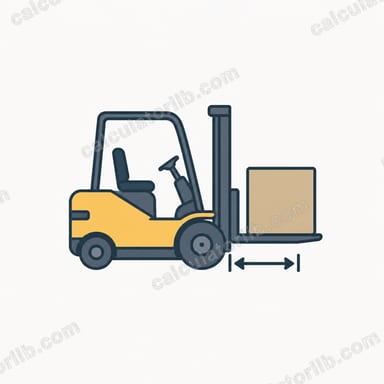
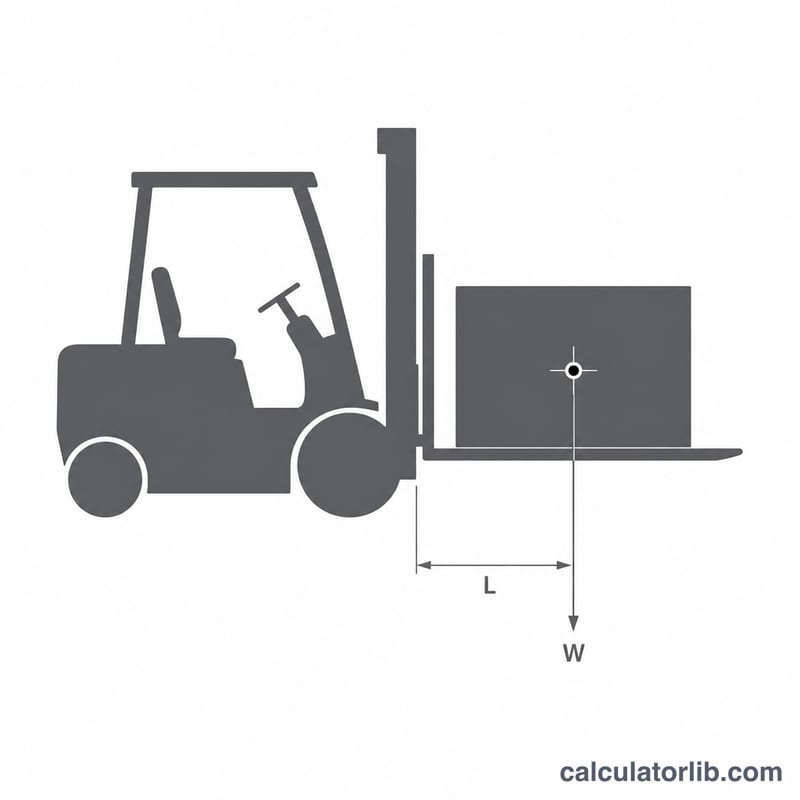
A forklift data plate quotes one capacity at one load center, typically 24 in (or 500 mm) measured from the face of the forks to the centre of gravity of the load. As soon as the load is deeper, wider or unevenly packed, its centre of gravity moves forward and the truck can safely lift less. This tool converts the rated figure into the derated capacity at your actual load center, then compares it with the weight you intend to lift.
The formula
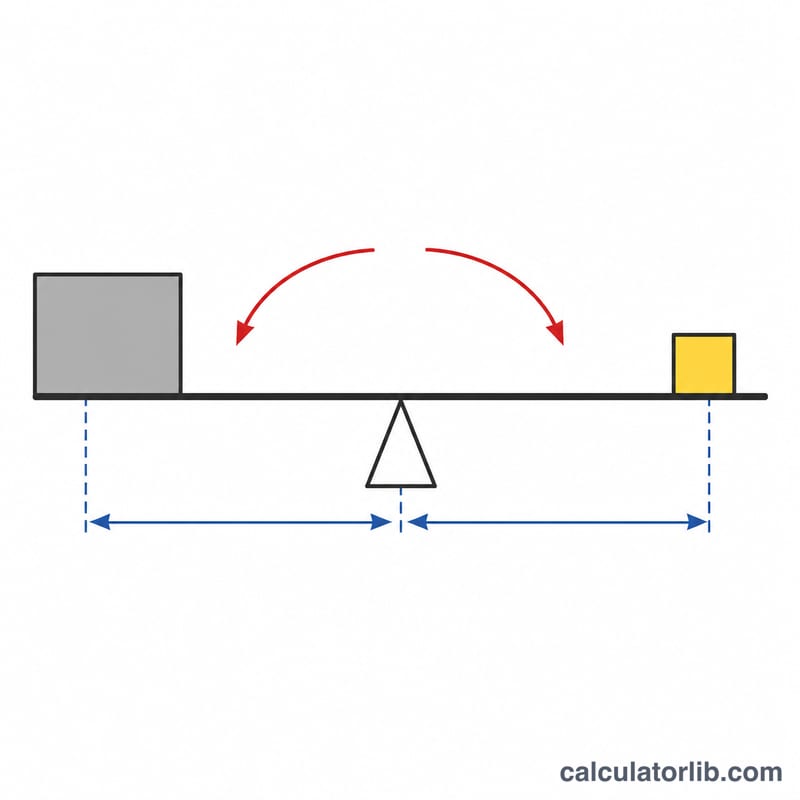
The counterweight of a forklift balances a fixed overturning moment. Holding that moment constant gives:
$$C_a = \frac{C_r \times D_r}{D_a}$$where \(C_r\) = rated capacity from the data plate, \(D_r\) = rated load center, \(D_a\) = actual load center of your load, and \(C_a\) = the derated safe capacity. The product \(C_r \times D_r\) is the rated load moment. Utilisation of that limit is \(U = \frac{W}{C_a} \times 100\%\) for a load of weight \(W\).
Worked example
A truck is plated at 5,000 lb at a 24 in load center. A pallet 72 in deep and evenly loaded has its centre of gravity 36 in from the fork face:
$$C_a = \frac{5000 \times 24}{36} = 3333\,\text{lb}$$Lifting a 3,000 lb load leaves a margin of 333 lb, or \(U = \frac{3000}{3333.3} \times 100\% = 90\%\) of the derated limit - legal, but with little room for a misplaced pallet, so treat it as a caution lift.
Interpreting Your Result
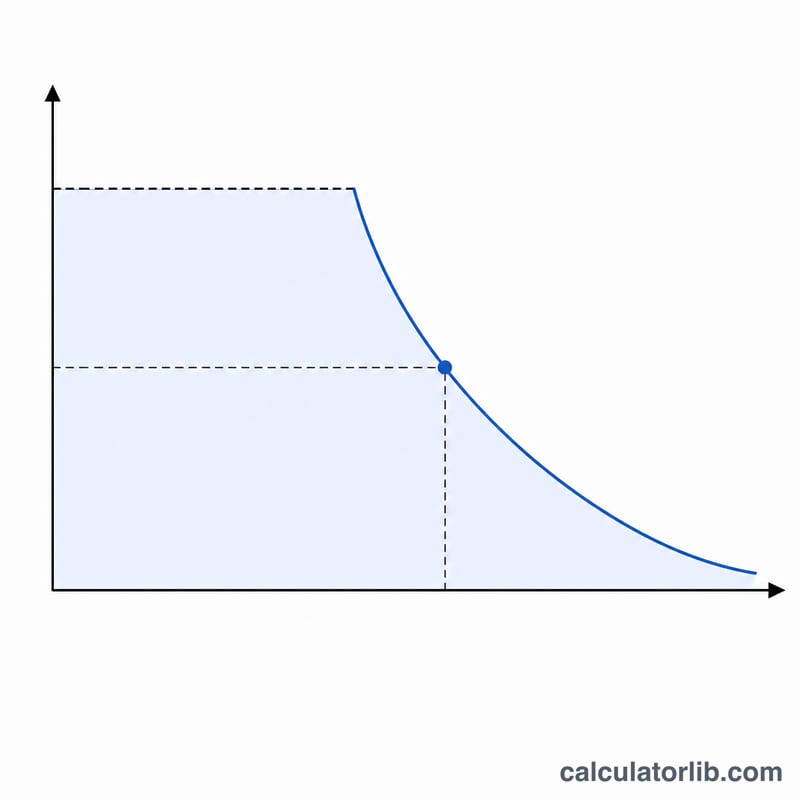
The calculator returns two numbers. The first, the derated capacity \(C_a\), is the heaviest load the truck may carry at the load center you entered. The second, utilisation \(U\), compares your actual load weight \(W\) to that limit:
$$U = \frac{W}{C_a}\times 100\%$$The single decision the result supports is simple: if \(W > C_a\), the lift is outside the truck's rated envelope — do not lift it. Split the load, use a larger-capacity truck, or bring the center of gravity closer to the fork face.
Worked example
A 5,000 lb @ 24 in truck is asked to carry a 3,000 lb crate whose center of gravity sits 36 in from the fork face:
$$C_a = \frac{5{,}000 \times 24}{36} = 3{,}333\ \text{lb}$$$$U = \frac{3{,}000}{3{,}333} \times 100\% = \;$$…giving a utilisation of 90%. The load is inside the limit, but only just — and 90% of a derated figure is a very different thing from 90% of the plate.
Reading the utilisation bands
- Above 100% — the load exceeds the derated capacity. The lift is not permitted as configured.
- At or near 100% — you are sitting on the manufacturer's stability limit with essentially no allowance for error in your load-center estimate. Load centers are usually eyeballed, and a few inches of error at this point pushes you over. Treat this as a stop-and-reassess result, not a pass.
- Mid-range (roughly 50–85%) — within the limit with room for ordinary estimation error, uneven load distribution and normal travel dynamics.
- Well below — comfortable; the governing concern is likely to be something other than capacity (visibility, aisle width, floor condition).
The plate value is a limit, not a target. It is set by the manufacturer from the truck's stability and structural design — tipping about the front axle, mast and carriage stress, tire and axle loading — and verified against stability test requirements such as ANSI/ITSDF B56.1 in the United States or ISO 1074 internationally. Nothing about operating at 99% of it is "efficient".
Regulatory context (United States)
Under US OSHA 29 CFR 1910.178(o)(2), only loads within the rated capacity of the truck may be handled. Separately, 1910.178(a)(4) prohibits modifications and additions that affect capacity and safe operation without the manufacturer's prior written approval, and 1910.178(a)(5) requires the capacity, operation and maintenance instruction plates, tags or decals to be changed accordingly. In practice that means a truck fitted with an attachment must be re-plated, and the plated figure for that configuration is the one that governs. Requirements outside the US differ — for example the UK's PUWER/LOLER regime and employer duties under other national rules — so check the regulations that apply where the truck is operated.
What this figure does not include
This calculator models load-center derating only. Your specific data plate may list additional, separately stated derates that must be applied on top of this result, including:
- Attachment derates — clamps, rotators, fork positioners and push/pulls both add dead weight forward of the axle and push the effective load center outward.
- Lift-height derates — many plates give a lower capacity above a stated height, because the truck becomes less laterally stable as the mast extends.
- Mast tilt — forward tilt moves the combined center of gravity toward the fulcrum.
- Side shift — shifting a load off centerline reduces lateral stability and is often derated explicitly.
If the plate lists several of these for your configuration, the lowest applicable value governs. When the plate is missing, illegible or does not match the attachments fitted, take the truck out of service and contact the manufacturer or dealer — do not estimate. This article is general information about how derating works and is not a substitute for the manufacturer's manual, your site's safe-work procedures, or a qualified person's assessment.
Key Terms and Variables
| Term / symbol | Typical units | Definition |
|---|---|---|
| Rated capacity \(C_r\) | lb or kg | The maximum load the manufacturer certifies the truck to carry, valid only at the rated load center and under the other conditions stated on the data plate. |
| Rated load center \(D_r\) | in or mm | The load-center distance the rated capacity is quoted at. Commonly 24 in on US-market counterbalanced trucks and 500 mm on metric-market trucks; 600 mm and other values also occur. |
| Actual load center \(D_a\) | in or mm | The real horizontal distance from the fork face to the center of gravity of the load you are about to lift. For a uniform, evenly loaded rectangular pallet this is roughly half the load's depth along the forks. |
| Derated (residual) capacity \(C_a\) | lb or kg | The capacity that remains at the actual load center: \(C_a = C_r D_r / D_a\), capped at \(C_r\). Also called reduced or net load-center capacity. |
| Load weight \(W\) | lb or kg | The total weight actually being lifted — product plus pallet, slip sheet, dunnage, banding and any container. |
| Utilisation \(U\) | % | \(U = (W / C_a) \times 100\%\). How much of the available derated capacity the load consumes. |
| Load moment | lb·in or kg·mm | The turning effect of the load about the fulcrum, \(C_r \times D_r\) at the rating point. Derating is simply the statement that this moment is held constant: a 5,000 lb × 24 in plate is a 120,000 lb·in moment, which at 36 in allows 3,333 lb. |
| Center of gravity (CG) | — | The point at which a body's weight acts. Stability depends on the combined CG of truck plus load staying inside the truck's stability triangle. An off-center or top-heavy load moves the CG even when the weight is legal. |
| Fork face | — | The vertical front surface of the carriage / load backrest against which the load rests. All load-center distances are measured from here, not from the fork tips. |
| Data plate (nameplate) | — | The permanently affixed plate stating model, serial number, attachments fitted, and the capacity for each rated configuration. It must be legible and must match the truck as currently equipped. |
| Load backrest (LBRE) | — | The vertical guard extension above the carriage that prevents a load from tipping back toward the operator when the mast is tilted rearward. |
| Fulcrum (front axle) | — | The pivot line about which a counterbalanced truck would tip forward. The load acts on one side of it and the truck's own mass on the other — this lever relationship is the whole basis of derating. |
| Counterweight | lb or kg | The mass built into the rear of the truck to oppose the load moment. It is what makes a counterbalanced truck's rating possible and is why capacity cannot be raised by adding ballast informally. |
| Effective load center with attachment | in or mm | The load center measured from the original fork face once an attachment is fitted: the attachment's own thickness pushes the load forward, so \(D_{\text{eff}}\) = attachment forward offset + the load's own half-depth. |
| Net capacity after attachment | lb or kg | The re-plated capacity for the truck with the attachment installed, accounting for both the attachment's weight acting forward of the fulcrum and the increased effective load center. It is always lower than the bare-fork rating and must come from the manufacturer's written figure, not from a calculation you perform yourself. |
FAQ
Does a shorter load center let me lift more? Not automatically. Mast, chain, carriage and hydraulic limits still cap the truck at its rated capacity, so this calculator never reports more than \(C_r\).
Where is the load center measured from? From the vertical face of the forks to the centre of gravity of the load. For a uniform pallet it is half the load depth; for an uneven load it sits toward the heavy end and must be estimated conservatively.
What about attachments and lift height? Clamps, rotators and long forks add weight ahead of the front axle and push the effective load center out; high lift heights and forward mast tilt reduce stability further. Those derates are printed on the data plate of the specific truck and are not included here.