What this calculator does
This tool applies to carriers licensed under the International Fuel Tax Agreement (IFTA), which covers the 48 contiguous US states and 10 Canadian provinces. Rates and rules change every quarter, so enter the official rate table for the quarter you are filing; amounts are shown in US dollars per gallon, the unit used on the standard IFTA rate sheet. This calculator is an estimating aid, not a substitute for your base jurisdiction return.
How to use it
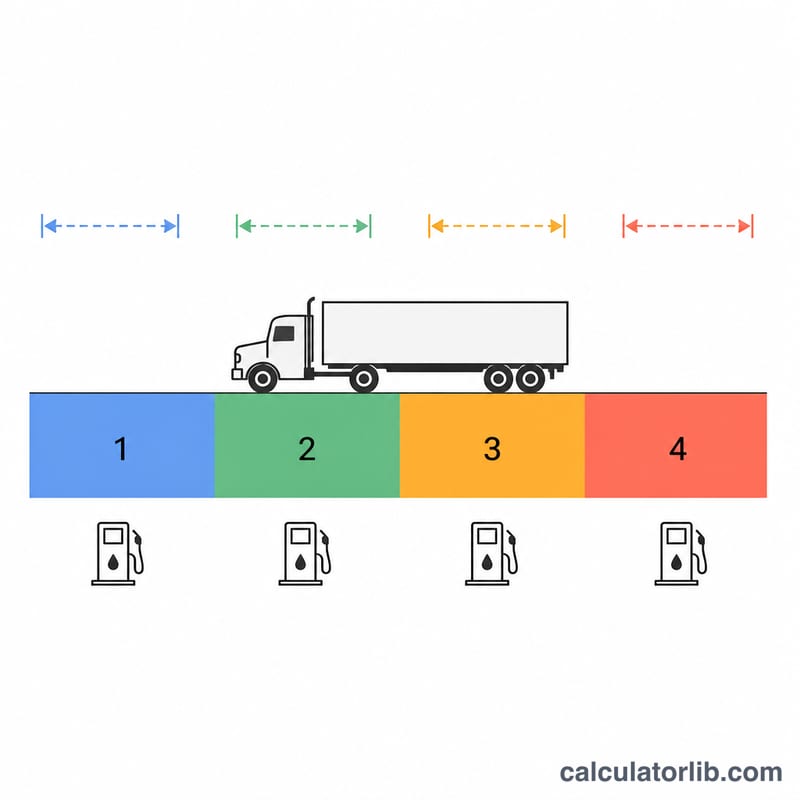
For each jurisdiction you travelled in, enter the miles driven there, the taxable gallons you actually pumped there, and that jurisdiction tax rate per gallon. Leave unused rows at zero. The calculator first pools every row to get your fleet average fuel economy, then allocates consumption back to each jurisdiction.
The formula explained
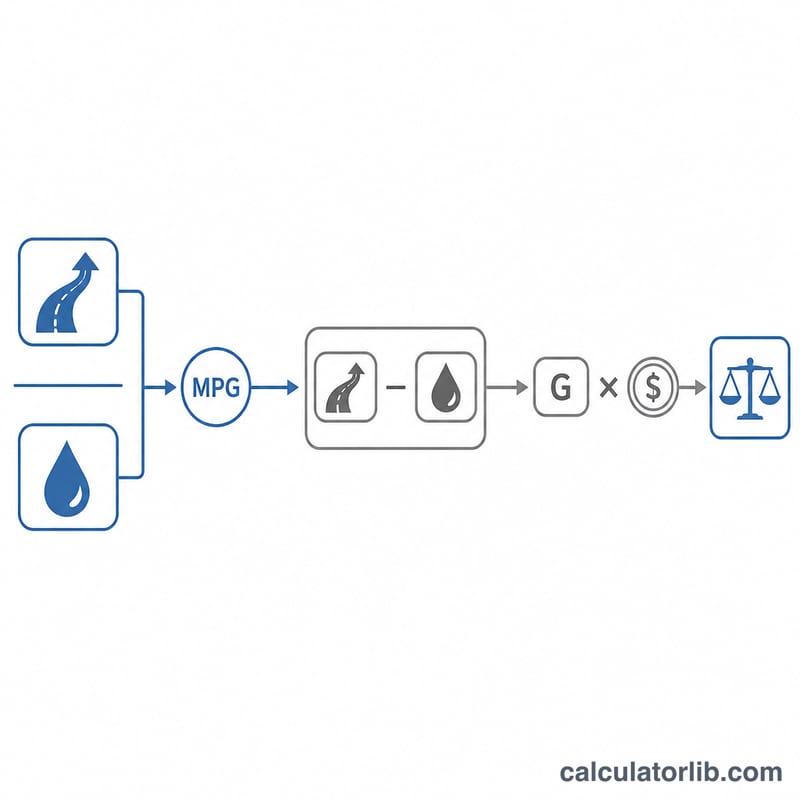
Fleet average fuel economy uses all miles and all gallons together: \(\text{MPG}\) = total miles ÷ total gallons. Taxable gallons for a jurisdiction are then \(\text{Miles}_j / \text{MPG}\), and the tax is the shortfall between what you burned there and what you bought there:
$$\text{Tax}_j = \left( \frac{\text{Miles}_j}{\text{MPG}} - \text{Gallons}_j \right) \times \text{Rate}_j$$A positive figure is tax owed; a negative figure is a credit because you pre-paid tax at the pump on fuel you burned elsewhere.
Worked example
A truck runs 3,000 miles in State A buying 400 gallons at 0.30 per gallon, and 2,000 miles in State B buying 200 gallons at 0.25 per gallon.
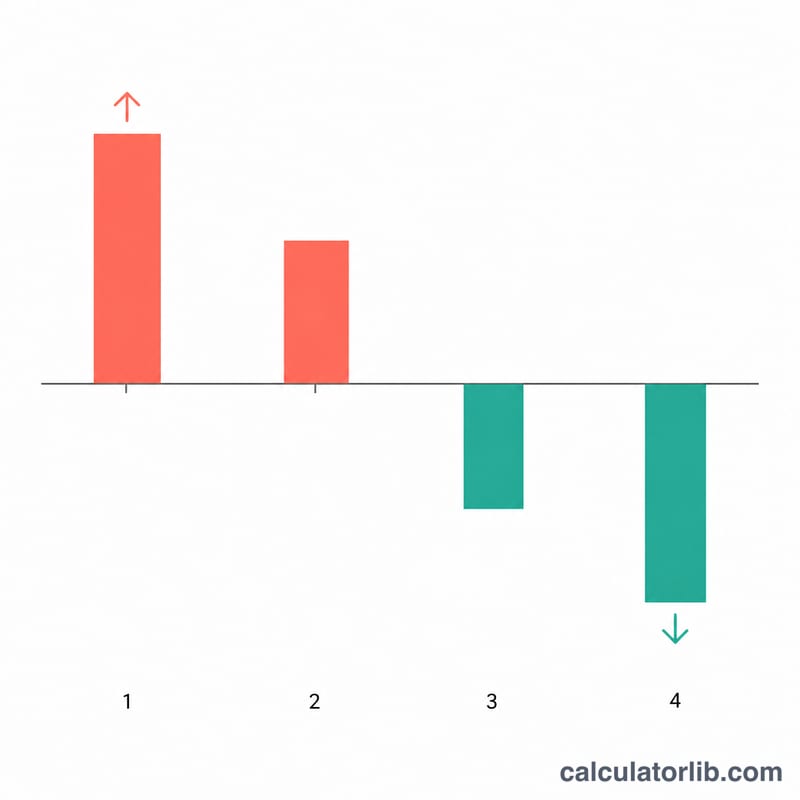
$$\text{MPG} = \frac{5000}{600} = 8.333$$$$\text{Tax}_A = \left( \frac{3000}{8.333} - 400 \right) \times 0.30 = (360 - 400) \times 0.30 = -\$12.00$$$$\text{Tax}_B = \left( \frac{2000}{8.333} - 200 \right) \times 0.25 = (240 - 200) \times 0.25 = \$10.00$$The net position is a credit of 2.00 for the quarter.
Key IFTA Terms Defined
The following terms come from the International Fuel Tax Agreement, which applies only in the United States (48 contiguous states) and the 10 Canadian provinces. Alaska, Hawaii, the US territories and the Canadian territories are not IFTA members.
| Term | Definition |
|---|---|
| IFTA | The International Fuel Tax Agreement, a cooperative arrangement among US states and Canadian provinces that lets an interstate motor carrier file one quarterly fuel-use tax return with a single jurisdiction instead of separate returns everywhere it travels. |
| Base jurisdiction | The member state or province where the qualified vehicles are registered and where operational records are kept or can be made available. It issues the license, receives the quarterly return and payment, and settles the amounts with the other jurisdictions. |
| IFTA license and decals | A single licence issued by the base jurisdiction, with a pair of decals displayed on each side of the cab of every qualified vehicle. Decals are issued per calendar year. |
| Qualified motor vehicle | Generally a vehicle used for the interstate transport of persons or property with two axles and a gross or registered gross weight over 26,000 lb (11,797 kg), or three or more axles regardless of weight, or a combination exceeding that weight. Recreational vehicles used for personal pleasure are excluded. |
| Total miles | Every mile or kilometre travelled by the fleet's qualified vehicles in the quarter, in all jurisdictions, whether loaded, empty, deadhead or bobtail, and whether taxable or not. |
| Taxable miles | The portion of total miles in a given jurisdiction that is subject to that jurisdiction's fuel-use tax — that is, total miles in the jurisdiction minus any exempt miles it recognises. |
| Non-taxable or exempt miles | Miles a particular jurisdiction excludes from its fuel-use tax base, such as certain toll-road, off-highway, forest-road or fuel-trip-permit miles. Exemptions are defined jurisdiction by jurisdiction and are not uniform, so the same trip can be exempt in one state and taxable in the next. |
| Tax-paid gallons | Fuel placed in the supply tank of a qualified vehicle on which that jurisdiction's fuel tax was already paid at the pump, supported by a receipt or bulk-withdrawal record showing the jurisdiction, date and quantity. |
| Taxable gallons (consumed) | The fuel the fleet is deemed to have burned in a jurisdiction, computed as that jurisdiction's taxable miles divided by the fleet average MPG — not the fuel bought there. |
| Net taxable gallons | Taxable gallons consumed in a jurisdiction minus tax-paid gallons purchased in that jurisdiction. A positive figure is untaxed consumption; a negative figure is over-purchase. |
| Fleet average MPG | Total miles for the whole fleet in the quarter divided by total tax-paid gallons for the whole fleet, usually reported to two decimal places. One fleet-wide figure is applied to every jurisdiction; per-truck or per-state MPG is not used. |
| Surcharge jurisdiction | A member jurisdiction that levies an additional per-gallon surcharge reported on its own line of the return. The surcharge is not collected at the pump, so it is charged on gallons consumed with no purchase credit. Indiana, Kentucky and Virginia have used this structure. |
| Quarterly reporting periods | Q1 = January–March, Q2 = April–June, Q3 = July–September, Q4 = October–December. A return is required for every quarter the licence is active, including quarters with no travel (a "zero" return). |
| Filing due dates | The standard IFTA due date is the last day of the month following the quarter: April 30 for Q1, July 31 for Q2, October 31 for Q3 and January 31 for Q4. When the date falls on a weekend or legal holiday, the next business day applies. |
| Penalty and interest | Under the IFTA Articles of Agreement a late-filed or underpaid return carries a penalty of $50 or 10% of the net tax due, whichever is greater, plus interest accrued per jurisdiction on the tax owed to it, calculated monthly from the due date. The interest rate is set annually under the Agreement and is published by IFTA, Inc. |
| Tax due vs. credit/refund | If total net taxable gallons across jurisdictions produce a positive amount, that balance is paid to the base jurisdiction. If the total is negative, the return shows a credit, which the base jurisdiction either carries forward against future quarters or refunds under its own rules. |
Interpreting Your Result
A positive jurisdiction figure means you owe that jurisdiction. It says the fuel your fleet burned inside its borders — its miles divided by your fleet MPG — was greater than the tax-paid gallons you bought there. You used untaxed fuel on its roads, so the difference is taxed at its current rate.
A negative figure is a credit. You bought more tax-paid fuel in that jurisdiction than you burned there, typically because it has cheap fuel or you filled up before crossing a line. You already paid tax on gallons you burned somewhere else, and that overpayment offsets what you owe elsewhere.
The net figure is the sum, not a per-state bill. Because credits and debits offset, the net amount can be small even when individual jurisdiction lines are large. You pay or receive that one net amount through your base jurisdiction, which then distributes each jurisdiction's share to it and collects each credit on your behalf — that clearing function is the entire point of IFTA. A net credit is not automatically cash: most base jurisdictions carry it forward against the next quarters (commonly up to eight quarters) or refund it on request, and small balances are often held rather than refunded. Check your own base jurisdiction's rule.
Sanity-check the fleet MPG before you trust anything else. Fleet MPG drives every taxable-gallon figure on the return, so an error there distorts all jurisdictions at once. A loaded Class 8 tractor-trailer realistically runs roughly 5–8 MPG; straight trucks and lighter qualified vehicles may run higher. A result under about 3 MPG or over about 12 MPG is almost always a data problem, not a real operating result:
- MPG too low — miles are missing (a jurisdiction left off the return, a trip not logged) or fuel was double-counted, inflating gallons.
- MPG too high — fuel receipts are missing, a bulk-tank withdrawal was never recorded, or reefer/auxiliary fuel was excluded while its miles stayed in.
- Unit mismatch — mixing kilometres with miles or litres with gallons on the same return. Convert everything to one unit system first; 1 US gallon ≈ 3.785 L and 1 mile ≈ 1.609 km.
Surcharge lines always show an amount due. Jurisdictions that use a surcharge — Indiana, Kentucky and Virginia among them — collect it only through the return, never at the pump. The surcharge line therefore charges gallons consumed with no purchase credit, and it can never come out negative. If your surcharge line shows a credit, it was computed wrongly. Note that this calculator applies one rate per jurisdiction line, so to model a surcharge state you must enter it as two lines: the regular rate on net taxable gallons, and the surcharge rate on taxable gallons with tax-paid gallons entered as zero.
What this result is. It is an estimate for checking your own worksheet arithmetic — confirming your MPG is plausible, catching a jurisdiction you forgot, or previewing whether the quarter will land as a payment or a credit. It is not a filed IFTA return, it does not include penalty or interest, it does not apply jurisdiction-specific mileage exemptions, and it is not tax advice. The rates change every quarter; the amount you actually file must come from your base jurisdiction's return using the official IFTA, Inc. rate table for that exact quarter, from your trip records and fuel receipts. For anything consequential, work with your base jurisdiction or a qualified tax professional.
FAQ
Why is my fuel economy averaged across all states? IFTA requires a single fleet MPG for the quarter so consumption is allocated proportionally to miles, not guessed per state.
Do toll or off-road miles count? Some jurisdictions exempt certain miles and surcharge others. Enter only taxable miles, and add surcharge jurisdictions as a separate row with zero gallons.
What if I bought no fuel in a jurisdiction? Enter 0 gallons; every taxable gallon burned there becomes tax owed at that jurisdiction rate.