What this calculator does
A greenhouse heater is sized by how fast heat escapes through the glazing, not by floor area alone. This tool estimates the hourly heat loss \(Q\) in BTU/hr on your coldest design night, then adds a safety margin so you can pick a heater with real-world reserve. Units are imperial (feet, degrees Fahrenheit, BTU), the convention used for heater ratings in North America.
The formula
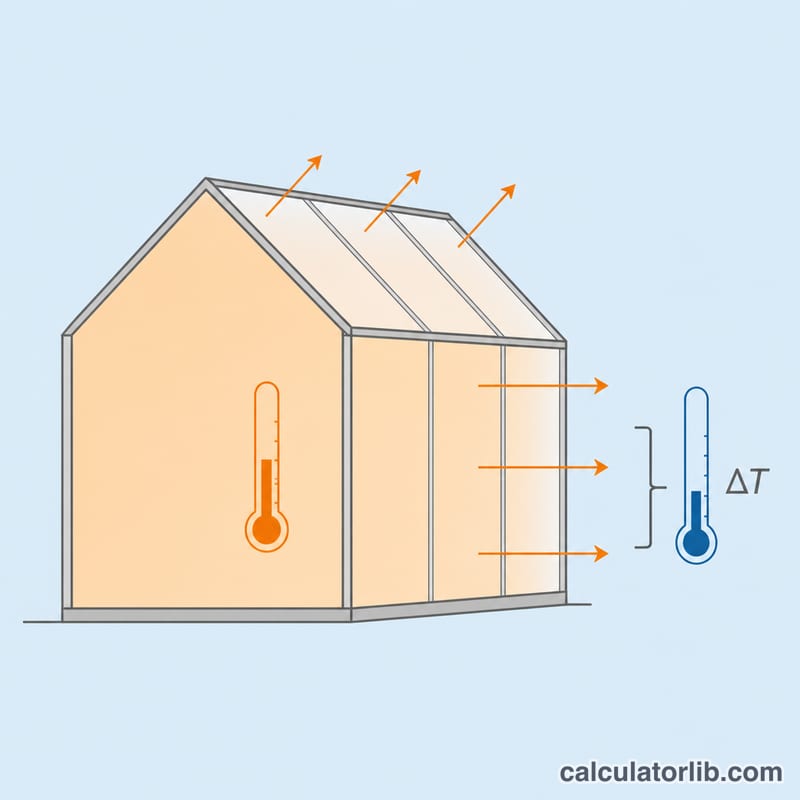
Heat loss through a covering is the classic conduction relationship:
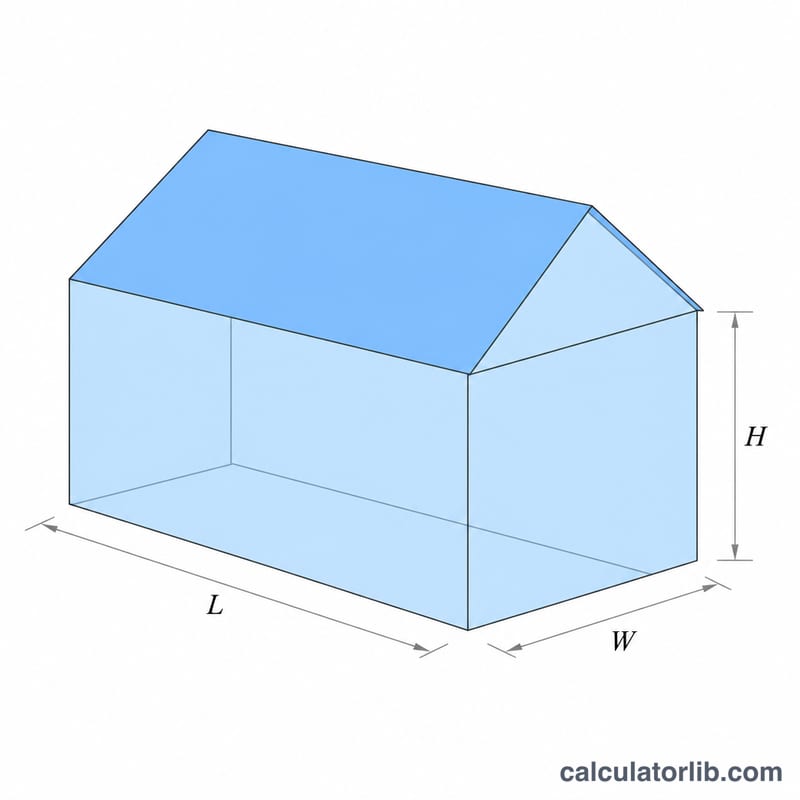
$$Q = A \times U \times \Delta T$$where \(A\) = exposed surface area in ft², \(U\) = the glazing heat-loss coefficient in BTU/hr/ft²/°F, and \(\Delta T = T_{in} - T_{out}\) in °F. The surface area of a simple even-span house is
$$A = 2(L \times H) + 2(W \times H) + 1.1(L \times W)$$The 1.1 factor covers the extra roof area created by the slope. The floor is left out because ground losses are small compared with losses through film or polycarbonate. Typical U-factors: single poly film 1.15, single glass 1.20, fiberglass 1.00, double inflated poly 0.70, twin-wall polycarbonate 0.65, triple-wall 0.50.
Worked example
A 20 ft × 12 ft house with 7 ft walls, double-layer inflated poly (\(U = 0.70\)), held at 60 °F when it is 20 °F outside:
$$A = 2(20 \times 7) + 2(12 \times 7) + 1.1(20 \times 12) = 712\,\text{ft}^2$$$$Q = 712 \times 0.70 \times 40 = 19{,}936\,\text{BTU/hr}$$With a 20% margin the heater should deliver about \(19{,}936 \times 1.2 = 23{,}923\) BTU/hr, so a 25,000 BTU unit is the sensible pick.
Glazing U-Factor Lookup Table
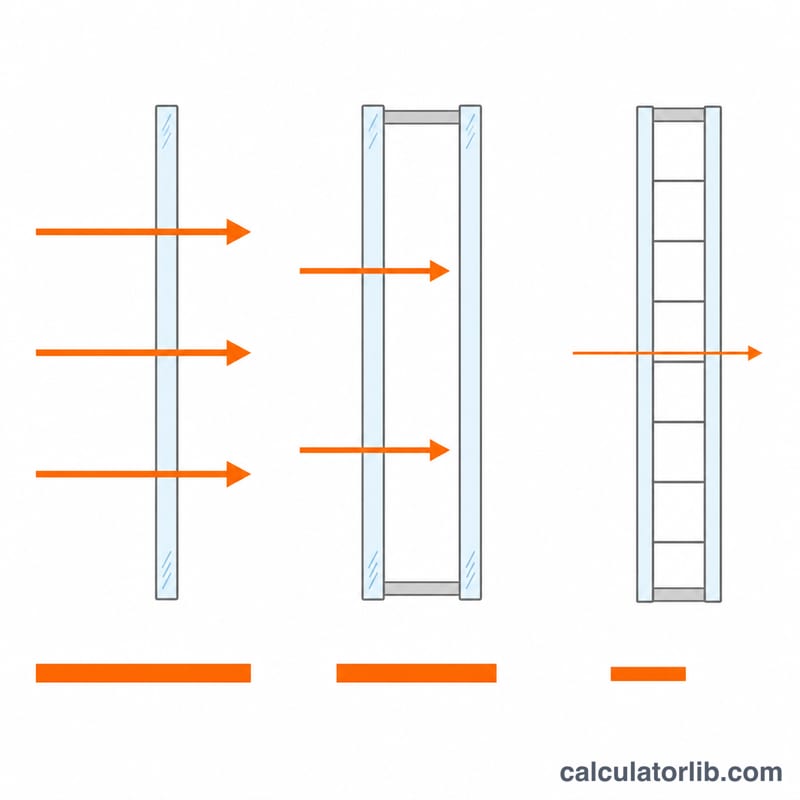
The U-factor is the heat lost through one square foot of glazing per hour for each degree Fahrenheit of temperature difference. It is the single input that most changes your answer, so pick it from the covering you actually have — not from the best-case marketing figure. These are US-customary values (BTU/hr·ft²·°F), the convention used in North American greenhouse design literature (NGMA / ASABE-style tables); to convert to SI, multiply by 5.678 to get W/m²·K.
| Glazing / covering | U-factor (BTU/hr·ft²·°F) | R-value equivalent (1/U) | Effective U with inner night curtain |
|---|---|---|---|
| Single glass (lapped or sealed lite) | 1.20 | 0.83 | ≈ 0.85 |
| Single polyethylene film | 1.15 | 0.87 | ≈ 0.80 |
| Corrugated fiberglass (FRP) panel | 1.00 | 1.00 | ≈ 0.72 |
| Double inflated poly film | 0.70 | 1.43 | ≈ 0.52 |
| Twin-wall polycarbonate, 8 mm | 0.65 | 1.54 | ≈ 0.48 |
| Double-pane insulated glass | 0.55 | 1.82 | ≈ 0.42 |
| Triple-wall polycarbonate, 16 mm | 0.50 | 2.00 | ≈ 0.38 |
The R-value column is simply the reciprocal, \(R = 1/U\). Note that a greenhouse R-value of 1.5 is nothing like a wall R-value of 15 — glazing is a thin, transparent skin, and that is why the heating load per square foot is so high.
The night-curtain column assumes a single closed thermal screen with tight edge and gable seals, which typically cuts heat loss by about 25–35%; a loose screen with open gaps may save half that. The calculator's U-factor list offers 1.20, 1.15, 1.00, 0.70, 0.65 and 0.50 — for double-pane glass (0.55) or a curtained house, choose the nearest listed value, and lean to the higher (worse) one when in doubt.
Published U-factors vary by roughly ±10% between manufacturers and test methods, and they assume still-air conditions. A windy, exposed site can raise the effective loss by 10–20% or more, and film that has lost its inflation, a torn cover, or leaky vents and doors will all push the real number above the table. Treat these as design values, not guarantees.
Heater Size by Greenhouse Size and Glazing
Every row below uses the same method as the calculator. The glazed surface area of a gable-roofed house is approximated as
$$A = 2\,(L + W)\,H + 1.1\,L\,W$$where the second term is the roof, with the 1.1 factor accounting for the slope. The heat load is then \(Q = A \cdot U \cdot \Delta T\), and the heater requirement adds a safety margin. All three houses are shown for a 60 °F night-time set point against a 20 °F night (ΔT = 40 °F) and a 0 °F night (ΔT = 60 °F).
| House (L × W × H, ft) | Glazed area A (ft²) | Glazing (U) | Q at ΔT = 40 °F | Q at ΔT = 60 °F | Required with 20% margin (ΔT = 60 °F) | Next standard rating |
|---|---|---|---|---|---|---|
| 8 × 10 × 7 hobby | 340 | Single poly (1.15) | 15,640 | 23,460 | 28,152 BTU/hr | 30,000 |
| 8 × 10 × 7 hobby | 340 | Double poly (0.70) | 9,520 | 14,280 | 17,136 BTU/hr | 20,000 |
| 8 × 10 × 7 hobby | 340 | Twin-wall (0.65) | 8,840 | 13,260 | 15,912 BTU/hr | 20,000 |
| 12 × 20 × 7 | 712 | Single poly (1.15) | 32,752 | 49,128 | 58,954 BTU/hr | 80,000 |
| 12 × 20 × 7 | 712 | Double poly (0.70) | 19,936 | 29,904 | 35,885 BTU/hr | 50,000 |
| 12 × 20 × 7 | 712 | Twin-wall (0.65) | 18,512 | 27,768 | 33,322 BTU/hr | 50,000 |
| 20 × 48 × 8 commercial hoop | 2,144 | Single poly (1.15) | 98,624 | 147,936 | 177,523 BTU/hr | 200,000 (or 2 × 100k) |
| 20 × 48 × 8 commercial hoop | 2,144 | Double poly (0.70) | 60,032 | 90,048 | 108,058 BTU/hr | 125,000 (or 2 × 80k) |
| 20 × 48 × 8 commercial hoop | 2,144 | Twin-wall (0.65) | 55,744 | 83,616 | 100,339 BTU/hr | 125,000 |
Worked check on the first row, so the arithmetic is visible:
$$A = 2\,(8 + 10)\,(7) + 1.1\,(8)(10) = 252 + 88 = 340\ \text{ft}^2$$$$Q = 340 \times 1.15 \times (60 - 0) = 23{,}460\ \text{BTU/hr}$$$$Q_{\text{heater}} = 23{,}460 \times 1.20 = 28{,}152\ \text{BTU/hr}$$Two patterns are worth reading off the table. First, going from single poly to double poly on the same house cuts the requirement by about 39% — the same saving you would otherwise have to buy as a bigger heater and burn as fuel every night. Second, the 20 × 48 hoop under single poly at ΔT = 60 °F lands just above the largest common single unit heater, so it is a two-heater house; splitting the load into two units placed at opposite ends also gives more even temperatures and a partial backup if one fails.
Choosing and Installing the Heater
The calculated number is a design load, not a catalogue item. Turn it into a purchase like this:
- Round up, never down. Vented unit heaters are commonly sold at 30,000, 50,000, 80,000 and 100,000 BTU/hr; small hobby heaters fill in the 10,000–25,000 range. A required 58,954 BTU/hr goes to an 80,000 unit, not a 50,000 one. Above about 120,000 BTU/hr, two smaller heaters at opposite ends usually beat one large one.
- Match the margin to the site. Use 10–15% on a sheltered site with a tight, well-maintained cover, and 20–25% on an exposed, windy site, an older house, or where a crop failure is expensive. The margin covers wind, infiltration, cold snaps colder than your design outside temperature, and recovery after a door is left open.
- Set a realistic design outside temperature. Use a cold local design night for your area, not the record low — sizing for the record low buys a heater that short-cycles all winter. Then ask whether your inside set point really needs to be 60 °F; cool-growing crops held at 45 °F cut ΔT, and the load, by a quarter or more.
- Derate for altitude. Combustion output falls roughly 4% per 1,000 ft of elevation. At 5,000 ft a heater loses about 20% of its rating, so a 100,000 BTU/hr nameplate delivers about 80,000: divide your requirement by 0.80 before you pick a model, and check the manufacturer's high-altitude conversion kit and orifice requirements.
- Plan combustion air and the flue before you buy. A vented gas or oil heater must draw outside combustion air and exhaust through a correctly sized, correctly terminated flue. Unvented heaters dump water vapour, carbon dioxide and combustion by-products into the house, which can damage foliage and is dangerous to people. Fit a carbon monoxide alarm regardless. Fuel, venting and clearance rules are set by national and local codes — have gas, oil and electrical work done by a qualified installer to the code that applies where you are.
Sizing the fuel supply
Once you know the input rating, these heating values give the consumption rate (divide the heater's input BTU/hr by the value):
| Fuel | Approximate heating value | Example: 100,000 BTU/hr input |
|---|---|---|
| Propane (LP) | 91,500 BTU/gal | ≈ 1.1 gal/hr |
| Natural gas | 1,030 BTU/ft³ | ≈ 97 ft³/hr |
| No. 2 fuel oil | 138,000 BTU/gal | ≈ 0.72 gal/hr |
| Electricity | 1 kW = 3,412 BTU/hr | ≈ 29.3 kW |
These are typical values; actual energy content varies slightly by supplier and blend, and the figures above are per unit of fuel input — a heater that is 80% efficient delivers only 80% of it into the house. The electric row is the reason electric resistance heat is usually limited to small hobby houses: 29.3 kW is a very large service, whereas the 8 × 10 hobby house above needs only about 8.3 kW.
Install for even heat, then reduce the load
- Add horizontal air-flow (HAF) circulation fans so the heat reaches the far corners and plant canopy rather than pooling at the ridge. Without circulation, a correctly sized heater still leaves cold spots.
- Use a thermostat or controller with its sensor at canopy height, shielded from direct sun and away from the heater discharge, ideally in an aspirated box.
- Keep a second layer of protection for the coldest nights — a minimum-temperature alarm, and where practical a backup heat source, since heaters fail on exactly the nights they are needed.
- Cut demand before you upsize. Adding an inner poly layer or a closed night curtain typically removes 25–40% of the load, and sealing doors, vents and the foundation line removes more. That is cheaper than a larger heater and keeps paying back every night of the season, whereas an oversized heater short-cycles, heats unevenly and costs more to run.
All temperatures, BTU figures and heater ratings here use US customary units and North American equipment conventions. This is general information for sizing, not a substitute for the heater manufacturer's instructions or the advice of a licensed gas, oil or electrical professional working to your local code.
FAQ
Which outside temperature should I use? Use the coldest night you actually expect to grow through, not the record low; sizing for an extreme outlier leaves the heater short-cycling all winter.
Why add a safety margin? Wind, open vents, door leaks and a dirty or sagging cover all raise real losses above the textbook value. 10-25% is typical; use the higher end on exposed, windy sites.
Does thermal screening help? Yes. An inner poly layer or a night curtain effectively lowers \(U\) — rerun the calculator with the lower U-factor to see the saving before you buy a bigger heater.